Roles And Responsibilities Of Branches Sales Team

Rating:
80%
Roles And Responsibilities Of Branches Sales Team Roles And Responsibilities Of Branches Sales Team
Slide 1 of 9

or

Favourites Favourites

Try Before you Buy Download Free Sample Product

Audience Impress Your
Audience
Editable 100%
Editable
Time Save Hours
of Time
The Biggest Sale is ending soon in
0
0
:
0
0
:
0
0
Rating:
80%
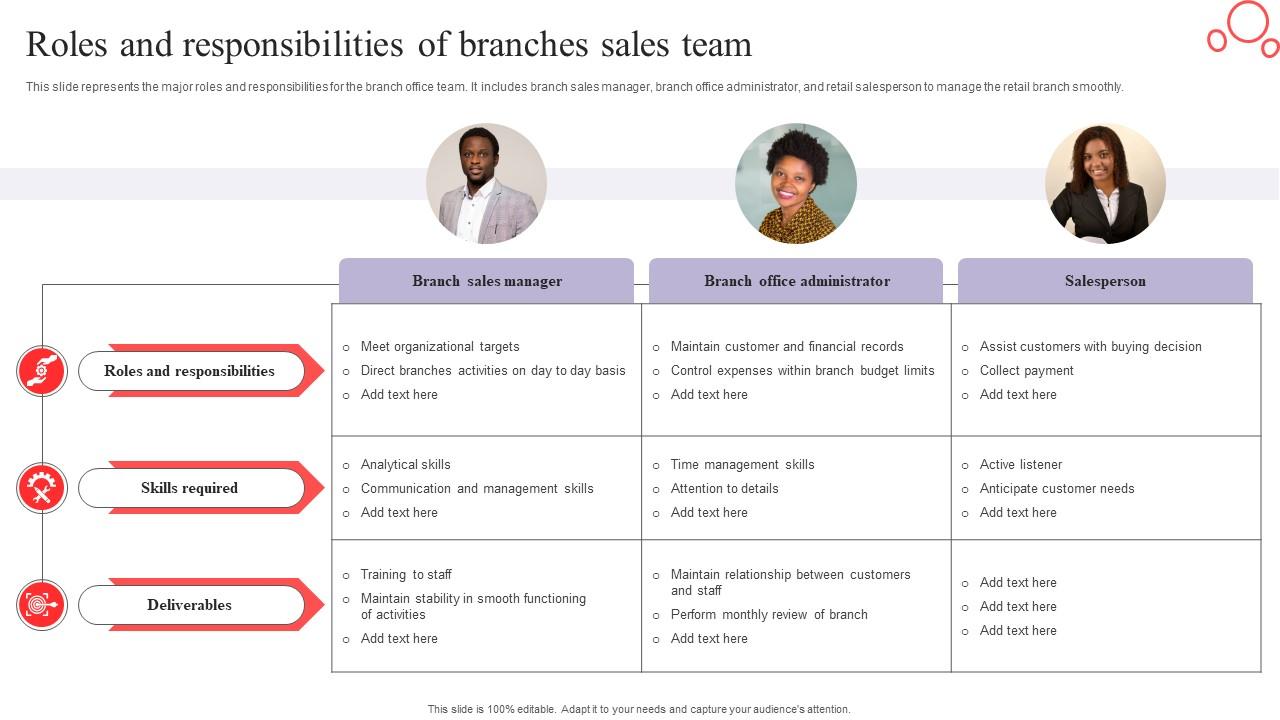
This slide represents the major roles and responsibilities for the branch office team. It includes branch sales manager, branch office administrator, and retail salesperson to manage the retail branch smoothly. Presenting our set of slides with Roles And Responsibilities Of Branches Sales Team. This exhibits information on three stages of the process. This is an easy to edit and innovatively designed PowerPoint template. So download immediately and highlight information on Roles And Responsibilities, Skills Required, Deliverables.

FAQs for Roles And Responsibilities Of

Honestly, the best teams actually work together instead of everyone just doing their own thing. Like, top performers will share leads and back each other up on deals - which sounds obvious but most places don't do this at all. They also know their local market inside out. What businesses are growing, who's having a rough time, all that stuff. Meanwhile average teams just follow whatever headquarters says to do. Oh and having someone who keeps everyone coordinated makes a huge difference. It's not just about individual numbers anymore.

Look, communication is honestly everything for your sales team. Without it, people are basically running around blind - nobody knows who's handling what leads, problems take forever to solve, and half the team doesn't even know what they're supposed to be doing. Regular check-ins help a ton. Also make sure everyone can access the same customer info (you'd be shocked how often this gets screwed up). Your clients will notice the difference too. Better communication = stronger relationships = more sales. It really does work like dominoes once you get it rolling.

Track your sales volume, conversion rates, and deal sizes first - those three tell you the most. Customer acquisition matters too, obviously. Pipeline velocity is clutch because stalled deals are basically worthless deals. I'd throw in some activity stuff like calls and meetings so you can see what's actually driving the results. Retention rates are solid if your branches work existing accounts too. Honestly though? Start small with maybe 4 metrics max. You can always add more later but drowning in data helps nobody.

Dude, seasonal patterns completely change how you approach goal-setting. Like, if you're in retail you better crank up those Q4 targets, or focus heavy on spring for home improvement stuff. I swear it took me ages to get the hang of this at my first branch - felt like I was always behind the curve. During slow periods, spend time building relationships with clients. Peak season though? That's pure sales hustle mode. Oh and definitely track your numbers year over year so you can actually predict when things will pick up and plan your team around it.

Dude, local market knowledge makes or breaks branch sales teams. Top performers get their area - they know regional preferences, competition, pricing stuff, cultural vibes. One-size-fits-all approaches? Total disaster from what I've seen. Your reps should know which businesses are booming, what economic headaches locals face, buying patterns specific to that market. Oh and honestly, some managers underestimate how much this intel matters. Short version: gather this info regularly. Share it with your whole team. Game changer.

Dude, start with a CRM - seriously, it's a lifesaver for tracking leads and automating follow-ups. Since you're always running around to client sites anyway, get a mobile app that syncs everything. Digital proposals are clutch too because clients can sign right there instead of this whole back-and-forth email thing. Oh, and set up some automated email sequences for prospects. Even switching from Excel to a real sales pipeline will probably save you like 5 hours a week (I'm not even exaggerating). Just pick one thing first though - don't go crazy buying every tool at once.

Pair them with your best people for shadowing those first couple weeks. Real product training before they ever talk to customers - that's non-negotiable. They need to sit in on actual calls and pick up your specific pitch style. Generic sales training is pretty much useless for branch work, honestly. Local market stuff matters too - what works downtown might bomb in the suburbs, you know? Weekly check-ins for their first month so you can catch problems early. Oh, and start them off with your easiest accounts first. Builds confidence way faster than throwing them to the wolves.

Honestly, just show up consistently and actually listen to what they need. Coffee chats work way better than pushy sales calls - nobody wants to feel like a walking dollar sign. Write down the little stuff they mention (kids, hobbies, whatever) so you remember next time. Promise small, deliver big on everything. Those boring chamber meetings? Go anyway - that's where your clients are. I'd start with monthly check-ins for your best accounts. Sounds obvious but most bankers skip the relationship part and wonder why they're struggling. Be the person they call first when they need something.

Honestly, start with super local research - find out who's getting ignored in your area. LinkedIn's great for B2B stuff, but don't sleep on just talking to other businesses for referrals. I'd probably hit up some industry events too, though half of them are pretty boring tbh. The trick is actually caring about the community instead of just pitching everyone. Oh, and partner with companies that aren't direct competitors but serve similar people - they're usually down to help. Pick one group that's underserved and really focus there. Way better than trying to be everything to everyone.

Dude, motivation is everything for sales teams. Seriously - I've seen productivity jump like 20-30% when people actually feel recognized and have real money/career growth on the line. Nobody's gonna bust their ass making cold calls for the same flat paycheck as the slacker next to them, you know? Mix it up with monthly bonuses and longer-term opportunities. Oh, and make sure your incentives drive the right behaviors - not just volume that tanks your quality. That's where a lot of companies mess up honestly.

Branch sales teams? Yeah, they're always struggling with leads not coming in consistently and branches barely talking to each other. Plus you can't see what's actually happening day-to-day when managing remotely - honestly the worst part. Get everyone using the same CRM system first, that'll fix most communication issues. Set up regular video calls (emails don't cut it) and create processes that work everywhere but let your managers tweak things for their local market. Oh and definitely start with better communication tools before anything else, trust me on that one.

Look, the real game-changer is getting corporate and branches actually talking to each other regularly. Your branch managers know what customers really want and what tactics work in their area. Corporate has the big picture stuff - market data, what's crushing it at other locations, budget decisions. When they share info both ways instead of corporate just barking orders down? That's where deals start closing. I've seen this work so well when done right. Weekly calls between branch managers and corporate sales heads is honestly the easiest way to start. Just get them in the same room (or Zoom) and watch what happens.

Your sales team really needs that customer feedback - it's like having a cheat sheet for what actually works. Honestly, most teams are just guessing without it. Use what customers tell you to train reps on handling objections better and figure out which sales tactics click with your local crowd. The feedback also helps you spot where your process is frustrating people (there's always something). Don't just collect it though - you've got to actually share those insights with your reps regularly so they can pivot when needed. Customers appreciate being heard too.

LinkedIn's honestly your best bet - share stuff about local market trends, community events, whatever's happening in your area that business owners would care about. Twitter's solid for quick back-and-forth with local companies. Facebook... eh, kinda depends. Works if you're going after small local businesses but otherwise it's pretty meh for B2B. Just focus on actually helping people instead of being salesy all the time. Pick whichever platform feels most natural to you and stick with it. Posting twice a week consistently will beat going crazy for a month then disappearing.

Honestly, diverse sales teams just work better. When your team reflects your customer base, people trust you faster - it's wild how much that matters. Different backgrounds mean fresh approaches to problems too. Like, someone might catch market trends or customer quirks that'd totally fly over your head otherwise. I've watched our branches crush it once they started hiring more diversely. Short answer? Stop hiring the same type of person over and over. Mix it up next round and you'll probably see your numbers jump. Cultural insights alone are worth it.

Ratings and Reviews

80% of 100
Review Form
Write a review
Most Relevant Reviews
  1. 80%

    by Delmer Black

    “Detailed and great to save your time.”
  2. 80%

    by Edmund Ortega

    What an exhaustive collection of templates you guys have there in slideteam. Impressive!!!

2 Item(s)

per page: