Sales Incentive Compensation Policy Plan Chart
Try Before you Buy Download Free Sample Product
Audience
Editable
of Time
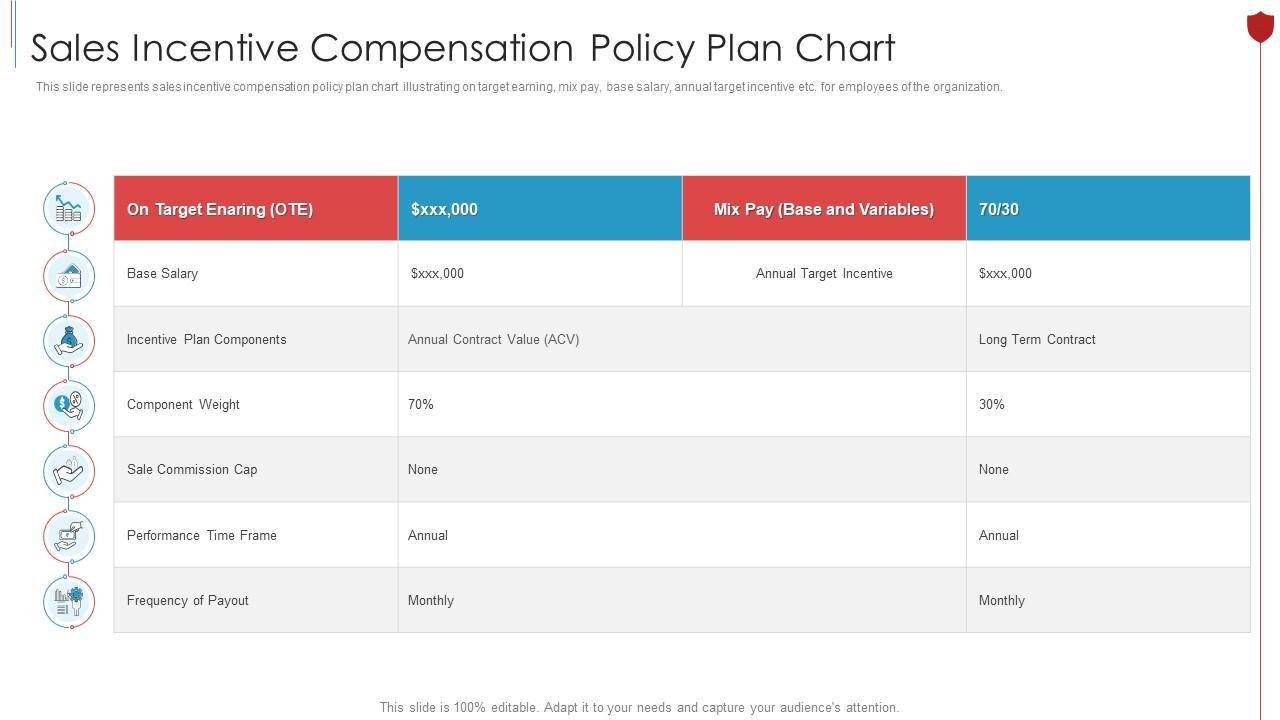
This slide represents sales incentive compensation policy plan chart illustrating on target earning, mix pay, base salary, annual target incentive etc. for employees of the organization.
People who downloaded this PowerPoint presentation also viewed the following :
Sales Incentive Compensation Policy Plan Chart with all 6 slides:
Use our Sales Incentive Compensation Policy Plan Chart to effectively help you save your valuable time. They are readymade to fit into any presentation structure.
FAQs for Sales Incentive Compensation
Key components of an effective sales compensation plan include base salary, commission structure, performance bonuses, territory assignments, and clear quota definitions. These elements work together by providing financial security, rewarding achievement, and motivating consistent performance, with many organizations finding that balanced compensation structures drive both individual success and team collaboration, ultimately delivering higher revenue and improved sales retention.
Aligning sales compensation with business objectives involves linking variable pay to strategic metrics like revenue growth, customer retention, market penetration, and profitability targets, rather than just volume-based quotas. Through balanced scorecards and tiered commission structures, organizations streamline goal achievement across departments, with many companies finding that strategic alignment delivers improved performance consistency, enhanced cross-functional collaboration, and ultimately sustainable competitive advantage.
Competitive benchmarking ensures sales compensation plans attract and retain top talent by analyzing market rates, commission structures, and incentive programs across similar industries and company sizes. This data enables organizations to position their compensation competitively while balancing cost management with performance motivation, ultimately delivering stronger recruitment outcomes and reduced turnover in increasingly competitive talent markets.
Effective sales compensation requires role-specific structures that align incentives with responsibilities, such as base-heavy plans for account managers, commission-focused models for hunters, and team-based bonuses for support roles. Through strategic combinations of salary, commission rates, and performance metrics tailored to each position, organizations streamline motivation while delivering consistent results across diverse sales functions, ultimately enhancing overall team performance.
Key metrics include revenue growth, quota attainment rates, sales cycle length, customer acquisition costs, retention rates, and individual versus team performance ratios. These measurements enable organizations to assess plan effectiveness by tracking motivation levels, identifying top performers, and optimizing compensation structures, with many companies finding that balanced scorecards ultimately deliver improved sales outcomes and strategic alignment.
Sales compensation plans address high performer retention by offering accelerated commission structures, performance bonuses, equity participation, recognition programs, and career advancement pathways tied to results. These strategic incentives enable organizations to reward top talent competitively while creating long-term financial motivation, with many companies finding that tiered compensation models and retention bonuses ultimately reduce turnover costs and maintain competitive advantage.
Overly complicated sales compensation structures create confusion among sales teams, administrative burdens for management, disputes over calculations, reduced motivation due to unclear targets, and difficulty tracking performance metrics. These complexities often result in decreased productivity, higher turnover rates, and costly administrative overhead, with many organizations finding that simplified structures ultimately deliver better sales outcomes and team satisfaction.
Sales compensation plans should be reviewed quarterly and updated annually, with additional assessments during major market shifts, product launches, or organizational changes. This regular evaluation ensures alignment with business objectives, market conditions, and sales performance trends, while quarterly reviews allow companies to identify compensation gaps, address retention issues, and maintain competitive positioning in an increasingly dynamic sales environment.
Technology streamlines sales compensation management through automated commission calculations, real-time performance tracking, and integrated CRM systems that eliminate manual errors. These platforms enable finance teams to process payouts faster, provide sales representatives with transparent dashboards showing their earnings progress, and deliver scalable solutions that grow with expanding sales organizations, ultimately enhancing accuracy while reducing administrative overhead.
Sales compensation significantly impacts team dynamics by balancing individual achievement with collective goals through hybrid structures, team-based bonuses, and collaborative incentives. While purely individual plans can create competition, strategic combinations incorporating shared revenue targets, cross-selling rewards, and group performance metrics enable organizations to foster cooperation, ultimately delivering both personal motivation and enhanced team collaboration for sustained business growth.
Different industries significantly influence sales compensation plan design through varying sales cycles, customer relationships, regulatory requirements, and market dynamics. Financial services typically emphasize long-term incentives due to compliance needs, while technology companies often use accelerators for rapid growth, and manufacturing focuses on territory-based commissions, with many organizations finding that industry-specific structures ultimately deliver better alignment and performance outcomes.
Creative commission structures include tiered rates that increase with higher sales volumes, team-based bonuses that reward collaborative achievement, milestone rewards for reaching specific targets, accelerators for exceeding quotas, and customer retention bonuses. These approaches enhance performance by motivating sustained effort, encouraging teamwork, and aligning compensation with strategic business outcomes, with many organizations finding that varied structures ultimately drive both individual excellence and overall revenue growth.
Sales compensation plans can incorporate non-monetary incentives through recognition programs, career advancement opportunities, flexible work arrangements, professional development training, and exclusive access to high-profile accounts. These incentives enhance employee satisfaction, reduce turnover costs, and boost long-term performance, with many organizations finding that strategic combinations of monetary and non-monetary rewards ultimately deliver stronger retention and competitive advantage.
Legal considerations for compensation plans include compliance with wage and hour laws, anti-discrimination regulations, commission payment statutes, employment contract requirements, and state-specific compensation mandates. These frameworks ensure fair pay practices by establishing clear payment terms, preventing discriminatory structures, and protecting both employer and employee rights, with many organizations finding that proactive legal compliance ultimately enhances workforce trust and reduces costly litigation risks.
Effectively communicating sales compensation plan changes requires transparent explanation of modifications, clear timelines, detailed impact analysis on individual earnings, and comprehensive Q&A sessions addressing concerns. Through structured team meetings, one-on-one discussions, and written documentation, organizations ensure smooth transitions while maintaining trust and motivation, with many sales teams finding that early communication and ongoing support minimize resistance and enhance adoption.
-
What an exhaustive collection of templates you guys have there in slideteam. Impressive!!!
-
The content is very helpful from business point of view.