

Scientific Computing Powerpoint Presentation Slides





Try Before you Buy Download Free Sample Product
 Impress Your
Audience
 100%
Editable
 Save Hours
of Time


The use of computer science and software engineering ideas to address scientific issues is known as computational science. It entails using computer hardware, networking, algorithms, programming, databases, and other domain-specific knowledge to create computer-based simulations of physical processes. Here is a professionally designed Scientific Computing template that gives a brief idea about the computational science program provider and the critical principles of their approach. In this PowerPoint Presentation, we have covered the need for computational science and how enterprises can use computational science for businesses. In addition, this Scientific Computing PPT contains a slide depicting a career in computational science, computational science program, and fee structure. Also, the PPT presentation provides an introduction to computational science, including components of computational science, pillars, applications, and a comparison between computational science and data science. Lastly, this Scientific Computing deck comprises a roadmap, a 30-60-90 days plan for the computational science program, and a dashboard. Customize this 100 percent editable template based on your needs by getting assistance from our highly efficient research team. Get access now.
People who downloaded this PowerPoint presentation also viewed the following :
Content of this Powerpoint Presentation
Slide 1: This slide introduces Scientific Computing. State your company name and begin.
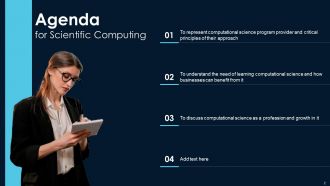
Slide 2: This slide states Agenda of the presentation.
Slide 3: This slide presents Table of Content for the presentation.
Slide 4: This slide shows title for topics that are to be covered next in the template.
Slide 5: This slide represents the overview of computational science coaching provider company.
Slide 6: This slide displays key principles of our approach for learning, such as experience through engaging videos.
Slide 7: This slide shows title for topics that are to be covered next in the template.
Slide 8: This slide showcases Need for Learning Computational Science.
Slide 9: This slide presents How can Enterprises use Computational Science for Business.
Slide 10: This slide shows title for topics that are to be covered next in the template.
Slide 11: This slide describes the computational scientist profession, including the job description and skills required.
Slide 12: This slide depicts the professional growth in computational science and how graduates will be prepared for optimization.
Slide 13: This slide shows title for topics that are to be covered next in the template.
Slide 14: This slide presents Available Options for Computational Science Program.
Slide 15: This slide displays Teaching and Assessment Method for Computational Science.
Slide 16: This slide represents Structure of the Computational Science Program.
Slide 17: This slide showcases Fee Structure for Computational Science Program.
Slide 18: This slide shows title for topics that are to be covered next in the template.
Slide 19: This slide presents Overview of the Computational Science.
Slide 20: This slide depicts the components of computational science such as algorithms and models, software developed to solve problems, etc.
Slide 21: This slide represents the main pillars of computational science such as science and engineering, mathematics and computing, etc.
Slide 22: This slide showcases applications of computational science by astrophysicists.
Slide 23: This slide presents comparison between computational science and data science.
Slide 24: This slide shows title for topics that are to be covered next in the template.
Slide 25: This slide describes the roadmap for computational science program.
Slide 26: This slide shows title for topics that are to be covered next in the template.
Slide 27: This slide presents 30-60-90 Days Plan for Computational Science.
Slide 28: This slide shows title for topics that are to be covered next in the template.
Slide 29: This slide presents Dashboard for Computational Science Program.
Slide 30: This slide contains all the icons used in this presentation.
Slide 31: This slide is titled as Additional Slides for moving forward.
Slide 32: This slide displays Column chart with two products comparison.
Slide 33: This is a Comparison slide to state comparison between commodities, entities etc.
Slide 34: This is Our Team slide with names and designation.
Slide 35: This slide shows Post It Notes. Post your important notes here.
Slide 36: This slide depicts Venn diagram with text boxes.
Slide 37: This is a Timeline slide. Show data related to time intervals here.
Slide 38: This is Our Goal slide. State your firm's goals here.
Slide 39: This is an Idea Generation slide to state a new idea or highlight information, specifications etc.
Slide 40: This slide contains Puzzle with related icons and text.
Slide 41: This is a Thank You slide with address, contact numbers and email address.
Scientific Computing Powerpoint Presentation Slides with all 46 slides:
Use our Scientific Computing Powerpoint Presentation Slides to effectively help you save your valuable time. They are readymade to fit into any presentation structure.








FAQs for Scientific Computing
Scientific computing emphasizes mathematical modeling, numerical analysis, algorithm optimization, computational theory, and high-performance processing to solve complex scientific problems. These principles differentiate it from traditional computing by prioritizing accuracy, scalability, and specialized algorithms, with many research institutions and engineering firms finding that this approach enables breakthrough discoveries, accelerates research timelines, and delivers precise simulations for critical decision-making.
Scientific computing leverages parallel computing by distributing computational tasks across multiple processors, cores, or machines simultaneously, enabling faster processing of large datasets, complex simulations, and mathematical modeling. Through techniques like domain decomposition and task parallelization, research institutions and industries streamline climate modeling, drug discovery, and financial risk analysis, ultimately delivering significantly reduced computation times and enhanced research capabilities.
Numerical methods enhance simulation accuracy through adaptive mesh refinement, higher-order discretization schemes, error estimation algorithms, iterative solvers, and convergence analysis techniques. These approaches enable researchers in fields like climate modeling, pharmaceutical development, and aerospace engineering to minimize computational errors, reduce approximation uncertainties, and achieve more reliable predictive results, ultimately delivering faster scientific discoveries and improved research outcomes.
High-performance computing accelerates scientific breakthroughs by enabling complex simulations, processing massive datasets, and solving computationally intensive problems across disciplines like climate modeling, drug discovery, and materials science. Through parallel processing and advanced algorithms, researchers can explore previously impossible scenarios, reduce experimental costs, and accelerate time-to-discovery, ultimately delivering faster innovation cycles and competitive advantages in pharmaceutical development, energy research, and aerospace engineering.
Open-source libraries enhance scientific computing accessibility by eliminating costly software licenses, providing extensive documentation and community support, and offering standardized tools across disciplines. Through platforms like Python's NumPy, SciPy, and R packages, researchers streamline complex calculations, collaborate more effectively, and accelerate discovery timelines, with many institutions finding that democratized access ultimately delivers faster innovation and broader scientific participation.
Ethical considerations include data integrity, transparency in methodologies, bias mitigation, reproducibility standards, and responsible interpretation of results. These principles enhance scientific credibility by ensuring accurate representations, minimizing algorithmic prejudices, and maintaining public trust, with research institutions finding that robust ethical frameworks ultimately deliver more reliable outcomes and stronger collaborative partnerships across disciplines.
Machine learning integrates into scientific computing workflows through automated data preprocessing, predictive modeling for complex simulations, and pattern recognition in large datasets. These techniques streamline research processes by accelerating hypothesis testing, optimizing computational resources, and enhancing accuracy in fields like climate modeling and drug discovery, ultimately delivering faster insights and reduced computational costs.
Researchers face challenges including computational complexity verification, parameter sensitivity analysis, experimental data scarcity, reproducibility across different systems, and uncertainty quantification in model outputs. These validation hurdles are particularly pronounced in climate modeling, drug discovery, and materials science, where researchers increasingly adopt ensemble methods, cross-validation techniques, and collaborative verification protocols to enhance model reliability and scientific credibility.
Reproducibility ensures scientific computing results can be verified and built upon by others, establishing credibility and accelerating research progress through consistent methodologies, transparent documentation, and standardized environments. It can be ensured through version control systems, containerization technologies, automated workflows, and comprehensive metadata recording, with many research institutions finding that these practices ultimately enhance collaboration and research impact.
Cloud computing services benefit scientific experiments and data analysis by providing scalable computational resources, eliminating hardware limitations, and enabling collaborative research across institutions. Through platforms like AWS and Google Cloud, researchers access high-performance computing for complex simulations, store massive datasets cost-effectively, and accelerate discovery timelines, with many laboratories finding that cloud infrastructure delivers faster results while reducing operational costs.
Emerging trends in scientific computing include quantum computing applications, AI-accelerated simulations, cloud-based high-performance computing, edge computing for real-time data processing, and hybrid modeling approaches. These technologies streamline research workflows by reducing computational bottlenecks, enhancing collaborative capabilities, and enabling faster discovery cycles, with many institutions finding that strategic adoption delivers significant competitive advantages in grant acquisition and publication outcomes.
Domain-specific languages enhance productivity in scientific computing by providing specialized syntax, built-in mathematical operations, and optimized libraries tailored for specific research fields. Languages like MATLAB for engineering, R for statistics, and Julia for high-performance computing streamline complex calculations, reduce development time, and minimize coding errors, with many research institutions finding that these tools accelerate discovery while enabling researchers to focus on scientific innovation rather than programming complexities.
Scientific computing revolutionizes traditional fields like engineering and physics by enabling complex simulations, accelerating research timelines, and enhancing precision in modeling and analysis. Through advanced algorithms and computational power, engineers optimize designs faster, physicists simulate phenomena previously impossible to study, and both fields achieve breakthrough discoveries, ultimately delivering cost-effective solutions and competitive advantages.
Visualization tools transform complex scientific computing datasets into interpretable charts, graphs, heat maps, and interactive models that reveal hidden patterns and relationships. Through advanced rendering technologies, researchers in fields like climate modeling, molecular biology, and astrophysics can identify anomalies, validate hypotheses, and communicate findings more effectively, ultimately accelerating discovery processes and enhancing collaborative research outcomes.
Quantum computing will revolutionize scientific computing by enabling exponentially faster simulations, complex molecular modeling, and optimization problems previously impossible with classical computers. Pharmaceutical companies, climate researchers, and materials scientists are increasingly investing in quantum-hybrid systems, with early adopters finding that quantum algorithms dramatically accelerate drug discovery, weather prediction, and materials engineering, ultimately delivering unprecedented computational advantages.
-
Best way of representation of the topic.
-
I can always count on your designs for my professional needs. I believe I found a one-stop-shop for PPTs.