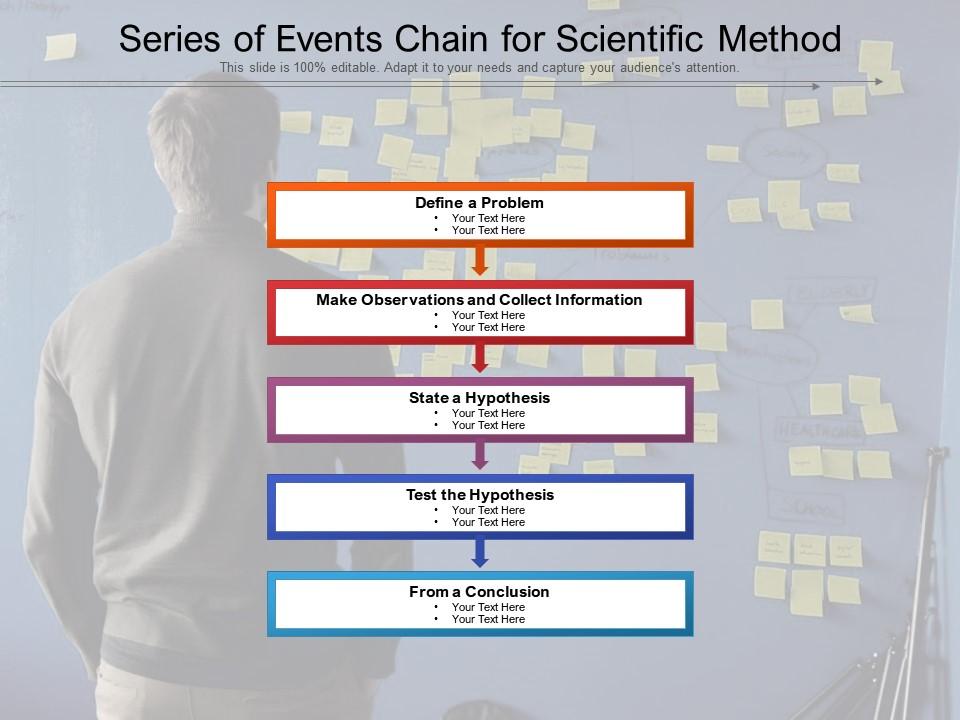
Series of events chain for scientific method

Rating:
80%
Series of events chain for scientific method
Slide 1 of 2
Favourites Favourites

Try Before you Buy Download Free Sample Product

Audience Impress Your
Audience
Editable 100%
Editable
Time Save Hours
of Time
The Biggest Sale is ending soon in
0
0
:
0
0
:
0
0
Rating:
80%
Presenting this set of slides with name Series Of Events Chain For Scientific Method. The topics discussed in these slides are Hypothesis, Conclusion, Observations. This is a completely editable PowerPoint presentation and is available for immediate download. Download now and impress your audience.

FAQs for Series of events chain

So there are six main steps to follow. First you observe something weird or interesting. Then ask yourself "why is this happening?" Make an educated guess - that's your hypothesis. Test it with experiments (honestly the most annoying part usually). Analyze whatever data you get to see if you were right. Draw your conclusions from there. Don't worry if you have to go back and redo steps - that's super normal and happens all the time in real science!

Honestly, having a hypothesis is like using GPS instead of just driving around randomly hoping you'll find your destination. It forces you to actually think about what you expect to discover and why. Without one, you'll end up in that awful trap where you're just collecting random data and praying something interesting shows up (been there, it sucks). Your experiments will be way more focused when you know what variables matter. The trick is making it specific enough that you can prove yourself wrong - otherwise what's the point? Try the "if-then" format to keep things tight and testable.

So basically, when experimental data doesn't match what theories predict, scientists have to go back and fix their models - or sometimes trash them completely. Quantum mechanics is a perfect example of this. Classical physics just couldn't handle the weird stuff happening at atomic levels, so they had to build something entirely new. Other times observations just add more detail or precision to existing theories. Honestly, this cycle never ends - every new dataset could potentially flip our understanding. When you're digging through papers, definitely focus on ones where observations forced major theoretical changes. Those are the really interesting ones that show how messy and cool science actually is.

So basically, experiments are where you find out if your hypothesis is actually right or total garbage. You design tests that could either back you up or completely wreck your theory - honestly, getting proven wrong happens more than you'd think. The whole point is making it repeatable so other people can double-check your work. Control your variables, measure stuff properly, that whole deal. Here's the thing though - don't design experiments just to prove yourself right. Make them tough enough that they'll call you out if you're wrong. That's how real science works.

Honestly, it's all about what kind of data you're working with. Physics people do statistical modeling on their experimental stuff. Anthropologists? They're coding interviews and looking for themes - totally different world. Biology's weird because they mix both approaches, like running stats on lab results but then describing animal behavior patterns. Psychology is obsessed with regression and ANOVA (sometimes way too obsessed, if you ask me). The trick is just matching your method to what you've got. Before you start crunching numbers, step back and think: what's this data actually telling me?

First thing - get informed consent sorted. People need to know what they're getting into and that they can bail whenever. Also gotta minimize any harm, whether that's physical or psychological stuff. Protection of confidentiality is huge too. Honestly, looking back at some old psych experiments is wild - like what were they even thinking? Your research should actually benefit society, not just pad your CV. Oh and most places require ethics board approval before you start anything, so factor that waiting time into your timeline. It's usually longer than you'd expect.

Okay so peer review is basically quality control for science. Other experts read through your study before it gets published - they'll tear apart your methods, check your data, challenge your conclusions. Super brutal honestly. They catch mistakes you missed and make sure your research actually proves what you claim it does. Short sentences get rejected, weak arguments get called out. It's like having the smartest people in your field double-check everything (except they're definitely not trying to spare your feelings). Only studies that survive this gauntlet make it to journals. That's why peer-reviewed research is so much more reliable than random studies you find online.

Honestly, yeah! The scientific method works great for random daily stuff. I use it constantly - like when I was trying to figure out why my succulents kept croaking (spoiler: overwatering). Just pick one thing to change at a time instead of going crazy with fixes. Write down what you think might work, test it for a bit, then see what actually happened. Super basic but it beats the usual "throw solutions at the wall" approach. Did this with my commute too - tracked different routes for two weeks and found one that saves me like 15 minutes. Being systematic about small problems is honestly kind of satisfying once you get into it.

Dude, science has changed so much it's wild. We can run experiments now that were literally impossible 20 years ago - computational modeling, AI generating hypotheses, instruments measuring stuff at the molecular level. The basic steps haven't changed (observe, test, analyze), but your tools are crazy powerful. Global collaboration happens instantly instead of waiting months for letters to arrive. Honestly, the biggest game-changer? Processing massive amounts of data while testing tons of variables at once. You should mess around with some basic data analysis tools sometime - it'll blow your mind how different research feels now.

Honestly, confirmation bias is the worst one - you'll unconsciously hunt for stuff that backs up what you already think. Small sample sizes will totally screw you over too. And don't even get me started on people who can't control their variables properly. Document everything because your memory is garbage (learned this the hard way). Also, most people jump to conclusions way too fast. Try to actively look for data that proves you wrong - sounds weird but it works. Get other people to review your stuff when you can.

Your research question should really drive which method you pick. Quantitative stuff is great for testing hypotheses - surveys, experiments, all those hard numbers you can run stats on. But qualitative lets you dig into the messy, complex things that numbers can't capture through interviews and observations. I've seen way too many studies that would've been stronger if they'd mixed both approaches, honestly. Sometimes you'll start with one method and realize halfway through you need to switch gears. That's totally normal. Just figure out what you're actually trying to discover first.

Replicability is like insurance against weird results or biased research. Other scientists need to repeat your experiment and get the same outcome - that's how we know findings are legit and not just random luck. It weeds out questionable studies from solid ones. Can't replicate it? Probably not worth building on. I learned this the hard way in grad school actually. More labs that can reproduce your results = more trust from the scientific community. Design experiments with replication in mind from the start. Otherwise you'll just end up with data nobody believes.

Honestly, mixing different fields just makes your research way stronger. You're getting fresh perspectives that'll spot things you'd totally miss otherwise. A biologist teaming up with a data scientist? They're gonna find patterns neither would catch alone. Better experiments, stronger results, connections you never saw coming. I always think the coolest breakthroughs happen when people from random fields start talking to each other. Your methodology gets more solid too. Next time you hit a wall, seriously just grab coffee with someone from a completely different department. Their weird questions might crack the whole thing open.

Okay so basically control variables stop you from getting totally confused about what actually caused your results. Like imagine you're testing fertilizer but didn't think about how much sun or water each plant got - you'd have no clue if the fertilizer even worked or if it was just random stuff affecting growth. Super annoying when that happens in experiments honestly. You gotta keep everything else the same across your test groups. Only change the one thing you're actually studying. Otherwise you're just shooting in the dark trying to figure out what made the difference. Makes sense?

Look, the media can totally butcher scientific findings if you let them - they love drama over accuracy. You've got to get out there yourself and explain your research in normal people language. Social media helps, but honestly, building relationships with good journalists is clutch. Don't just dump your study and walk away hoping someone else gets it right. The public makes decisions about vaccines and climate stuff based on what they hear, so if you don't control the narrative, someone else will. And trust me, they probably won't nail it.

Ratings and Reviews

80% of 100
Review Form
Write a review
Most Relevant Reviews
  1. 80%

    by Darren Olson

    Thanks for all your great templates they have saved me lots of time and accelerate my presentations. Great product, keep them up!
  2. 80%

    by Craig Moreno

    Appreciate the research and its presentable format.
  3. 80%

    by Richard Scott

    Use of icon with content is very relateable, informative and appealing.
  4. 80%

    by Clark Ruiz

    Great product with highly impressive and engaging designs.

4 Item(s)

per page: