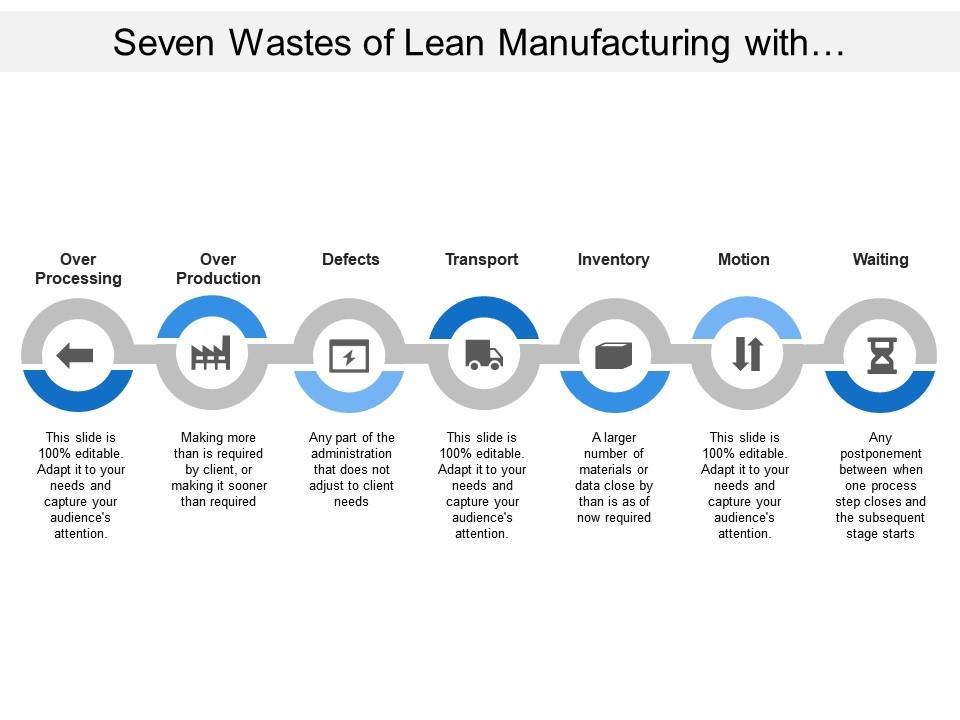
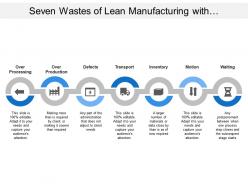
Seven wastes of lean manufacturing with transport motion and defects

Rating:
100%
Seven wastes of lean manufacturing with transport motion and defects
Slide 1 of 5
Favourites Favourites

Try Before you Buy Download Free Sample Product

Audience Impress Your
Audience
Editable 100%
Editable
Time Save Hours
of Time
The Biggest Sale is ending soon in
0
0
:
0
0
:
0
0
AI-Ready
Upload this template to AI and ask it to make any changes to content or color
100% editable Powerpoint Template for AI-assisted presentations. Finish your work in less time. Download Prompt Kit ​
Works with
Microsoft PowerPoint
Microsoft 365
Claude for PowerPoint
ChatGPT
Google Slides
Microsoft Copilot
Rating:
100%
Presenting this set of slides with name - Seven Wastes Of Lean Manufacturing With Transport Motion And Defects. This is a seven stage process. The stages in this process are Lean Waste, Lean Manufacturing, Six Sigma.

FAQs for Seven wastes of lean manufacturing with transport

The seven wastes in lean manufacturing include overproduction, waiting, transportation, overprocessing, inventory excess, motion inefficiency, and defects. These wastes significantly impact operational efficiency by increasing costs, extending lead times, and reducing quality, with many manufacturing organizations finding that systematically eliminating them streamlines workflows, minimizes resource consumption, and ultimately delivers improved productivity and competitive advantage.

Organizations systematically identify and measure the seven wastes through value stream mapping, time-motion studies, process observation audits, waste tracking metrics, and employee feedback systems. These methodologies enable manufacturers to quantify overproduction, waiting times, transportation inefficiencies, and inventory excess, while measuring defects, unnecessary motion, and over-processing, ultimately delivering cost reduction and operational excellence across production lines.

Strategies to reduce overproduction include implementing just-in-time production systems, utilizing pull-based manufacturing triggered by actual customer demand, establishing takt time alignment, employing smaller batch sizes, and creating visual management systems. These approaches streamline operations by minimizing excess inventory, reducing storage costs, and improving cash flow, with manufacturers in automotive and electronics sectors finding that demand-driven production ultimately delivers greater operational efficiency and customer responsiveness.

Minimizing waiting time eliminates production bottlenecks, reduces idle labor costs, and accelerates throughput by ensuring continuous workflow between manufacturing stages. This optimization enables factories to increase output capacity, reduce lead times, and improve resource utilization, with many manufacturing facilities finding that streamlined processes ultimately deliver faster customer deliveries and enhanced competitive positioning.

Eliminating unnecessary transportation involves strategic layout redesign, implementing pull systems, establishing point-of-use storage, optimizing batch sizes, and creating dedicated material flow paths. Manufacturing facilities achieve significant efficiency gains by positioning workstations closer together, reducing handling steps, and synchronizing material delivery with production schedules, ultimately minimizing waste while enhancing operational flow.

Businesses can address excess inventory waste through demand forecasting analytics, just-in-time delivery systems, supplier relationship optimization, and flexible production scheduling that aligns with actual customer needs. These lean approaches enable manufacturers and retailers to maintain adequate stock levels while reducing carrying costs, minimizing storage requirements, and improving cash flow, ultimately delivering enhanced operational efficiency without sacrificing service quality.

Unnecessary motion represents wasted time and energy from excessive worker movement, poor workplace layout, and inefficient processes that don't add customer value. Techniques like 5S workplace organization, value stream mapping, and ergonomic workstation design streamline operations by minimizing travel distances, optimizing tool placement, and improving workflow sequences, ultimately delivering faster production cycles and reduced operational costs across manufacturing environments.

Organizations create a continuous improvement culture by empowering employees to identify inefficiencies, implementing regular kaizen events, establishing clear waste reduction metrics, and rewarding innovative solutions. Through structured training programs and cross-functional teams, companies like Toyota and GE streamline operations while fostering ownership, ultimately delivering enhanced productivity, reduced costs, and sustained competitive advantage in manufacturing excellence.

**INPUT**: What tools and methodologies are most effective in analyzing and addressing the seven wastes in a manufacturing environment? **OUTPUT**: Effective tools for analyzing the seven wastes include value stream mapping, 5S methodology, root cause analysis, kaizen events, and statistical process control systems. These methodologies streamline operations by identifying bottlenecks, eliminating redundancies, and optimizing workflow processes, with many manufacturing organizations finding that combining lean tools with digital monitoring delivers measurable cost reductions and enhanced operational efficiency.

Information technology and automation mitigate lean manufacturing's seven wastes by streamlining inventory management, enhancing production scheduling, reducing defects through quality control systems, and minimizing transportation inefficiencies. Through IoT sensors, predictive analytics, and automated workflows, manufacturers eliminate overproduction, reduce waiting times, and optimize motion patterns, ultimately delivering significant cost reductions and operational efficiency gains across production environments.

Toyota's production system eliminated overproduction and waiting through just-in-time manufacturing, while General Electric streamlined processes to reduce defects and excess inventory across multiple facilities. Ford's assembly line optimization minimized unnecessary motion and transportation waste, and 3M implemented continuous improvement programs targeting overprocessing. These transformations delivered substantial cost reductions, faster production cycles, and enhanced operational efficiency, with many manufacturers finding that systematic waste elimination ultimately provides significant competitive advantages.

Workforce training enhances waste identification by teaching employees to recognize inefficiencies, standardize processes, and implement continuous improvement methodologies like 5S and kaizen. Through comprehensive education programs, manufacturing teams develop problem-solving skills, increase quality awareness, and contribute valuable frontline insights, ultimately reducing defects, minimizing downtime, and streamlining operations across production lines.

Companies should track metrics including overall equipment effectiveness (OEE), cycle time reduction, inventory turnover rates, defect rates, employee productivity ratios, and customer satisfaction scores to measure waste elimination progress. These comprehensive indicators enable manufacturers across automotive, electronics, and pharmaceutical sectors to quantify improvements in operational efficiency, cost reduction, and competitive positioning, ultimately delivering measurable ROI from lean initiatives.

The seven wastes adapt to service industries by focusing on waiting times, over-processing customer requests, defects in service delivery, excess motion in workflows, and underutilized employee skills. Implementation requires adjustments like measuring customer wait times instead of inventory levels, tracking information flow rather than material movement, and emphasizing employee engagement over physical waste, with many financial services and healthcare organizations finding that these modifications streamline operations while enhancing customer experiences.

Lean principles integrate with sustainable practices by eliminating waste that also reduces environmental impact, optimizing resource utilization, and implementing circular economy approaches like remanufacturing and recycling. This strategic combination enables manufacturers to achieve cost reduction, minimize carbon footprints, and enhance operational efficiency simultaneously, with automotive and electronics companies increasingly finding that sustainability-focused lean initiatives deliver both competitive advantage and regulatory compliance.

Ratings and Reviews

100% of 100
Review Form
Write a review
Most Relevant Reviews
  1. 100%

    by Dylan Richards

    Great experience, I would definitely use your services further.
  2. 100%

    by Dorian Armstrong

    Really like the color and design of the presentation.

2 Item(s)

per page: