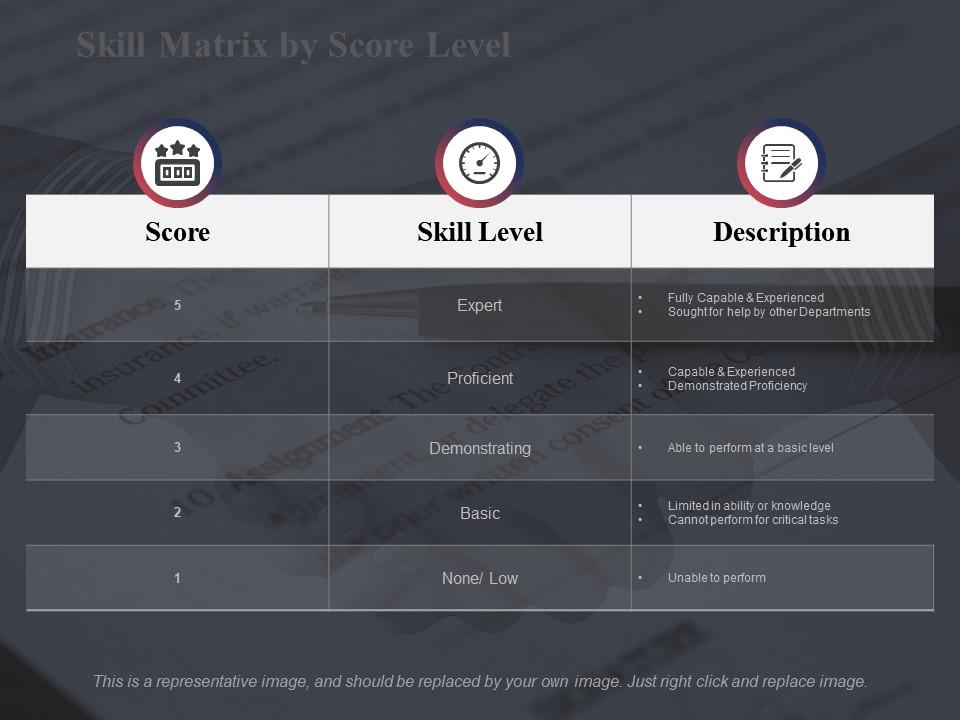
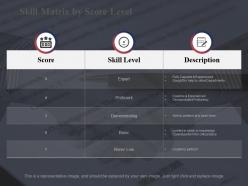
Skill matrix by score level score skill level description
Try Before you Buy Download Free Sample Product
Audience
Editable
of Time
Acquaint folks with a few double edged expressions with our Skill Matrix By Score Level Score Skill Level Description. Introduce them to journalese.
People who downloaded this PowerPoint presentation also viewed the following :
Skill matrix by score level score skill level description with all 5 slides:
Our Skill Matrix By Score Level Score Skill Level Description don't give dichotomy a chance to emerge. Eliminate any cause for dilemma.
FAQs for Skill matrix by score level score
A skill matrix is a comprehensive framework that maps employee competencies against required job functions, enabling organizations to identify skill gaps, training needs, and internal talent for promotions or project assignments. Through systematic assessment and visualization, companies streamline workforce planning, enhance resource allocation, and accelerate professional development initiatives, ultimately delivering improved operational efficiency and competitive advantage in talent management.
Effective skill matrix implementation begins with comprehensive skills assessment, clear competency definitions, regular team evaluations, collaborative goal setting, and transparent tracking systems. Through systematic documentation and review processes, departments can identify skill gaps, optimize resource allocation, and enhance training programs, with many organizations finding that structured matrices ultimately deliver improved project outcomes and strategic workforce development.
Technical skill matrices should include programming languages, system architecture knowledge, database management, cybersecurity fundamentals, cloud platforms, and project management capabilities. These competencies enable organizations to strategically allocate resources, identify training gaps, and enhance team performance across development cycles, with many technology companies finding that comprehensive skill mapping ultimately delivers faster project completion and improved operational efficiency.
A skill matrix facilitates employee development by identifying skill gaps, tracking competencies, and creating targeted training plans aligned with career goals and organizational needs. Through visual competency mapping, managers can design personalized development pathways, assign stretch projects, and provide strategic mentoring opportunities, with many organizations finding that structured skill assessment accelerates promotion readiness and internal mobility.
Skill matrices for remote teams can be adapted through digital platforms with real-time collaboration features, virtual skill assessments, and cloud-based tracking systems that enable seamless updates across locations. These digital approaches streamline remote talent allocation, enhance cross-functional project coordination, and facilitate virtual mentoring programs, with many distributed organizations finding that centralized skill visibility ultimately delivers improved team productivity and strategic resource optimization.
Assessing and updating skill matrices requires regular performance reviews, peer evaluations, self-assessments, and continuous feedback from supervisors and colleagues. Organizations typically conduct quarterly or annual skills audits, incorporating training completions, certification achievements, and project outcomes to maintain accuracy, with many finding that structured assessment cycles and digital tracking systems streamline the process while ensuring skills data remains current and actionable.
A skill matrix enables strategic workforce planning by identifying current competencies, skill gaps, and future talent needs across teams and departments. Through comprehensive skill mapping, organizations streamline resource allocation for projects, enhance training program development, and optimize team compositions, ultimately delivering improved operational efficiency and competitive advantage in talent management.
A skill matrix helps identify skill gaps by visually mapping current employee competencies against required skills for each role, department, and strategic initiative. Through systematic assessment and comparison, organizations can pinpoint missing capabilities, plan targeted training programs, and make informed hiring decisions, ultimately strengthening workforce capabilities and maintaining competitive advantage in an increasingly skills-focused business environment.
**INPUT**: What are some best practices for creating a visually engaging skill matrix presentation? **OUTPUT**: Best practices include using color coding for proficiency levels, clear hierarchical layouts, consistent typography, interactive elements, and strategic white space management. These design approaches streamline comprehension by highlighting skill gaps, facilitating quick talent assessments, and enabling strategic workforce planning, with many organizations finding that visually compelling matrices enhance stakeholder engagement and accelerate decision-making processes. **Word count: 56 words**
A skill matrix supports succession planning by identifying skill gaps, mapping employee competencies against future leadership requirements, and highlighting development opportunities for high-potential candidates. Through strategic talent mapping, organizations can create targeted training programs, accelerate internal promotions, and build robust leadership pipelines, with many companies finding that systematic skill assessment reduces external hiring costs while enhancing retention.
**INPUT**: What tools or software can assist in the creation and maintenance of a skill matrix? **OUTPUT**: Skill matrix tools include Excel templates, HR management systems like BambooHR and Workday, specialized platforms such as Skills Base and AG5, and project management software like Monday.com. These technologies streamline skill tracking by automating assessments, visualizing competency gaps, and enabling real-time updates, with many organizations finding that integrated platforms deliver enhanced workforce planning and strategic talent development outcomes. **Word count: 60 words**
Different industries customize skill matrices by incorporating sector-specific competencies, regulatory requirements, and operational priorities into their frameworks. Healthcare organizations emphasize clinical certifications and patient safety protocols, while manufacturing focuses on technical machinery skills and safety compliance, and financial services prioritize analytical capabilities and regulatory knowledge, ultimately enabling targeted workforce development that aligns with each industry's unique performance standards and competitive requirements.
Skill matrices integrate seamlessly into performance reviews by providing objective benchmarks for competency assessment, identifying skill gaps, and tracking development progress over time. Through systematic evaluation frameworks, organizations streamline feedback processes, enhance career planning discussions, and create data-driven development pathways, with many HR departments finding that this integration delivers more targeted coaching and measurable performance improvements.
Organizations face challenges including data accuracy concerns, employee resistance to assessment, time-intensive initial setup, maintaining current information, and potential skill gaps revelation. However, these obstacles become manageable through phased implementation, transparent communication about career development benefits, automated tracking systems, and regular update schedules, with many companies finding that initial investment ultimately delivers enhanced resource allocation and strategic workforce planning.
Visualizing a skill matrix improves collaboration by clearly mapping each team member's expertise, competency levels, and knowledge gaps, enabling strategic task allocation and cross-functional partnerships. Through visual representation, teams can identify skill overlaps, create targeted mentoring relationships, and streamline project planning, ultimately enhancing communication transparency and delivering more efficient resource utilization across departments.
-
Wonderful templates design to use in business meetings.
-
Presentation Design is very nice, good work with the content as well.