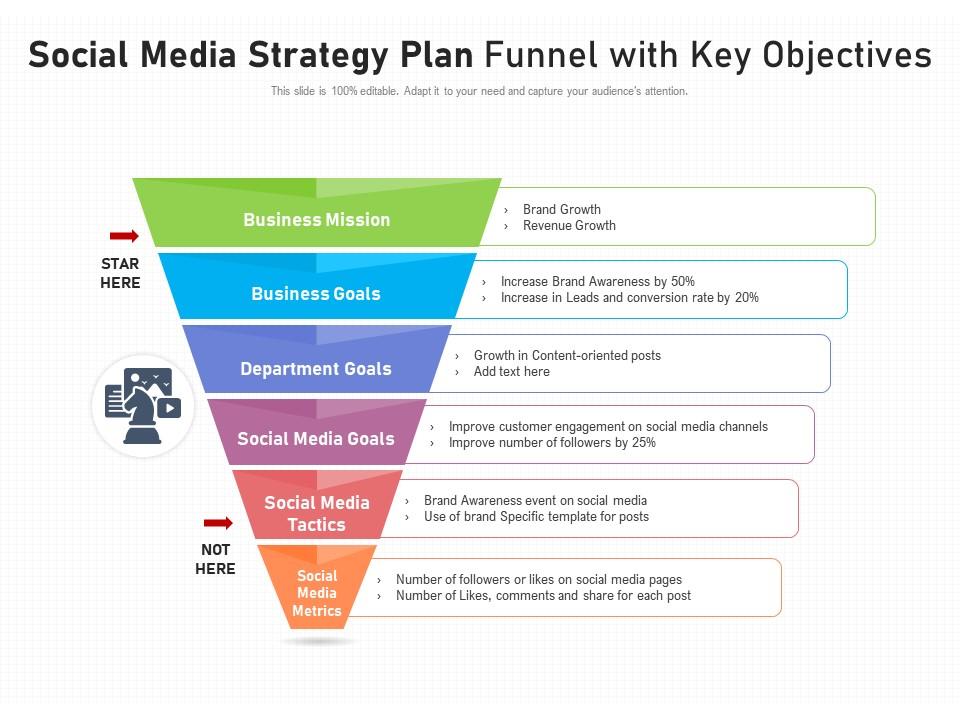
Social media strategy plan funnel with key objectives
Try Before you Buy Download Free Sample Product
Audience
Editable
of Time
Our Social Media Strategy Plan Funnel With Key Objectives are topically designed to provide an attractive backdrop to any subject. Use them to look like a presentation pro.
People who downloaded this PowerPoint presentation also viewed the following :
Social media strategy plan funnel with key objectives with all 2 slides:
Use our Social Media Strategy Plan Funnel With Key Objectives to effectively help you save your valuable time. They are readymade to fit into any presentation structure.
FAQs for Social media strategy plan funnel
Key stages include awareness, interest, consideration, conversion, and retention, each building progressively deeper audience relationships through targeted content and engagement tactics. These stages interact synergistically, with awareness content feeding interest generation, consideration nurturing leading to conversions, and retention strategies creating brand advocates who amplify awareness, ultimately delivering sustained growth and competitive advantage.
Businesses can effectively use audience segmentation by dividing followers based on demographics, behaviors, interests, purchase history, and engagement patterns to deliver targeted content at each funnel stage. This strategic approach enables personalized messaging for awareness campaigns, tailored product recommendations for consideration phases, and customized retention strategies, ultimately delivering higher conversion rates and stronger customer relationships across platforms.
Key metrics include awareness stage (reach, impressions, brand mentions), consideration stage (engagement rates, click-through rates, social shares), and conversion stage (lead generation, conversion rates, customer acquisition costs). These metrics enable organizations to optimize content strategies, allocate resources effectively, and demonstrate ROI, with many businesses finding that stage-specific tracking significantly enhances campaign performance and strategic decision-making.
Paid advertising amplifies the social media strategy funnel by driving targeted reach at the awareness stage and retargeting engaged users for conversions. Through platforms like Facebook and LinkedIn, businesses create broad awareness campaigns showcasing brand value, then deploy conversion-focused ads to users who previously engaged, ultimately delivering higher ROI and shorter sales cycles across industries.
Content serves as the primary driver moving users through each funnel stage, from awareness-building posts and educational videos that attract prospects, to product demonstrations and testimonials that nurture consideration, to exclusive offers and user-generated content that drive conversions. Strategic content mapping enables businesses to deliver targeted messaging at optimal touchpoints, with many organizations finding that personalized content experiences significantly enhance engagement rates and ultimately accelerate the customer journey from discovery to purchase.
Businesses effectively retarget funnel drop-outs through personalized ad campaigns, lookalike audience creation, email remarketing sequences, and platform-specific retargeting pixels that track user behavior at each stage. By segmenting audiences based on their exit points, companies can deliver tailored content addressing specific concerns, with many finding that this targeted approach increases conversion rates significantly.
Social media strategy funnels benefit from analytics platforms like Google Analytics and Hootsuite, CRM systems, automation tools, content management systems, and AI-powered chatbots. These technologies streamline audience targeting, content scheduling, and lead nurturing across platforms, with retail brands and service companies finding that integrated approaches ultimately deliver higher conversion rates and enhanced customer engagement throughout the funnel.
Different social media platforms significantly impact strategy funnel design through unique audience behaviors, content formats, and engagement mechanisms, requiring tailored approaches for each stage. LinkedIn excels at awareness and consideration phases with professional content, while Instagram and TikTok drive engagement through visual storytelling, and Facebook facilitates conversion through targeted advertising, ultimately delivering platform-optimized customer journeys.
Common pitfalls include neglecting audience segmentation, creating generic content for all funnel stages, poor platform selection, inconsistent posting schedules, and inadequate performance tracking. Many organizations find that avoiding these mistakes by implementing targeted content strategies, platform-specific approaches, and robust analytics systems ultimately delivers higher engagement rates, improved conversion metrics, and stronger customer relationships across their social media channels.
Storytelling can be incorporated by crafting narrative-driven content at each funnel stage, using brand stories for awareness, customer journeys for consideration, and success testimonials for conversion. This approach enables businesses to create emotional connections, build trust through authentic narratives, and guide users seamlessly through the funnel, ultimately delivering higher engagement and stronger brand loyalty.
User-generated content plays a crucial role in nurturing leads through the social media strategy funnel by building authentic trust, providing social proof, and creating emotional connections at every stage. Through customer testimonials, reviews, and shared experiences, businesses enhance credibility and accelerate conversion rates, with many organizations finding that UGC delivers significantly higher engagement and ultimately stronger customer relationships than traditional branded content.
Creating seamless online-to-offline transitions involves implementing location-based targeting, personalized retargeting campaigns, QR code integrations, and exclusive in-store promotions tied to digital engagement. Retail brands and restaurants increasingly use geofencing technology and mobile apps to bridge this gap, delivering personalized offers when customers are near physical locations, ultimately driving foot traffic while enhancing customer experiences.
Brands measure social media strategy funnel ROI by tracking conversion rates, customer acquisition costs, lifetime value metrics, engagement-to-sales ratios, and attribution modeling across touchpoints. Through advanced analytics platforms, companies like e-commerce retailers and SaaS providers streamline performance measurement, optimize budget allocation, and demonstrate tangible revenue impact, ultimately delivering measurable business growth and competitive advantage.
Influencer partnerships enhance awareness by expanding reach to new audiences, leveraging authentic storytelling, creating viral content opportunities, and utilizing cross-platform promotion strategies. Through strategic collaborations with relevant influencers, brands can access engaged communities, generate organic conversations, and build credibility through trusted voices, with many organizations finding that authentic influencer content delivers significantly higher engagement rates than traditional advertising approaches.
Analyzing the customer journey through social media strategy funnels reveals critical touchpoint effectiveness, content performance patterns, conversion bottlenecks, engagement timing preferences, and platform-specific behavioral insights. These analytics enable businesses to optimize content placement, streamline audience targeting, and enhance campaign ROI, with many organizations finding that journey mapping ultimately delivers improved conversion rates and strategic competitive advantage.
-
Innovative and Colorful designs.
-
Perfect template with attractive color combination.
-
Appreciate the research and its presentable format.