Software quality maturity model
Try Before you Buy Download Free Sample Product
Audience
Editable
of Time
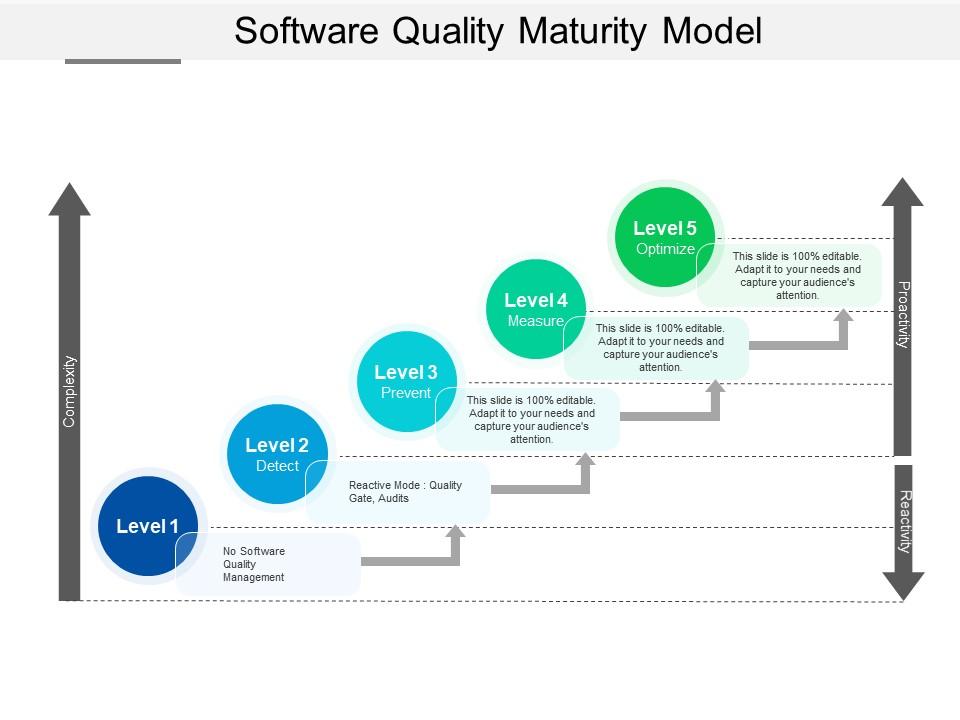
Bringing you a professionally designed software quality maturity model to reflect different levels of software growth. Five stages are shown here as five levels to display continuous improvement and software development. Crafted with the graphics of five levels and catching colors which helps to portray the correct motive of this presentation. Reflect how well the used software complies with or conforms to a given design, based on functional requirements or specifications. Mastering these elements will take you to a better vision and your desired objective. Just click on the download button and unveil the advantages this PPT slide have for you. Get folks to contemplate contemporary ideas with our Software Quality Maturity Model. Address any antiquated beliefs.
People who downloaded this PowerPoint presentation also viewed the following :
Software quality maturity model with all 5 slides:
Our Software Quality Maturity Model team always have their eyes and ears open. They are alert to changing demands.
FAQs for Software
The Software Quality Maturity Model includes initial, managed, defined, quantitatively managed, and optimizing stages, progressing from ad-hoc processes to systematic quality optimization. Organizations advance through these stages by implementing standardized procedures, establishing metrics-driven approaches, and creating continuous improvement frameworks, with many software companies finding that higher maturity levels deliver significantly reduced defects and enhanced development efficiency.
Organizations assess their position within the Software Quality Maturity Model through comprehensive evaluations of their current processes, documentation standards, testing frameworks, and quality metrics against established maturity benchmarks. Many companies engage third-party assessors or use self-assessment tools to identify gaps in their software development lifecycle, ultimately enabling targeted improvements that enhance product reliability, reduce defects, and accelerate time-to-market.
**INPUT**: What are the common metrics used to measure software quality at different maturity levels? **OUTPUT**: Software quality metrics include defect density, code coverage, mean time to failure, customer satisfaction scores, and cyclic complexity measurements across maturity stages. These metrics enable organizations to streamline development processes, enhance product reliability, and accelerate delivery timelines, with many software companies finding that systematic measurement ultimately delivers competitive advantage and improved customer experiences. [Word count: 54 words]
The Software Quality Maturity Model integrates with Agile methodologies by embedding continuous improvement practices into iterative development cycles, incorporating quality gates within sprints, and establishing metrics that track both velocity and defect reduction. Through automated testing frameworks and regular retrospectives, organizations streamline quality processes while maintaining Agile flexibility, ultimately delivering faster releases with enhanced reliability and reduced technical debt.
CI/CD plays a pivotal role in advancing software quality maturity by automating testing processes, ensuring consistent code integration, reducing deployment risks, and enabling rapid feedback loops throughout development cycles. These practices streamline quality assurance by catching defects early, minimizing manual errors, and accelerating delivery timelines, with many organizations finding that mature CI/CD pipelines ultimately deliver higher software reliability and competitive market responsiveness.
Organizations effectively transition between maturity levels by establishing clear process documentation, implementing structured training programs, and creating dedicated quality assurance teams with defined roles and responsibilities. Through systematic gap analysis and incremental improvements, companies in sectors like healthcare, financial services, and manufacturing enhance their software delivery capabilities, reduce defect rates, and achieve faster time-to-market, ultimately delivering competitive advantage.
Teams can improve software quality processes by implementing automated testing frameworks, establishing code review protocols, adopting continuous integration practices, creating comprehensive documentation standards, and fostering cross-functional collaboration. These practices streamline development workflows by reducing manual errors, accelerating feedback cycles, and enhancing team accountability, with many organizations finding that strategic implementation ultimately delivers faster releases and significantly improved product reliability.
Stakeholder involvement significantly accelerates progression through the Software Quality Maturity Model by ensuring alignment between quality initiatives, business objectives, and user requirements across all organizational levels. Through active participation in quality planning, feedback cycles, and governance structures, stakeholders enable faster defect resolution, improved process adoption, and better resource allocation, ultimately delivering more robust software products and sustainable quality improvements.
Organizations typically face challenges including cultural resistance to process changes, resource allocation for training and assessment activities, integration complexity with existing development workflows, and maintaining consistent documentation standards across teams. These implementation hurdles often require strategic change management, dedicated quality assurance personnel, and executive sponsorship, with many software development companies finding that gradual adoption and cross-functional collaboration ultimately deliver sustainable process improvements and enhanced product reliability.
Yes, the Software Quality Maturity Model applies comprehensively to both software development and maintenance phases, addressing requirements analysis, design, coding, testing, deployment, and ongoing support activities. Through structured maturity levels, organizations streamline development workflows while enhancing maintenance efficiency, with many software companies finding that integrated application across both phases delivers improved code quality, reduced defect rates, and ultimately stronger competitive advantage in increasingly complex digital environments.
Tools supporting software quality maturity transitions include automated testing frameworks, continuous integration platforms, code analysis tools, defect tracking systems, and performance monitoring solutions. These technologies streamline quality processes by enabling automated code reviews, real-time defect detection, and comprehensive test coverage, with many organizations finding that strategic tool integration accelerates their maturity progression while delivering improved software reliability and faster release cycles.
Team training and development enhances software quality maturity by building technical competencies, establishing standardized processes, and fostering quality-focused mindsets across development cycles. Through structured learning programs, organizations streamline code reviews, automate testing procedures, and implement consistent documentation practices, with many software teams finding that continuous skill development ultimately delivers faster deployment cycles, reduced defect rates, and improved customer satisfaction.
Successful SQMM implementations include Microsoft's Xbox division achieving Level 5 maturity through automated testing frameworks, IBM's software services reducing defect rates by 40% across development cycles, and Motorola's embedded systems team streamlining quality processes. These organizations demonstrate how systematic maturity progression enhances product reliability, accelerates time-to-market, and delivers competitive advantage through measurable quality improvements.
Automation significantly elevates software quality maturity by streamlining testing processes, reducing human error, and enabling continuous integration and deployment practices. Organizations implementing automated testing frameworks, code analysis tools, and deployment pipelines achieve faster feedback cycles, improved consistency, and enhanced defect detection capabilities, ultimately delivering higher-quality software with greater operational efficiency and competitive advantage.
Customer feedback can be incorporated into the Software Quality Maturity Model through systematic feedback collection, requirements validation, defect tracking, user acceptance testing, and continuous improvement cycles. These integration points enable organizations to align quality metrics with user expectations, identify gaps between perceived and actual quality, and prioritize enhancement efforts based on customer impact, ultimately delivering more market-responsive software solutions.
No Reviews