

Steps to choose right devops tools it powerpoint presentation slides





Try Before you Buy Download Free Sample Product
 Impress Your
Audience
 100%
Editable
 Save Hours
of Time


Choosing the right devops tools for your organization can be a daunting task. There are so many options available, and each tool has its own set of features and benefits. In this blog post, we will outline the steps you should take to choose the right devops tools for your business. By following these steps, you can ensure that you select the tools that will best meet your needs and help your business succeed. SlideTeam’s devOps templates can help you get started with the right tools for your project. We have a wide variety of templates to choose from, so you can find the perfect fit for your team and your project. Download our templates today and see how easy it is to get started with the right tools for your next devOps project.
People who downloaded this PowerPoint presentation also viewed the following :
Content of this Powerpoint Presentation
Slide 1: This slide represents the Steps to Choose Right DevOps Tools (IT).
Slide 2: This is an Agenda slide that illustrates Steps to Choose the Right DevOps Tools (IT).
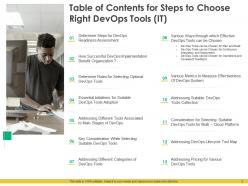
Slide 3: This is a Table of Contents slide that includes various Steps to Choose the Right DevOps Tools (IT) covering readiness assessment, rules for selecting optimal DevOps tools, essential initiatives for suitability, and more.
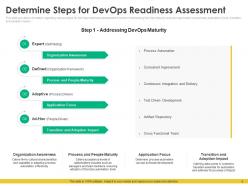
Slide 4: This slide provides information regarding various steps for DevOps readiness assessment in terms of addressing DevOps maturities such as organization awareness, application focus, transition, and adoption impact.
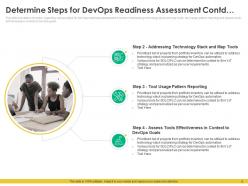
Slide 5: This slide provides information regarding various steps for DevOps readiness assessment in terms of addressing technology stack and map tools, usage pattern reporting, and assessing effectiveness in context to DevOps goals.
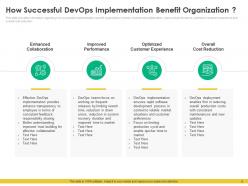
Slide 6: This slide provides information regarding how successful implementation benefits the organization in terms of enhanced collaboration, improved performance, optimized customer experience, and overall cost reduction.
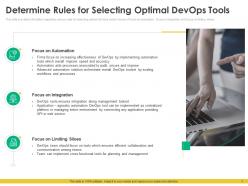
Slide 7: This slide provides information regarding various rules for selecting optimal DevOps tools in terms of focus on automation, integration, and limiting siloes.
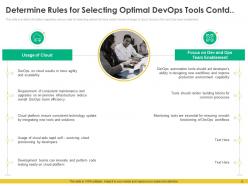
Slide 8: This slide provides information regarding various rules for selecting optimal DevOps tools in terms of usage of cloud, focusing on Dev, and Ops team enablement.
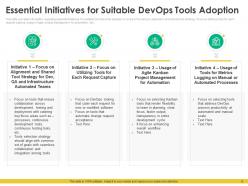
Slide 9: This slide provides information regarding essential initiatives for suitable DevOps tools adoption in terms of focusing on alignment, shared tool strategy, utilizing tools for each request capture, usage of agile project management for automation, etc.
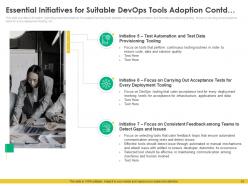
Slide 10: This slide provides information regarding essential initiatives for suitable DevOps tools adoption in terms of test automation and test data provisioning tooling, focusing on carrying out acceptance tests for every deployment tooling, etc.
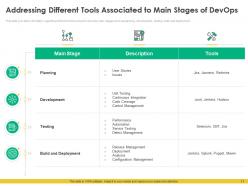
Slide 11: This slide provides information regarding different tools involved in DevOps’ main stages such as planning, development, testing, build, and deployment.
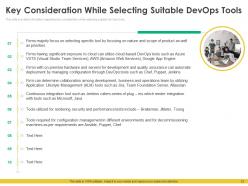
Slide 12: This slide provides information regarding key considerations while selecting suitable DevOps tools.
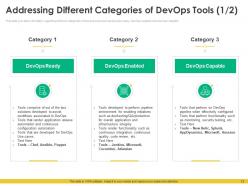
Slide 13: This slide provides information regarding different categories of DevOps tools such as DevOps ready, DevOps enabled, and DevOps capable.
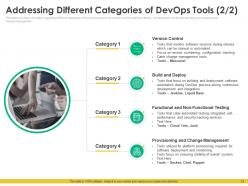
Slide 14: This slide provides information regarding different categories of DevOps tools such as version control, build and deploy, functional and non-functional testing, provisioning, and change management.
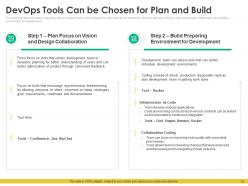
Slide 15: This slide provides information regarding various ways through which suitable DevOps tools can be selected in terms of planning focus on vision and design collaboration; and building environment for development.
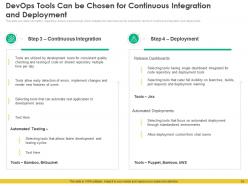
Slide 16: This slide provides information regarding various ways through which suitable DevOps tools can be selected in terms of continuous integration and deployment.
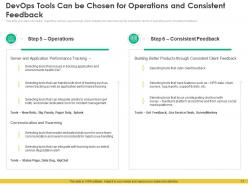
Slide 17: This slide provides information regarding various ways through which suitable DevOps tools can be selected in terms of operations and consistent feedback.
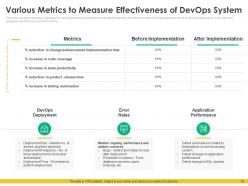
Slide 18: This slide provides information regarding the various metrics that are considered essential in determining the effectiveness of DevOps systems in terms of DevOps deployment, error rates, application performance, and other metrics.
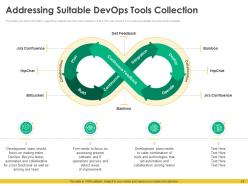
Slide 19: This slide provides information regarding suitable DevOps tools collection that a firm can choose from the available DevOps tools.
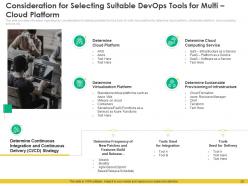
Slide 20: This slide provides information regarding key considerations for selecting suitable DevOps tools for multi-cloud platforms by determining cloud platform, virtualization platform, cloud computing service, etc.
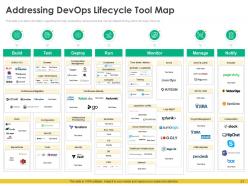
Slide 21: This slide provides information regarding the tool map presenting various tools that can be utilized during the entire DevOps Lifecycle.
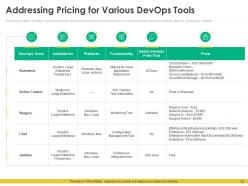
Slide 22: This slide provides information regarding pricing for various DevOps tools and compares them on various parameters such as suitability, platform, functionality, and free trial.
Slide 23: This is a 100% editable slide that includes Icons to Choose Right DevOps Tools (IT).
Slide 24: This is a template that illustrates Additional Slides.
Slide 25: This is a 100% editable 30-60-90 Day Plan slide.
Slide 26: This is a 100% editable Weekly Timeline with Task Names to capture your audience's attention.
Slide 27: This is a slide that illustrates the Roadmap for Process Flow.
Slide 28: This is a slide that includes mission, vision, goal, and more.
Slide 29: This is a 100% editable team introduction slide that includes employee names and designations.
Slide 30: This is an About Us slide that includes information on the target audience, value clients, and more.
Slide 31: This is a 100% editable slide that includes company goals.
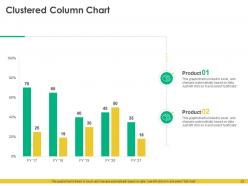
Slide 32: This is a slide that illustrates Clustered Column Chart to excel and change automatically based on data.
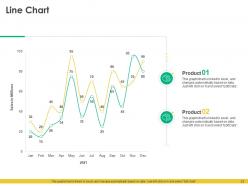
Slide 33: This is a line Chart template that is linked to excel and can change automatically based on data.
Slide 34: This is a 100% editable financial template.
Slide 35: This is a 100% editable Comparison slide.
Slide 36: This is a 100% editable Puzzle template that can be used to capture your audience's attention.
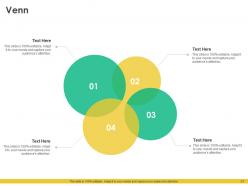
Slide 37: This is a 100% editable Venn Diagram template.
Slide 38: This is a thank you slide that includes company address, contact information, and more.
Steps to choose right devops tools it powerpoint presentation slides with all 38 slides:
Use our Steps To Choose Right DevOps Tools IT Powerpoint Presentation Slides to effectively help you save your valuable time. They are readymade to fit into any presentation structure.












FAQs for Steps to choose right devops tools it
Key factors include team expertise, scalability requirements, integration capabilities, security features, and cost-effectiveness. Organizations should evaluate how tools streamline collaboration between development and operations teams, automate deployment pipelines, and enhance monitoring capabilities, with many enterprises finding that strategic tool selection ultimately delivers faster release cycles, improved operational efficiency, and stronger competitive advantage.
Assessing DevOps tool compatibility involves evaluating integration capabilities, API support, data format alignment, and infrastructure requirements against your current systems. Through compatibility matrices and proof-of-concept testing, organizations streamline tool adoption while minimizing disruptions, with many finding that strategic tool selection ultimately delivers enhanced workflow efficiency and reduced operational overhead.
Team size and skill level significantly influence DevOps tool selection, with smaller teams requiring user-friendly, integrated platforms while larger organizations can leverage complex, specialized toolchains. Enterprise teams often adopt comprehensive suites like Azure DevOps or Atlassian, while startups favor simplified solutions like GitHub Actions, ultimately enabling organizations to match their technical capabilities with operational efficiency and scalability requirements.
Evaluate DevOps tool scalability by assessing performance under increased workloads, integration capabilities with existing systems, resource consumption patterns, and support for distributed architectures. Consider tools like Jenkins for CI/CD pipelines or Kubernetes for container orchestration, while examining licensing costs, community support, and vendor roadmaps, ultimately ensuring the solution scales seamlessly with your organization's growth trajectory.
**Best practices for integrating new DevOps tools include conducting thorough compatibility assessments, implementing gradual rollouts with pilot teams, establishing comprehensive training programs, and maintaining robust documentation standards. Through strategic phased deployment, organizations streamline adoption challenges while minimizing workflow disruptions, with many development teams finding that incremental integration ultimately delivers enhanced operational efficiency and sustained competitive advantage.** [Word count: 60 words]
Community support and documentation are critical when selecting DevOps tools, as they directly impact implementation speed, troubleshooting efficiency, and long-term maintenance capabilities. Strong communities provide faster problem resolution, extensive knowledge bases, and continuous improvements, while comprehensive documentation enables teams to reduce training time, minimize deployment errors, and scale operations more effectively across organizations.
Key metrics include deployment frequency, lead time for changes, mean time to recovery, change failure rate, and system uptime percentages. These measurements enable organizations to track operational efficiency, identify bottlenecks, and optimize resource allocation, with many financial services and e-commerce companies finding that consistent monitoring ultimately delivers faster releases and enhanced customer experiences.
Balancing open-source and commercial DevOps tools requires evaluating factors like budget constraints, support requirements, security needs, and scalability demands. Organizations typically adopt a hybrid approach, using open-source solutions for development environments while leveraging commercial tools for production systems, ultimately delivering cost efficiency and enterprise-grade reliability across their infrastructure.
Common pitfalls include choosing tools without assessing team expertise, selecting incompatible solutions that create integration challenges, overcomplicating workflows with unnecessary features, and ignoring scalability requirements. Organizations often find that prioritizing vendor lock-in avoidance, ensuring proper training resources, and aligning tool capabilities with actual workflow needs ultimately delivers better adoption rates and operational efficiency.
DevOps tool costs significantly impact project budgets through licensing fees, infrastructure requirements, training expenses, and ongoing maintenance costs. While initial investments can be substantial, organizations typically find that strategic tool selection delivers cost savings through reduced deployment times, fewer production issues, and improved resource efficiency, ultimately providing strong return on investment.
**INPUT**: What security features should you prioritize when choosing DevOps tools? **OUTPUT**: Priority security features include automated vulnerability scanning, access controls with role-based permissions, encryption for data in transit and at rest, and comprehensive audit logging. These capabilities streamline security integration by identifying threats early, controlling resource access, and maintaining compliance requirements, with many financial services and healthcare organizations finding that built-in security automation ultimately delivers faster deployments while reducing risk exposure. [Word count: 60]
Team member feedback significantly influences DevOps tool selection by providing insights into workflow compatibility, skill requirements, learning curves, and integration challenges with existing systems. Through surveys, pilot programs, and collaborative evaluations, organizations can assess user experience, identify potential adoption barriers, and ensure selected tools align with team expertise, ultimately delivering higher adoption rates and improved operational efficiency across development cycles.
Automation capabilities in DevOps tools enhance productivity by streamlining code deployment, automating testing processes, and reducing manual configuration errors across development pipelines. These automated workflows enable teams to accelerate release cycles, minimize operational overhead, and focus on strategic development tasks, with many organizations finding that automated CI/CD processes deliver faster time-to-market and improved software quality.
Ensuring DevOps tools comply with industry regulations requires conducting comprehensive compliance audits, implementing security frameworks like SOC 2 or ISO 27001, and establishing continuous monitoring protocols. Organizations in healthcare, finance, and government sectors streamline regulatory adherence by selecting tools with built-in compliance features, automated audit trails, and certification support, ultimately delivering faster deployments while maintaining strict regulatory standards.
Vendor lock-in significantly influences DevOps tool selection by creating long-term dependencies that can limit flexibility, increase costs, and complicate future migrations between platforms or providers. Organizations increasingly prioritize open-source solutions, multi-cloud compatibility, and standardized APIs when evaluating tools, with many finding that strategic diversification ultimately delivers greater operational control and competitive advantage.
-
Best way of representation of the topic.
-
Visually stunning presentation, love the content.
-
Design layout is very impressive.