Strategic objectives alignment
Try Before you Buy Download Free Sample Product
Audience
Editable
of Time
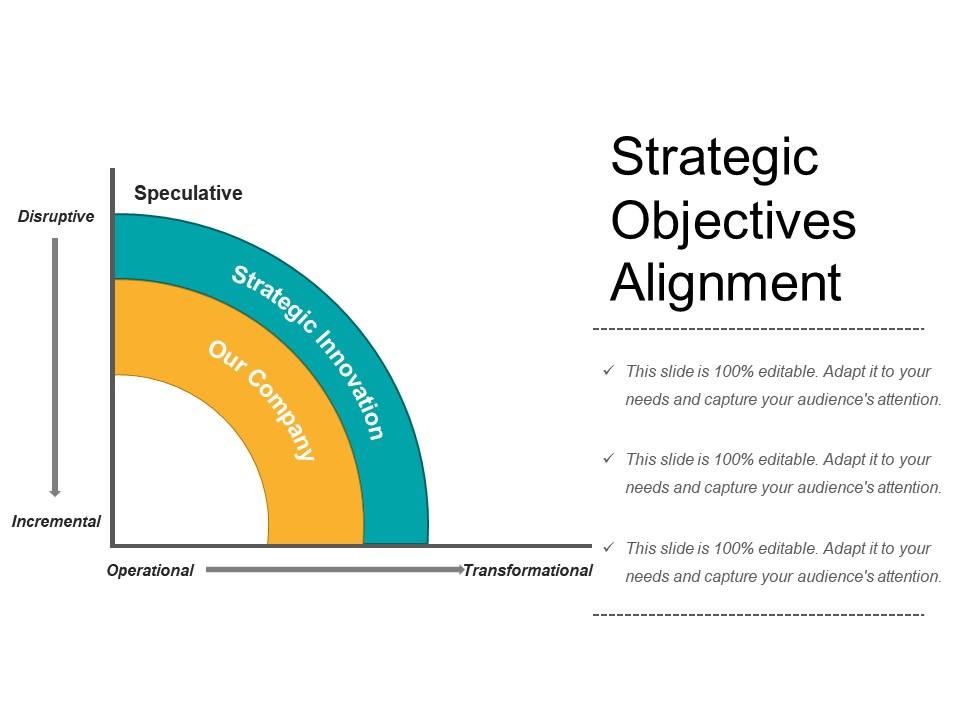
Transform your business completely with the help of this Strategic Objectives Alignment PowerPoint presentation. This strategic goal PPT slideshow consists of operational and transformational alignment. Employ this long-term plan PPT layout and reinvent your processes to drive maximum business growth along with the generation of customer value. Ensure that adequate and latest technology is integrated with your business for the best results. Use this corporate strategy PPT template to optimize your business processes, increase your brand image and improve the customer experience. Utilize this strategy PPT visual to encourage decision-making among employees and develop a sense of belongingness in them. Take advantage of this strategic management PowerPoint slide to depict the importance of information technology in the smooth functioning of an organization. Download this eye-catching corporate strategy PPT infographic to design your systems optimally for phenomenal growth.
People who downloaded this PowerPoint presentation also viewed the following :
Strategic objectives alignment with all 5 slides:
Correct biased coverage with our Strategic Objectives Alignment. Insist on journalists accepting facts.
FAQs for
Strategic alignment components include shared vision and goals, coordinated resource allocation, integrated communication systems, performance measurement frameworks, and cultural cohesion across departments. These elements work together by ensuring all organizational activities support overarching objectives, streamlining decision-making processes, and eliminating conflicting priorities, with many companies finding that proper alignment significantly enhances operational efficiency and competitive positioning.
Organizations can effectively measure strategic alignment success through key performance indicators, balanced scorecards, employee engagement surveys, project completion rates, and financial metrics aligned with strategic objectives. These measurement approaches enable leadership teams to track progress across departments, identify misalignment early, and adjust strategies accordingly, with many companies finding that regular quarterly assessments and cross-functional reviews ultimately deliver improved operational efficiency and stronger competitive positioning.
Leadership establishes strategic direction, communicates organizational priorities across all levels, and ensures resource allocation supports unified goals through consistent decision-making and performance management. Effective leaders foster alignment by modeling strategic behaviors, removing operational barriers, and maintaining ongoing dialogue between departments, with many organizations finding that strong leadership communication directly correlates with improved strategic execution and competitive advantage.
Organizations ensure clear strategic goal communication through cascading communication frameworks, regular town halls, departmental alignment sessions, visual dashboards, and leadership modeling. These approaches streamline understanding by translating high-level objectives into department-specific targets, creating transparent progress tracking, and establishing consistent messaging channels, with many companies finding that multi-tiered communication ultimately delivers enhanced employee engagement and accelerated goal achievement.
Common strategic alignment challenges include poor communication across departments, conflicting priorities between teams, unclear goal-setting processes, insufficient leadership buy-in, and lack of regular progress monitoring. These obstacles can be overcome by establishing clear communication channels, implementing unified performance metrics, conducting regular cross-functional meetings, and creating transparent reporting systems, ultimately delivering improved organizational cohesion and faster strategic execution.
Strategic alignment significantly influences organizational culture by creating shared purpose, clear direction, and unified goals that enhance employee engagement and motivation. When organizations achieve strategic alignment, employees understand their role in broader objectives, experience greater job satisfaction and commitment, while ultimately fostering collaborative environments that drive performance and retention across departments.
Technology enhances strategic alignment through real-time dashboards, automated reporting systems, collaborative planning platforms, data analytics tools, and integrated communication systems. These solutions streamline goal-setting and performance tracking across departments, while enabling faster decision-making and transparent progress monitoring, with many organizations finding that digital alignment tools significantly reduce miscommunication and accelerate strategic execution.
Performance metrics align with strategic objectives through outcome-based KPIs, cascading goal frameworks, balanced scorecards, and regular performance reviews that connect individual contributions to broader organizational targets. This strategic alignment enables organizations to maintain coherence by ensuring every department and employee understands their role in achieving company-wide objectives, ultimately delivering improved accountability, resource optimization, and competitive advantage across all business functions.
**INPUT**: What strategies can be employed to align diverse departments within a company towards a common goal? **OUTPUT**: Effective alignment strategies include establishing clear communication channels, implementing cross-functional project teams, creating shared performance metrics, developing unified strategic frameworks, and fostering collaborative decision-making processes. These approaches streamline coordination by breaking down silos, enhancing transparency, and ensuring consistent messaging, with many organizations finding that regular interdepartmental meetings and shared digital platforms ultimately deliver improved operational efficiency and accelerated goal achievement. [Word count: 60 words]
Companies can pivot their strategic alignment through comprehensive market analysis, stakeholder engagement, resource reallocation, agile planning processes, and cross-functional collaboration. Organizations like Netflix and Microsoft have successfully navigated major disruptions by reassessing core objectives, realigning operational priorities, and implementing flexible frameworks that enable rapid strategic adjustments, ultimately delivering competitive advantage in evolving markets.
Strategic alignment significantly enhances customer satisfaction by ensuring consistent service delivery, streamlined operations, and coordinated customer experiences across all touchpoints. When organizations align their strategic goals with stakeholder expectations, they deliver more predictable outcomes, foster stronger trust relationships, and create sustainable competitive advantages, with many companies finding that aligned strategies ultimately reduce customer complaints while increasing loyalty and stakeholder engagement.
Organizations can incorporate feedback loops through regular strategy reviews, cross-departmental alignment meetings, employee surveys, performance dashboards, and stakeholder consultations. These mechanisms enable continuous course correction by identifying misaligned initiatives, measuring progress against objectives, and gathering insights from various organizational levels, ultimately ensuring strategies remain responsive to market changes while maintaining internal coherence and operational effectiveness.
Methods to ensure employee performance aligns with strategic objectives include cascading goal-setting frameworks, balanced scorecards, performance management systems, regular strategic communication sessions, and competency-based evaluations. These approaches streamline alignment by translating high-level objectives into individual targets, measuring progress against strategic metrics, and fostering accountability, with many organizations finding that consistent reinforcement through feedback loops ultimately delivers enhanced operational efficiency and competitive advantage.
Strategic alignment in startups focuses on rapid pivoting, resource optimization, and founder-driven vision alignment, while large corporations emphasize cross-departmental coordination, stakeholder management, and systematic goal cascading across multiple business units. Startups can adjust alignment quickly through direct communication, whereas corporations require structured processes, formal governance systems, and change management protocols, ultimately delivering different speeds of strategic adaptation.
Organizations can improve strategic planning sessions through structured facilitation, clear objective setting, diverse stakeholder participation, data-driven decision making, and regular progress checkpoints. These practices enhance alignment by ensuring comprehensive input, measurable outcomes, and transparent communication across departments, with many companies finding that systematic approaches deliver stronger execution, reduced conflicts, and ultimately improved organizational performance.
-
Design layout is very impressive.
-
Top Quality presentations that are easily editable.