Strategic Risk Management Plan Timeline Risk Management And Mitigation Strategy

Rating:
100%
Strategic Risk Management Plan Timeline Risk Management And Mitigation Strategy
Slide 1 of 6
Favourites Favourites

Try Before you Buy Download Free Sample Product

Audience Impress Your
Audience
Editable 100%
Editable
Time Save Hours
of Time
The Biggest Sale is ending soon in
0
0
:
0
0
:
0
0
Rating:
100%
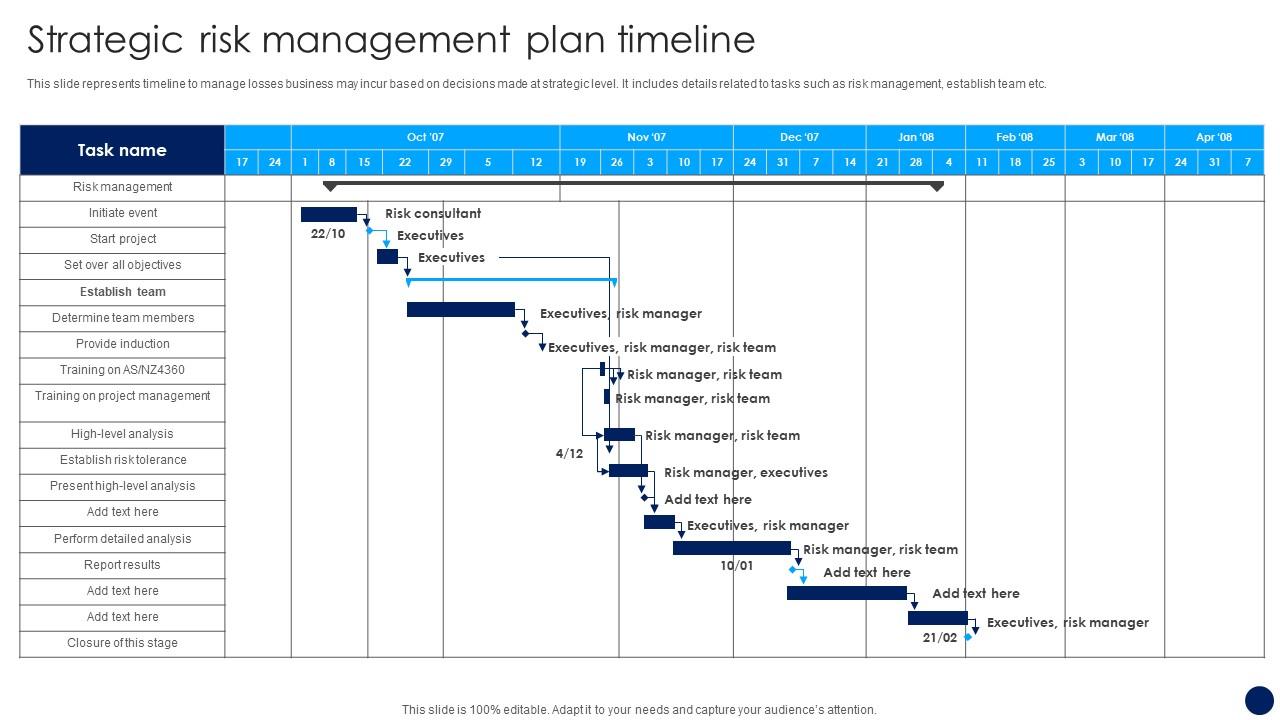
This slide represents timeline to manage losses business may incur based on decisions made at strategic level. It includes details related to tasks such as risk management, establish team etc. Present the topic in a bit more detail with this Strategic Risk Management Plan Timeline Risk Management And Mitigation Strategy. Use it as a tool for discussion and navigation on Risk Management, Project Management, Establish Team. This template is free to edit as deemed fit for your organization. Therefore download it now.

People who downloaded this PowerPoint presentation also viewed the following :

FAQs for Strategic Risk Management Plan Timeline Risk Management

**INPUT**: What are the key components of an effective strategic risk management framework? **OUTPUT**: Key components include risk identification processes, assessment methodologies, mitigation strategies, monitoring systems, and governance structures that align with organizational objectives. These frameworks streamline decision-making by establishing clear accountability, enabling proactive threat response, and integrating risk considerations into strategic planning, with many organizations finding enhanced operational resilience and competitive advantage.

Organizations identify and assess strategic risks through comprehensive risk mapping, scenario planning, stakeholder analysis, competitive intelligence gathering, and regular environmental scanning. These methodologies enable companies to evaluate threats across financial, operational, regulatory, and market dimensions, while many enterprises find that systematic risk assessment frameworks ultimately deliver enhanced decision-making capabilities and improved strategic resilience.

Corporate culture significantly influences strategic risk management success by shaping employee behaviors, decision-making processes, communication patterns, and risk awareness throughout the organization. A strong risk-conscious culture enables proactive identification, transparent reporting, and collaborative mitigation strategies, with many financial institutions and healthcare organizations finding that embedding risk considerations into daily operations ultimately delivers better compliance, reduced operational losses, and enhanced strategic decision-making capabilities.

Organizations align strategic goals with risk management by integrating risk assessment into strategic planning processes, establishing risk tolerance levels that support business objectives, and creating governance frameworks that connect risk oversight to strategic decision-making. This alignment enables companies to pursue growth opportunities while maintaining operational stability, with many financial services firms and manufacturing organizations finding that synchronized risk-strategic frameworks ultimately deliver competitive advantage and sustainable performance.

Common pitfalls include inadequate stakeholder engagement, siloed risk assessment approaches, over-reliance on historical data, insufficient integration with business planning, and lack of regular framework updates. These challenges often result from poor communication across departments, limited executive buy-in, and failure to adapt methodologies, with many organizations finding that comprehensive training and cross-functional collaboration ultimately delivers more effective risk oversight.

Technology and data analytics enhance strategic risk management by enabling real-time monitoring, predictive modeling, and automated threat detection across organizational operations. Through AI-powered analytics and integrated dashboards, companies can identify emerging risks faster, quantify potential impacts more accurately, and implement responsive mitigation strategies, with many financial services and manufacturing firms finding significantly improved operational resilience.

Continuous monitoring and revision ensure strategic risk management remains effective as business environments, market conditions, and organizational priorities evolve rapidly. Through real-time data analysis and regular assessment cycles, companies can identify emerging threats, adjust mitigation strategies, and capitalize on new opportunities, with many organizations finding that proactive risk framework updates deliver enhanced operational resilience and sustained competitive advantage.

Stakeholder engagement significantly enhances risk management effectiveness by providing diverse perspectives, early warning signals, and broader organizational buy-in across departments and external partners. Through collaborative input from employees, customers, suppliers, and investors, organizations identify blind spots, accelerate response times, and ensure comprehensive risk mitigation strategies, ultimately delivering stronger resilience and competitive advantage in increasingly complex business environments.

Organizations can foster proactive risk management through regular risk assessments, cross-functional collaboration, comprehensive training programs, clear escalation protocols, and integrated monitoring systems. These practices enable teams to identify emerging threats early, streamline decision-making processes, and maintain operational continuity, with many financial institutions and healthcare organizations finding that proactive approaches significantly reduce incident response times and costs.

Strategic risk management focuses on high-level threats to long-term business objectives, competitive positioning, and market opportunities, while operational risk management addresses day-to-day process failures, system breakdowns, and tactical execution issues. Strategic risks involve market shifts, regulatory changes, and competitive disruptions that affect overall direction, whereas operational risks center on immediate workflow efficiency, with organizations increasingly finding that integrated approaches deliver comprehensive protection.

Key metrics include risk-adjusted return on investment, incident frequency reduction, compliance score improvements, stakeholder confidence ratings, and business continuity recovery times. These measurements enable organizations to track operational efficiency, regulatory adherence, and financial protection, with many financial institutions and healthcare systems finding that comprehensive metric frameworks ultimately deliver enhanced decision-making capabilities and sustained competitive advantage.

Organizations develop risk-aware cultures by integrating risk assessment into daily decision-making processes, providing comprehensive training across all levels, establishing clear communication channels, and implementing accountability mechanisms that reward proactive risk identification. Through regular workshops, transparent reporting systems, and leadership modeling, companies create environments where employees actively identify potential threats, ultimately enhancing organizational resilience and competitive advantage.

Strategic risk management contributes to long-term business sustainability by identifying potential threats early, developing contingency plans, and creating resilient operational frameworks that adapt to market changes. Through proactive risk assessment and mitigation strategies, organizations can protect their assets, maintain stakeholder confidence, and capitalize on emerging opportunities, ultimately delivering sustained competitive advantage and enhanced organizational resilience.

Emerging trends in strategic risk management include AI-powered risk analytics, real-time monitoring systems, integrated ESG risk frameworks, cyber resilience strategies, and predictive scenario modeling. These technologies enhance organizational preparedness by identifying vulnerabilities faster, automating threat responses, and enabling proactive decision-making, with many enterprises finding that strategic risk integration ultimately delivers competitive advantage and operational resilience.

Risk management contributes to competitive advantage by enabling proactive decision-making, reducing operational disruptions, and building stakeholder confidence through transparent risk assessment. Strategic risk frameworks help companies identify market opportunities earlier, allocate resources more efficiently, and maintain business continuity, with many organizations finding that robust risk practices ultimately deliver lower costs and enhanced market positioning.

Ratings and Reviews

100% of 100
Write a review
Most Relevant Reviews
  1. 100%

    by Williams Nelson

    The templates are handy and I can personalize them as per my needs. Glad to be your subscriber!
  2. 100%

    by Thomas Garcia

    “Excellent information with easy access.”

2 Item(s)

per page: