Swot Analysis For Competitive Strategy Building
Try Before you Buy Download Free Sample Product
Audience
Editable
of Time
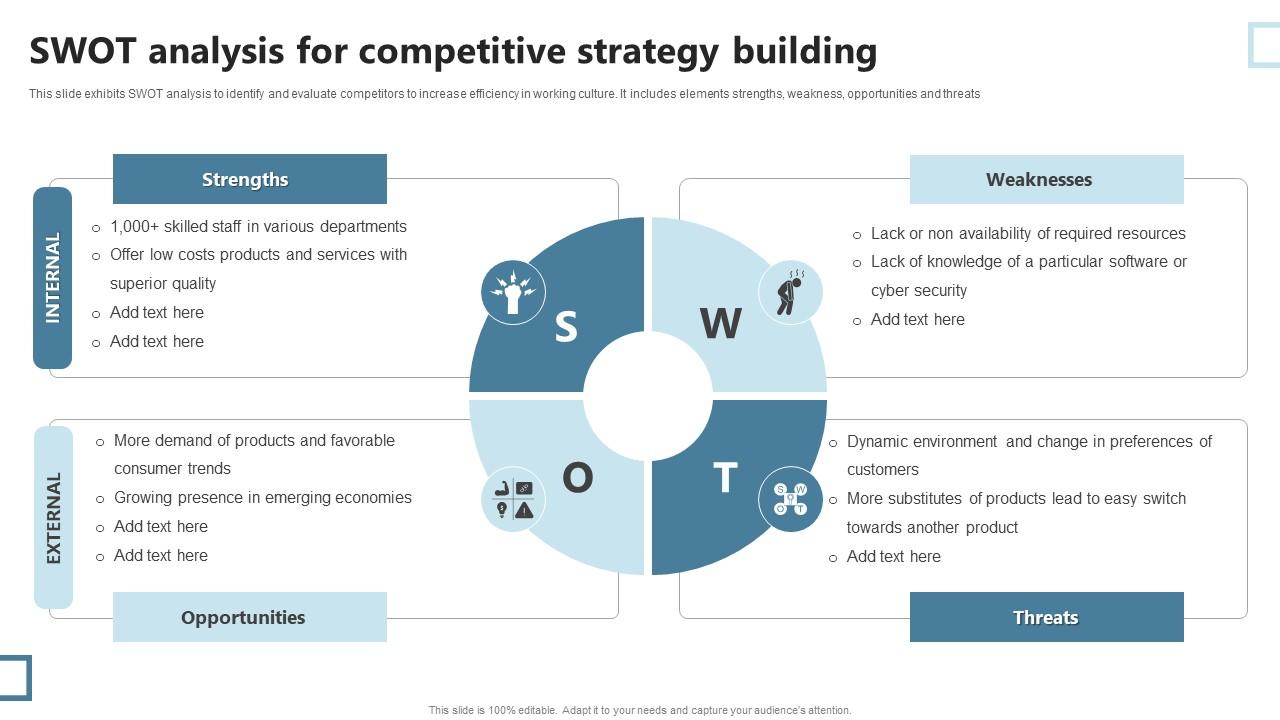
This slide exhibits SWOT analysis to identify and evaluate competitors to increase efficiency in working culture. It includes elements strengths, weakness, opportunities and threats
People who downloaded this PowerPoint presentation also viewed the following :
Swot Analysis For Competitive Strategy Building with all 6 slides:
Use our Swot Analysis For Competitive Strategy Building to effectively help you save your valuable time. They are readymade to fit into any presentation structure.
FAQs for Swot Analysis For
So SWOT has four parts - Strengths and Weaknesses are stuff you control internally, while Opportunities and Threats are external market things you can't really change. But here's what most people miss: you gotta connect them together, not just make four separate lists. Use your strengths to grab opportunities or fight off threats. Work on weaknesses before they bite you later. Sometimes you can even flip weaknesses into opportunities if you're creative about it. Fill out each section first, then literally draw lines between related items - that's where the real insights happen.
SWOT's actually pretty solid for strategic planning - way more useful than it sounds on paper. Map your internal strengths/weaknesses against what's happening externally (opportunities and threats). Here's the thing though: you gotta be brutally honest about where you suck, not just list the feel-good stuff. Get input from different departments first so you're not missing anything obvious. Once you've got everything laid out, build strategies around your strengths to grab opportunities while shoring up weak spots. I know it seems basic but it really works when you don't half-ass it.
Look, you can't just wing a SWOT analysis - you'll end up with total garbage. Market research gives you the actual data to figure out what your company's genuinely good at (and what it sucks at). Plus it helps you spot real opportunities out there instead of just hoping something works out. I learned this the hard way on a project last year, honestly. Get your internal numbers first, then dig into what competitors are doing. Short version: do the homework before you start filling out those four boxes, or you're basically just guessing and calling it strategy.
Honestly, you've got a huge advantage over big corporations with SWOT analysis. While they're stuck in endless committee meetings, you can pivot immediately when something changes. Focus on stuff you can actually act on right now - don't get caught up in fancy strategic planning that goes nowhere. Your weaknesses? They might actually point to niches those massive companies can't even touch because they're too big and clunky. I'd say update yours monthly, maybe even weekly since your situation shifts so fast. Keep it simple and use it for quick decisions, not some lengthy report that sits in a drawer.
Take your internal strengths and flip them outward - that's where the real opportunities hide. Got a killer tech team? They could do consulting or build new products. Strong customer relationships open doors to adjacent markets or referral programs. Honestly, this is my favorite part of SWOT analysis because it gets you thinking beyond just listing what you're good at. Your efficient operations might be the edge you need to compete in price-sensitive markets. For each strength, ask yourself: "How can this create value somewhere we're not playing yet?"
Dude, don't be vague - saying "we have good customer service" means nothing. What specifically makes you different? Get input from multiple people too, not just whoever talks the loudest in meetings (you know how that goes). Be honest about your weaknesses instead of sugarcoating everything. Threats suck to talk about but ignoring them won't make them disappear. Oh, and this might be obvious but actually DO something with the analysis afterward. I've seen so many companies spend hours on this stuff then never look at it again. Set real deadlines and assign owners to each action item.
Honestly, SWOT analysis is pretty clutch for catching problems before they wreck you. Yeah, the threats section shows external risks, but here's what most people miss - you gotta look at where your weaknesses overlap with those threats. That's your danger zone right there. Say you're short on staff and suddenly your competitor drops a major product launch. Yikes. I'd use whatever strengths you have to fight back against threats, then patch up those weak spots fast. Oh, and don't just make a pretty chart - actually do something with it or it's useless.
Honestly? Do it quarterly if you can swing it. The annual thing is way too slow - I've watched companies get totally caught off guard because their SWOT was ancient. Markets move crazy fast now, competitors come out of nowhere, your team picks up new skills. Whenever something big happens though - like new leadership or a product launch - update it right away. Oh, and economic weirdness definitely counts as "something big." The whole point is keeping it current. It's not homework you turn in once and forget about. Make it actually useful by treating it like... I dunno, your LinkedIn profile? Update when stuff changes.
Yeah, totally! I've actually done this for figuring out career moves and even picking apartments - works surprisingly well. So for personal stuff, you'd list your strengths (skills, connections, experience), then weaknesses (things you suck at, knowledge gaps). Opportunities might be industry trends or cool courses you could take. Threats? Economic downturns, more competition, whatever could mess with your plans. Same deal with community projects. What's your neighborhood good at? What's missing? Any outside opportunities worth grabbing? Honestly, it's way more useful than I expected for non-business decisions. Give it a shot next time you're stuck on something big!
Honestly? Just use whatever you've got - PowerPoint, Google Slides, even a Word table works great. Don't overthink it. Miro's pretty cool for remote teams since everyone can jump in and add stuff. Canva has decent templates if you need it to look polished for a presentation or whatever. I've watched people waste hours hunting for the "perfect" SWOT software when they could've been done already with basic tools. The content matters way more than fancy features. Start with a simple 2x2 grid and see how it goes. You can always get fancier later once you figure out what actually works for your situation.
Yeah, so the external environment basically IS your opportunities and threats - that's what you're analyzing when you do that part. Market trends, what competitors are doing, new regulations, economic stuff, tech changes. All that external noise either helps or hurts you. Don't just focus on competitors though, that's where people mess up. Demographic shifts can totally change your business, or supply chain problems might hit you. I usually start by just brain-dumping all the big external forces in my industry, then sort them into "good for us" or "bad for us" piles. Way easier than overthinking it.
Start with stakeholder interviews - different people will spot things you totally missed. Then dig into industry reports and competitor research to back up what you found. Honestly, I'd also survey your team because they catch blind spots every time. Look at your historical data and market trends to test if your assumptions actually hold up. The whole point is getting validation from multiple angles instead of just going with your gut (which, let's be real, can be way off). Oh, and definitely set up a meeting where stakeholders can poke holes in your analysis. That's where the real insights happen.
Dude, culture totally changes how SWOT analysis works. Aggressive sales might crush it in America but completely bomb in Japan - same strength becomes a weakness. Fast service? Germans love efficiency, but other cultures think you're being rude and impersonal. Your opportunities and threats flip around too since regulations and consumer habits are so different everywhere. I learned this the hard way on a project once. You really can't just copy-paste your home market assumptions. Get local people involved when you're breaking down each section, or you'll miss huge blind spots that could tank your strategy.
Apple crushed it with the iPhone launch - they knew design was their superpower but admitted they sucked at telecom stuff. The smartphone boom was their opening, even with BlackBerry breathing down their necks. Starbucks pulled something similar in 2008 when everything went sideways. They used SWOT to realize they'd expanded way too fast and needed to get back to basics. Nike does this constantly for new markets too, which honestly makes sense. But here's the thing - none of these companies just did it once and called it a day. They keep revisiting it and actually follow through instead of letting it collect dust.
Honestly, get people from different departments in there - not just the executives who think everything's going great. You want folks who'll actually call out problems they see day-to-day. Back up your points with real data when you can, though sometimes gut instinct matters too. An outside facilitator works wonders since they don't have skin in the game. Oh, and make sure everyone feels safe being brutally honest - that's where the good stuff comes from. List everything first without judging it, then go back and figure out what's actually true.
-
Their professional templates are very impressive, even my manager was curious about the source. I am very grateful.
-
“The presentation template I got from you was a very useful one.My presentation went very well and the comments were positive.Thank you for the support. Kudos to the team!”