


Technique To Prioritize Key Tasks In Agile Process Powerpoint Presentation Slides





Try Before you Buy Download Free Sample Product
 Impress Your
 Audience
 100%
100% Editable
 Save Hours
 of Time


Prioritization is the process of ordering things such that the most important thing is completed or dealt with first. This may entail arranging a set of activities or items that must be accomplished, as well as prioritising them based on various characteristics. Prioritization allows us to precisely identify what should be prioritised in order to accomplish more and be more productive. If you're looking for a way to prioritize your tasks and streamline your agile process, we've got the tools for you. Download our agile development PowerPoint templates now to get started. With these slide decks, you'll be able to plan your sprints like a pro and stay on track while keeping your team happy and productive.
People who downloaded this PowerPoint presentation also viewed the following :
Content of this Powerpoint Presentation
Slide 1: This slide introduces Technique to Prioritize Key Tasks In Agile Process.
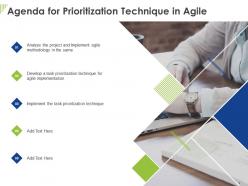
Slide 2: This slide depicts Agenda for Prioritization Technique in Agile.
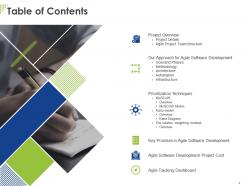
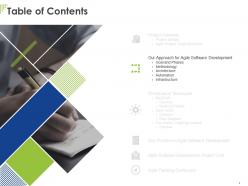
Slide 3: This slide displays Table of Contents
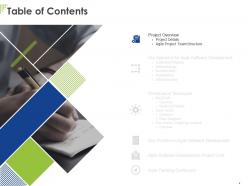
Slide 4: This slide displays Table of Contents.
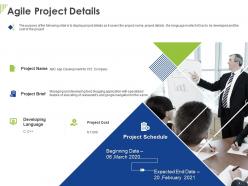
Slide 5: This slide showcases Agile Project Details. The purpose of the following slide is to display project details as it covers the project name, project details , the language in which it has to be developed and the cost of the project
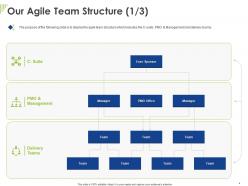
Slide 6: This slide shows Our Agile Team Structure. The purpose of the following slide is to display the agile team structure which includes the C-suite , PMO & Management and delivery teams.
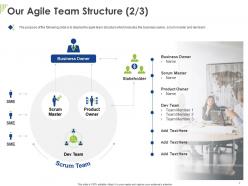
Slide 7: This slide depicts Our Agile Team Structure.
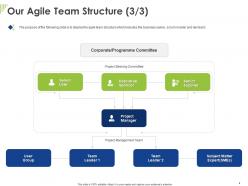
Slide 8: This slide showcases Our Agile Team Structure.
Slide 9: This slide showcases Table of Contents.
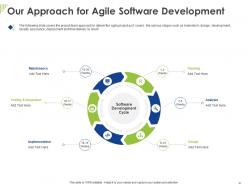
Slide 10: This slide shows Our Approach for Agile Software Development
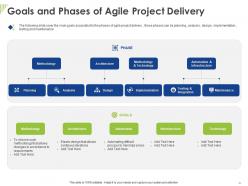
Slide 11: This slide depicts Goals and Phases of Agile Project Delivery. The following slide cover the main goals associated to the phases of agile project delivery , these phases can be planning , analysis , design , implementation , testing and maintenance
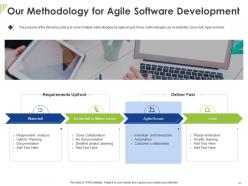
Slide 12: This slide depicts Our Methodology for Agile Software Development
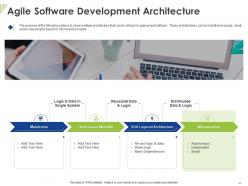
Slide 13: This slide showcases Agile Software Development Architecture.
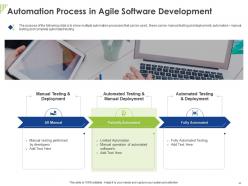
Slide 14: This slide presents Automation Process in Agile Software Development.
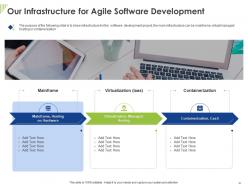
Slide 15: This slide shows Our Infrastructure for Agile Software Development.
Slide 16: This slide depicts Table of Contents.
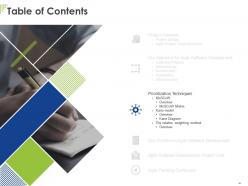
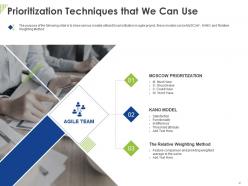
Slide 17: This slide showcases Prioritization Techniques that We Can Use.
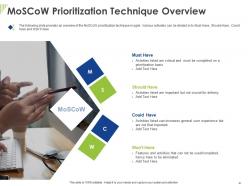
Slide 18: This slide presents MoSCoW Prioritization Technique Overview. The following slide provides an overview of the MoSCoW prioritization technique in agile.
Slide 19: This slide MoSCoW Prioritization Technique Matrix
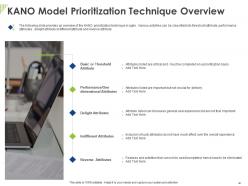
Slide 20: This slide showcases KANO Model Prioritization Technique Overview.
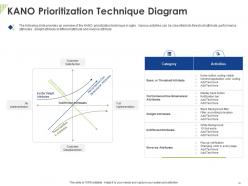
Slide 21: This slide presents KANO Prioritization Technique Diagram
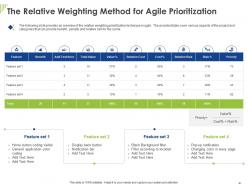
Slide 22: This slide showcases The Relative Weighting Method for Agile Prioritization.
Slide 23: This slide showcases Table of Contents.
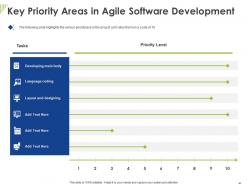
Slide 24: This slide showcases Key Priority Areas in Agile Software Development. The following slide highlights the various priority task in the project ad it rates them on a scale of 10
Slide 25: This slide showcases Table of Contents.
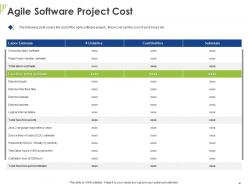
Slide 26: This slide showcases Agile Software Project Cost. The following slide covers the cost of the agile software project , these cost can the cost of work hours etc.
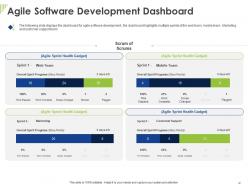
Slide 27: This slide depicts Agile Software Development Dashboard. The following slide displays the dashboard for agile software development , the dashboard highlights multiple sprints of the web team, mobile team . Marketing and customer support team
Slide 28: This is Technique to Prioritize Key Tasks In Agile Process Icon Slides.
Slide 29: This slide is titled as Additional Slides for moving forward.
Slide 30: This is About Us slide to showcase Company specifications.
Slide 31: This slide displays Vision & Mission, Goal.
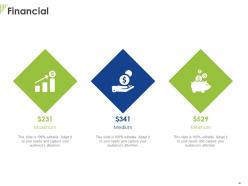
Slide 32: This is Financial slide. Showcase Finance related stuff here.
Slide 33: This is Venn slide.
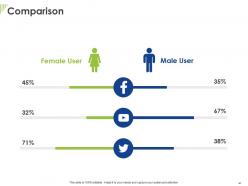
Slide 34: This is Comparison slide showcasing comparison between male and female users.
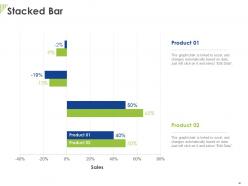
Slide 35: This slide shows Stacked Bar chart with product comparison.
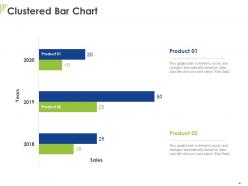
Slide 36: This slide shows Clustered Bar Chart with product comparison.
Slide 37: This is Thank You slide with Email address, Contact number and Address.
Technique To Prioritize Key Tasks In Agile Process Powerpoint Presentation Slides with all 37 slides:
Use our Technique To Prioritize Key Tasks In Agile Process Powerpoint Presentation Slides to effectively help you save your valuable time. They are readymade to fit into any presentation structure.


FAQs for Technique To Prioritize Key Tasks In Agile Process
Agile prioritization principles include customer collaboration, responding to change, delivering working software frequently, individuals over processes, and continuous feedback integration. These principles influence task prioritization by emphasizing customer value delivery, adaptive planning based on changing requirements, and iterative development cycles, with many organizations finding that this approach streamlines decision-making while ensuring strategic alignment with business objectives.
The MoSCoW method categorizes Agile tasks into Must-have, Should-have, Could-have, and Won't-have priorities, enabling teams to focus resources on critical deliverables while maintaining sprint flexibility. This strategic prioritization approach streamlines product development by ensuring essential features receive immediate attention, nice-to-have elements are appropriately scheduled, and scope creep is minimized, ultimately delivering higher customer value and faster time-to-market.
Team capacity directly influences task priorities by determining realistic workload limits, skill availability, resource constraints, and sprint commitments within agile frameworks. Understanding capacity enables teams to balance high-value deliverables with achievable timelines, while many organizations find that aligning priorities with actual capacity enhances productivity, reduces burnout, and ultimately delivers more predictable project outcomes.
User stories enhance Agile prioritization by providing business value context, clear acceptance criteria, and stakeholder perspectives that guide decision-making. Through story mapping and value-based ranking, teams can sequence development work based on customer impact and strategic objectives, while user personas and feedback loops ensure prioritization remains aligned with actual user needs, ultimately delivering more focused sprints and higher-value outcomes.
Techniques for identifying high-value tasks in Agile include MoSCoW prioritization, value-based ranking, user story mapping, impact-effort matrices, and stakeholder feedback sessions. These methods streamline decision-making by evaluating business impact, customer value, and resource requirements, with many product teams finding that strategic combination of these techniques delivers faster feature releases and enhanced customer satisfaction.
The Eisenhower Matrix integrates seamlessly into Agile task prioritization by categorizing user stories and tasks based on urgency and importance, enabling teams to focus sprint planning on high-impact deliverables. This strategic combination helps product owners distinguish between critical sprint work, important backlog items, and tasks that can be delegated or eliminated, ultimately streamlining velocity and ensuring development efforts align with business value and customer outcomes.
Customer feedback significantly impacts Agile prioritization by identifying high-value features, revealing usability issues, validating assumptions, and highlighting market demands that drive immediate sprint adjustments. This direct input enables product teams to shift resources toward customer-critical functionalities, reduce development of low-impact features, and accelerate delivery of solutions that enhance user satisfaction, ultimately delivering competitive advantage and improved market responsiveness.
Teams balance short-term and long-term objectives by implementing strategic prioritization frameworks like MoSCoW method, value-based scoring, and regular roadmap reviews that allocate capacity across immediate deliverables and future initiatives. Through iterative sprint planning and quarterly goal alignment, organizations streamline resource allocation, maintain stakeholder satisfaction, and ensure sustainable growth, with many finding that this balanced approach ultimately delivers both operational efficiency and competitive advantage.
RICE scoring evaluates tasks through four criteria: Reach (how many users affected), Impact (effect per user), Confidence (certainty in estimates), and Effort (resources required), calculating priority as Reach × Impact × Confidence ÷ Effort. This systematic approach enables product teams and project managers to make data-driven decisions, streamline resource allocation across competing initiatives, and ultimately deliver maximum value while minimizing subjective bias in prioritization processes.
Agile teams handle changing priorities through regular sprint reviews, dynamic backlog refinement, and stakeholder collaboration sessions that reassess value and urgency. These adaptive frameworks enable teams to pivot quickly while maintaining project momentum, with many organizations finding that structured priority matrices and continuous feedback loops ultimately deliver better alignment with business objectives and enhanced customer satisfaction.
Common Agile task prioritization tools include MoSCoW method, Kano model, story mapping, weighted shortest job first, and value vs. effort matrices. These frameworks streamline decision-making by enabling teams to assess business value, user impact, and resource requirements systematically, with many organizations finding that structured prioritization delivers faster sprint outcomes, improved stakeholder alignment, and ultimately enhanced product delivery in competitive markets.
Cross-functional collaboration enhances Agile prioritization by bringing diverse perspectives, technical constraints, market insights, and user feedback into unified decision-making processes. Teams combining developers, designers, product managers, and stakeholders can identify dependencies, assess feasibility, and align priorities with business objectives more effectively, ultimately delivering higher-value features while minimizing resource conflicts and development bottlenecks.
Agile teams face challenges including conflicting stakeholder priorities, lack of clear acceptance criteria, technical debt management, and difficulty estimating effort accurately. These obstacles can be overcome by implementing regular backlog grooming sessions, establishing transparent prioritization frameworks like MoSCoW or Value vs. Effort matrices, and maintaining consistent stakeholder communication, ultimately delivering enhanced project velocity and improved team alignment.
Technical debt significantly influences Agile task prioritization by requiring teams to balance immediate feature delivery with long-term code maintainability, system performance, and development velocity. Teams must strategically weave debt reduction tasks into their sprints alongside new features, with many organizations finding that addressing technical debt early prevents costly refactoring later, ultimately delivering faster development cycles and more stable products.
Strategies to improve stakeholder involvement in task prioritization include regular backlog refinement sessions, user story mapping workshops, transparent prioritization frameworks, stakeholder feedback loops, and collaborative sprint planning meetings. These approaches streamline decision-making by ensuring diverse perspectives are captured, aligning business objectives with development priorities, and establishing clear communication channels, with many organizations finding that enhanced stakeholder engagement ultimately delivers faster product iterations and improved customer satisfaction.
-
Signing up and purchasing was a breeze, and now I’ve been using their designs pretty regularly.
-
Illustrative design with editable content. Exceptional value for money. Highly pleased with the product.
-
Informative presentations that are easily editable.
-
Top Quality presentations that are easily editable.
-
Good