

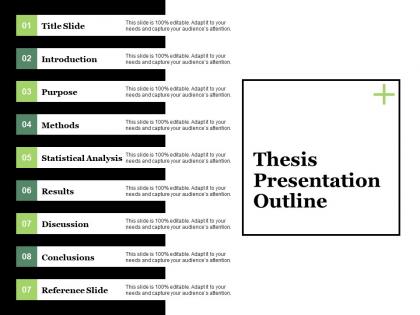
Thesis presentation outline ppt visual aids model




Try Before you Buy Download Free Sample Product
 Impress Your
 Audience
 100%
100% Editable
 Save Hours
 of Time


Filter out the data with our Thesis Presentation Outline Ppt Visual Aids Model. Gain access to the core facts.
People who downloaded this PowerPoint presentation also viewed the following :
Thesis presentation outline ppt visual aids model with all 5 slides:
Demarcate the boundaries with our Thesis Presentation Outline Ppt Visual Aids Model. Establish the ground rules for further action.
FAQs for Thesis presentation outline ppt
A thesis presentation outline should include an engaging introduction with research context, comprehensive literature review, clear methodology explanation, detailed findings presentation, thorough results analysis, and strong conclusion with implications. These components work together by establishing credibility, demonstrating systematic research approach, and showcasing academic rigor, with many graduate students finding that this structured format enhances audience engagement and examination success.
An effective thesis presentation introduction should establish context through background information, clearly state the research problem, present your thesis statement and objectives, outline your methodology, and preview your main findings. This structured approach engages your audience by providing a roadmap while building credibility, with many academic presenters finding that this comprehensive opening enhances audience understanding and sets clear expectations for the presentation's trajectory.
The literature review establishes theoretical foundation, demonstrates research gaps, contextualizes your study within existing scholarship, and validates your methodology choices within the thesis presentation outline. This critical section enables presenters to showcase comprehensive understanding, build credibility with academic audiences, and seamlessly transition into their original contributions, ultimately strengthening the overall argument and research positioning.
Research methodology should be presented with clear subsections covering research design, data collection methods, sampling strategies, analytical frameworks, and ethical considerations. This structured approach enables committee members and readers to quickly assess the study's rigor and validity, while demonstrating comprehensive planning that enhances credibility and facilitates smoother defense discussions.
Best practices for summarizing findings in a thesis presentation outline include highlighting key discoveries, organizing results by research questions, using visual data representations, connecting findings to hypotheses, and emphasizing practical implications. These approaches streamline complex research by presenting clear conclusions, supporting evidence, and actionable insights, with many academic institutions finding that structured summaries enhance audience comprehension and thesis defense success.
Visual aids enhance thesis presentations by supporting key arguments, simplifying complex data, maintaining audience engagement, and reinforcing critical findings through charts, graphs, diagrams, and infographics. These elements streamline comprehension by breaking down intricate research methodologies, statistical analyses, and theoretical frameworks, with many academic presenters finding that strategic visual integration ultimately delivers clearer communication and stronger audience retention.
Engaging thesis presentation strategies include interactive questioning, visual storytelling through compelling slides, strategic pauses for emphasis, real-world application examples, and audience participation opportunities. These approaches enhance comprehension by maintaining attention, encouraging active listening, and connecting complex research to practical implications, with many academic presenters finding that combining multiple engagement techniques ultimately delivers clearer knowledge transfer and more impactful presentations.
Research significance can be highlighted through dedicated problem statement sections, clear methodology justification, comprehensive literature gap analysis, and explicit contribution statements within your outline structure. Strategic placement in both introduction and conclusion sections, combined with visual impact slides showcasing real-world applications across academic and industry contexts, ensures your research value resonates with committee members, ultimately delivering compelling scholarly communication.
A thesis presentation typically runs 15-20 minutes, with introduction and background consuming 3-4 minutes, methodology requiring 2-3 minutes, results and discussion taking 8-10 minutes, and conclusions with future work needing 2-3 minutes. This strategic allocation enables comprehensive coverage while maintaining audience engagement, with many academic institutions finding that balanced time distribution between theoretical foundation and practical findings ultimately delivers clearer communication and stronger evaluation outcomes.
Handle post-presentation questions by listening carefully, acknowledging each question's value, and providing clear, concise responses while admitting knowledge limitations when necessary. Effective strategies include repeating questions for audience clarity, maintaining composure under pressure, and engaging constructively with feedback, with many successful candidates finding that thorough preparation for potential questions and viewing discussions as collaborative learning opportunities ultimately enhances their credibility and demonstrates scholarly maturity.
Common pitfalls include overloading slides with excessive text, lacking clear logical flow between sections, insufficient time allocation for each component, and neglecting to rehearse transitions between topics. These structural issues often result in rushed conclusions, confused audiences, and weakened defense performance, with many graduate students finding that strategic outline planning significantly enhances presentation clarity and academic success.
Tailoring a thesis presentation outline involves adjusting technical depth, terminology complexity, methodology emphasis, and contextual framing based on audience expertise and disciplinary background. For interdisciplinary committees, researchers streamline specialized jargon while enhancing broader implications, whereas expert panels enable deeper technical discussions, with many finding that audience-specific customization significantly improves comprehension and engagement outcomes.
A strong thesis conclusion includes a concise summary of key findings, explicit connections to research objectives, acknowledgment of study limitations, and clear implications for future research or practical applications. These elements work together by reinforcing the study's significance, demonstrating scholarly rigor, and providing actionable insights, with many academic institutions finding that structured conclusions ultimately enhance thesis defense success and research impact.
Effective linking requires strategic transitions that connect literature review to methodology, methodology to findings, and findings to conclusions through consistent themes, research questions, and logical progression. These connections involve summarizing key points before transitions, using bridging phrases like "building on this foundation" or "these findings demonstrate," and maintaining narrative flow, with many presenters finding that explicit roadmapping and recapping strengthens audience comprehension throughout.
When using presentation software for a thesis outline, consider visual hierarchy through consistent formatting, slide limits to maintain focus, and compatibility across devices for committee review. Software like PowerPoint or Google Slides enables clear section delineation, progress tracking, and collaborative feedback, while ensuring your outline remains adaptable for both presentation delivery and document conversion, ultimately streamlining your thesis development process.
-
Unique design & color.
-
Unique and attractive product design.
-
Nice template, and very helpful