Timeline For Project Schedule Management
Try Before you Buy Download Free Sample Product
Audience
Editable
of Time
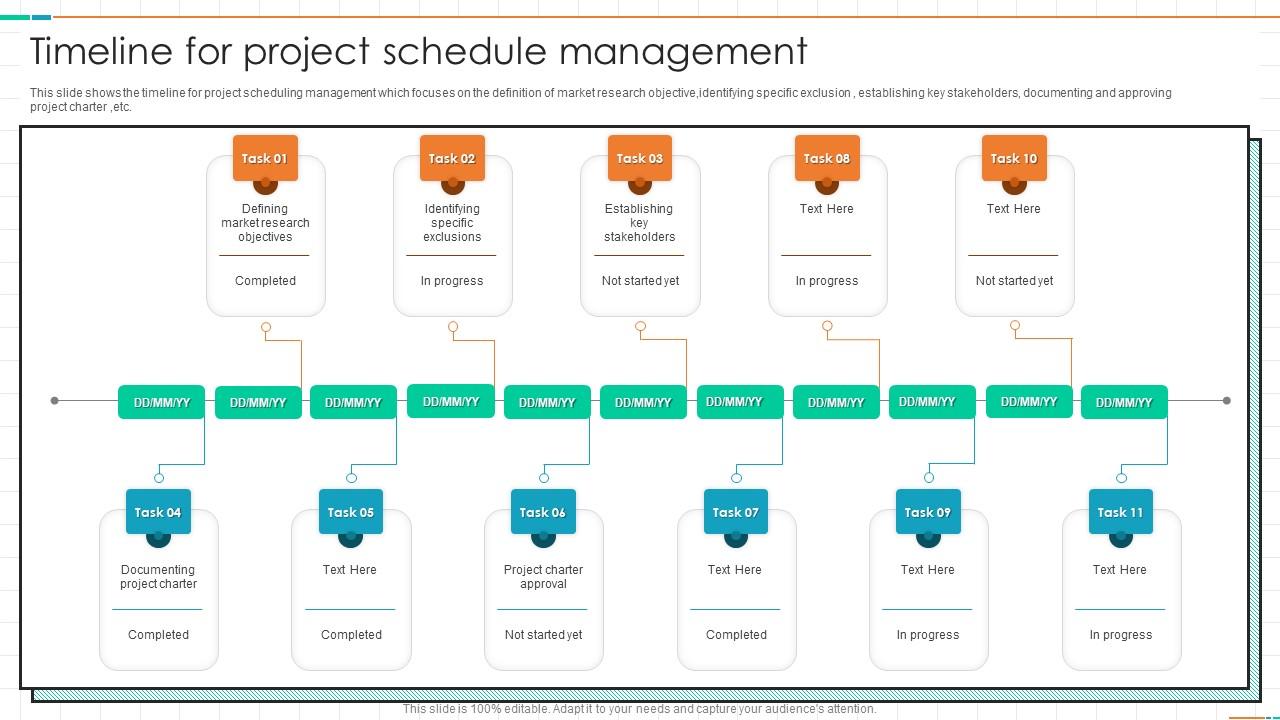
This slide shows the timeline for project scheduling management which focuses on the definition of market research objective,identifying specific exclusion , establishing key stakeholders, documenting and approving project charter ,etc.
People who downloaded this PowerPoint presentation also viewed the following :
Timeline For Project Schedule Management with all 6 slides:
Use our Timeline For Project Schedule Management to effectively help you save your valuable time. They are readymade to fit into any presentation structure.
FAQs for Timeline For
Key components of a project schedule management plan include schedule model development, activity sequencing methodology, duration estimating approaches, resource allocation frameworks, and progress monitoring protocols. These components work together by establishing clear timelines, defining task dependencies, and enabling proactive adjustments, with many organizations finding that comprehensive schedule management delivers improved project delivery rates and enhanced resource efficiency.
Project managers effectively balance time, scope, and resources by implementing strategic prioritization frameworks, establishing flexible milestone checkpoints, conducting regular stakeholder alignment reviews, and utilizing resource optimization tools. Through adaptive scheduling methodologies, organizations streamline project delivery while maintaining quality standards, with many finding that integrated planning approaches ultimately deliver faster completion times, reduced costs, and enhanced stakeholder satisfaction across complex initiatives.
Popular project schedule management tools include Microsoft Project, Asana, Trello, Monday.com, Smartsheet, and Gantt chart applications like GanttProject and TeamGantt. These platforms streamline project planning by enabling task assignments, deadline tracking, and resource allocation, with many organizations finding that integrated scheduling software reduces project delays by up to 30% while enhancing team collaboration and transparency.
Agile methodology transforms project scheduling by emphasizing iterative sprints, flexible timelines, and continuous adaptation, contrasting sharply with traditional methods' fixed milestones and rigid sequential phases. Through short development cycles and regular stakeholder feedback, organizations in software development, marketing, and product design achieve faster delivery, reduced risk, and enhanced responsiveness to changing requirements, ultimately delivering superior customer value.
Gantt charts serve as visual project roadmaps that display task sequences, dependencies, timelines, and resource allocation in an easy-to-understand format. These powerful scheduling tools enable project managers to track progress, identify potential bottlenecks, and communicate project status effectively to stakeholders, while many organizations find that Gantt charts significantly enhance coordination and deliver improved project outcomes.
Risks within project schedules can be identified through stakeholder consultations, historical data analysis, expert judgment, and regular schedule reviews to spot potential delays or resource conflicts. These proactive approaches enable project managers to develop contingency plans, build buffer time into critical paths, and implement risk mitigation strategies, ultimately delivering more predictable timelines and enhanced project success rates.
**INPUT**: What techniques can be employed to estimate task durations accurately? **OUTPUT**: Accurate task duration estimation techniques include expert judgment, analogous estimating, parametric modeling, three-point estimation, and bottom-up analysis. These methods enhance project scheduling by leveraging historical data, statistical modeling, and team expertise, with many organizations finding that combining multiple techniques, especially in construction and software development sectors, ultimately delivers more reliable timelines and improved resource allocation. [Word count: 58 words]
Dependencies significantly impact project timelines by creating sequential relationships where delays in predecessor tasks automatically extend successor activities, potentially causing cascading schedule shifts throughout the entire project. When critical path dependencies experience delays, projects face extended completion dates and resource conflicts, while non-critical dependencies may consume float time, ultimately reducing schedule flexibility and requiring proactive dependency management to maintain deliverable dates.
Best practices for communicating schedule changes include immediate notification, clear impact analysis, revised timelines with rationale, alternative solutions, and regular follow-up communications. These approaches streamline stakeholder alignment by maintaining transparency, enabling proactive decision-making, and preserving project credibility, with many organizations finding that structured change communication ultimately delivers stronger stakeholder relationships and enhanced project success rates.
Project managers can leverage historical data to enhance future scheduling by analyzing past project durations, identifying recurring bottlenecks, and understanding resource allocation patterns from completed initiatives. This data-driven approach enables more accurate time estimates, proactive risk mitigation, and strategic resource planning, with many organizations finding that historical insights reduce schedule overruns and deliver more predictable project outcomes.
Strategies include accelerating critical path activities, adding resources to bottleneck tasks, implementing parallel work streams, renegotiating scope or deadlines, and utilizing fast-tracking techniques. Through strategic resource reallocation and enhanced coordination, project managers can streamline workflows, minimize delays, and restore timeline momentum, with many organizations finding that proactive schedule recovery ultimately delivers improved efficiency and stakeholder confidence.
CPM uses fixed activity durations and focuses on identifying the longest path through project activities, while PERT employs probabilistic time estimates using optimistic, pessimistic, and most likely scenarios. CPM excels in construction and manufacturing projects where durations are predictable, whereas PERT proves valuable in research and development initiatives, ultimately enabling project managers to balance certainty with flexibility.
Key metrics include schedule variance (SV), schedule performance index (SPI), critical path duration, milestone completion rates, resource utilization percentages, and earned value metrics. These indicators enable project managers to identify delays early, optimize resource allocation, and maintain timeline adherence, with many organizations finding that proactive tracking ultimately delivers faster project completion and enhanced operational efficiency.
Stakeholder input can be effectively integrated through structured feedback sessions, requirement gathering workshops, milestone review meetings, and collaborative planning tools that capture diverse perspectives and constraints. By involving key stakeholders in timeline estimation, resource allocation discussions, and risk assessment phases, project managers ensure realistic schedules while building stakeholder buy-in and commitment to deliverable dates.
Common project schedule management challenges include unrealistic deadlines, scope creep, resource constraints, poor communication, and inadequate risk planning. These obstacles can be overcome by implementing robust planning frameworks, establishing clear stakeholder communication protocols, and utilizing project management software for real-time tracking, with many organizations finding that proactive scheduling and regular milestone reviews ultimately deliver improved project outcomes and enhanced operational efficiency.
-
“I really like the convenient operation and professionalism I saw on the SlideTeam website. I want to express my regards and appreciation to the team.”
-
Time saving slide with creative ideas. Help a lot in quick presentations..