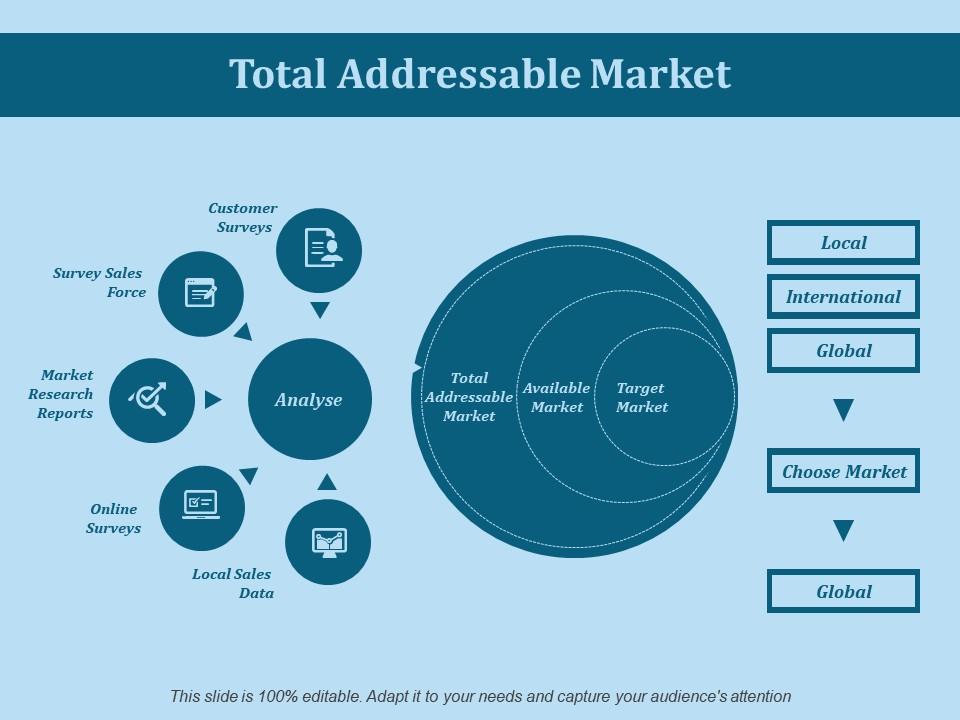
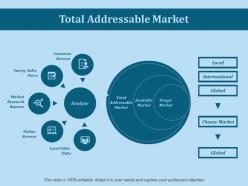
Total addressable market ppt styles gallery
Try Before you Buy Download Free Sample Product
Audience
Editable
of Time
Folks can't help but break out in a dance due to our Total Addressable Market Ppt Styles Gallery. They are bound to do the jig.
People who downloaded this PowerPoint presentation also viewed the following :
Total addressable market ppt styles gallery with all 5 slides:
Spray your thoughts with our Total Addressable Market Ppt Styles Gallery. Your audience will swoon with their heady aroma.
FAQs for Total addressable market
TAM is defined by the maximum revenue opportunity available if a company achieved 100% market share, calculated through comprehensive market sizing, customer segmentation, pricing analysis, geographic scope, and competitive landscape assessment. These factors combine to establish realistic market boundaries, with many organizations finding that accurate TAM calculations enable strategic resource allocation, investment prioritization, and growth forecasting, ultimately delivering competitive advantage in market positioning.
Businesses can accurately estimate their TAM through comprehensive market research including industry reports, competitor analysis, customer surveys, demographic studies, and regulatory data analysis. These research methods enable organizations to validate market size assumptions, identify underserved segments, and refine targeting strategies, with many companies finding that multi-source validation delivers more reliable projections and strategic competitive advantage.
TAM represents the entire market demand for a product or service, SAM narrows this to the segment your business can realistically serve, and SOM reflects the portion you can actually capture given competition and constraints. These metrics create a funnel approach, with many organizations finding that TAM guides strategic vision, SAM informs market entry decisions, and SOM drives realistic revenue forecasting and resource allocation.
Understanding TAM enables startups to demonstrate market size potential, revenue scalability, and growth trajectories to investors, making funding proposals more compelling and credible. Through comprehensive TAM analysis, startups can justify valuation expectations, secure appropriate funding rounds, and attract strategic investors, while investors gain clarity on market opportunity scope, ultimately facilitating better investment matching and funding success.
TAM fundamentally guides growth strategy by defining market boundaries, identifying expansion opportunities, prioritizing resource allocation, and establishing realistic revenue targets for strategic planning. This market sizing enables companies to make informed decisions about product development, geographic expansion, and competitive positioning, with many organizations finding that accurate TAM analysis drives more focused investment strategies and sustainable scaling initiatives.
Competitive analysis affects TAM calculation by identifying market share distribution, pricing strategies, customer segments, and growth barriers that influence addressable opportunities. Through competitor assessment, companies can refine their market sizing assumptions, adjust for realistic penetration rates, and identify underserved segments, ultimately delivering more accurate TAM estimates and strategic positioning advantages.
**INPUT**: What methodologies are most effective for calculating TAM in emerging markets? **OUTPUT**: Effective TAM calculation methodologies for emerging markets include bottom-up analysis using local data sources, top-down approaches with regional adjustments, value-based assessments, and proxy market comparisons from similar economies. These methods work by incorporating local purchasing patterns, infrastructure limitations, and regulatory environments, with many organizations finding that combining multiple approaches delivers more accurate market sizing and strategic insights for competitive positioning. [Word count: 60 words]
Businesses leverage TAM to enhance customer segmentation by identifying high-value market segments, prioritizing resource allocation across demographics, and mapping customer lifetime value against market size potential. Through TAM analysis, companies can focus on segments with greatest revenue opportunities, optimize marketing spend efficiency, and develop targeted products that capture larger market shares, ultimately delivering stronger competitive positioning.
Businesses can assess their TAM using market research platforms like IBISWorld and Statista, industry reports from McKinsey and Deloitte, government databases, competitor analysis tools, and customer surveys. These resources enable companies to gather comprehensive market data, validate assumptions through multiple sources, and build accurate TAM models, with many organizations finding that combining top-down and bottom-up approaches delivers the most reliable market size estimates.
Economic trends and market dynamics significantly reshape TAM by influencing consumer spending patterns, regulatory environments, technological adoption rates, and competitive landscapes across evolving industries. In sectors like renewable energy, fintech, and telehealth, economic shifts can expand addressable markets through increased demand and policy support, while market dynamics such as consolidation or disruption create new opportunities, with many organizations finding that adaptive strategies during economic transitions ultimately deliver sustainable competitive advantages.
Common TAM estimation pitfalls include overestimating market size without considering realistic penetration rates, using outdated data, ignoring geographic and demographic constraints, conflating TAM with SAM or SOM, and failing to account for competitive dynamics. These miscalculations can mislead strategic planning and investor presentations, with many startups finding that rigorous bottom-up analysis and conservative assumptions ultimately deliver more credible projections and sustainable growth strategies.
Understanding TAM enables M&A decision-makers to evaluate market size, growth potential, competitive positioning, and revenue opportunities across target companies and industries. Through comprehensive TAM analysis, acquirers can assess strategic fit, identify synergies, and validate acquisition premiums, while determining market expansion possibilities and competitive advantages, ultimately delivering more informed investment decisions and enhanced post-merger value creation in increasingly complex deal environments.
TAM influences marketing and sales strategies by determining market entry priorities, resource allocation decisions, customer segmentation approaches, and competitive positioning tactics. Through comprehensive TAM analysis, companies can identify high-potential market segments, optimize their sales force deployment, and develop targeted messaging that resonates with specific customer demographics, ultimately delivering more efficient customer acquisition and accelerated revenue growth.
Companies should adapt their TAM assessments by incorporating emerging technology impacts, expanding market definitions beyond traditional boundaries, and regularly updating assumptions about customer behavior and competitive landscapes. Through dynamic modeling and scenario planning, organizations can anticipate how innovations like AI, IoT, and digital transformation create new market segments while disrupting existing ones, ultimately enabling more accurate forecasting and strategic positioning in increasingly technology-driven markets.
Successful TAM analysis applications include Uber's expansion into food delivery and logistics, Netflix's global streaming strategy, and Airbnb's market entry decisions across different cities and countries. These companies leveraged TAM insights to identify high-potential markets, optimize resource allocation, and scale strategically, with many finding that comprehensive market sizing enabled faster international expansion and more effective competitive positioning in emerging segments.
No Reviews