Why we need corporate governance ppt powerpoint presentation layouts format
Try Before you Buy Download Free Sample Product
Audience
Editable
of Time
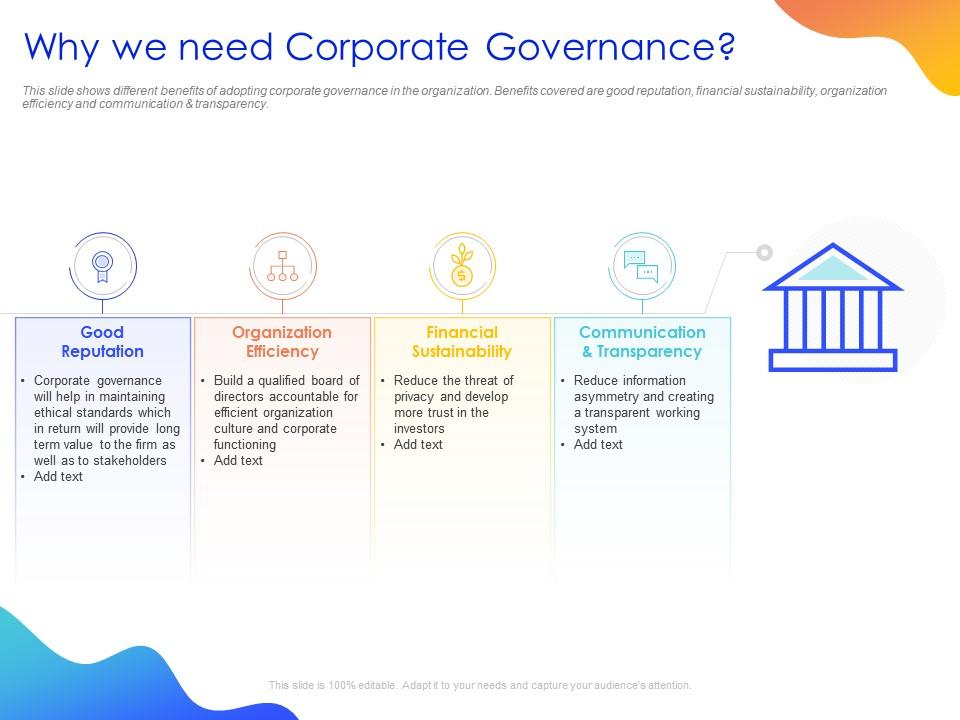
This slide shows different benefits of adopting corporate governance in the organization. Benefits covered are good reputation, financial sustainability, organization efficiency and communication and transparency.
People who downloaded this PowerPoint presentation also viewed the following :
Why we need corporate governance ppt powerpoint presentation layouts format with all 2 slides:
Use our Why We Need Corporate Governance Ppt Powerpoint Presentation Layouts Format to effectively help you save your valuable time. They are readymade to fit into any presentation structure.
FAQs for Why we need corporate governance ppt powerpoint
Key principles of effective corporate governance include board independence, transparent financial reporting, executive accountability, shareholder rights protection, and ethical business practices. These principles enhance organizational integrity by establishing clear oversight mechanisms, ensuring responsible decision-making, and building stakeholder trust, with many corporations finding that strong governance frameworks ultimately deliver sustainable growth and competitive advantage.
Corporate governance directly impacts financial performance by enhancing transparency, accountability, and strategic decision-making, which reduces operational risks and attracts investor confidence. Strong governance frameworks enable companies to streamline resource allocation, minimize compliance costs, and accelerate growth initiatives, with many organizations finding that robust oversight ultimately delivers improved profitability and sustained competitive advantage.
Board members serve as strategic overseers, fiduciary guardians, and accountability enforcers, ensuring management transparency, regulatory compliance, risk management, and stakeholder protection through independent oversight. These governance leaders guide executive compensation, audit processes, and strategic decision-making, with many corporations finding that engaged boards deliver enhanced investor confidence, operational integrity, and long-term competitive advantage.
Companies balance shareholder interests with stakeholder responsibilities through integrated governance frameworks, stakeholder engagement programs, sustainability reporting, and long-term value creation strategies. This approach enables organizations to deliver competitive returns while addressing employee welfare, environmental impact, and community needs, with many finding that stakeholder-focused policies ultimately enhance shareholder value and operational resilience.
Organizations commonly face challenges including resistance to transparency, inadequate board oversight, conflicting stakeholder interests, compliance complexity, and insufficient accountability mechanisms when implementing corporate governance. These obstacles often stem from entrenched practices, resource constraints, and competing priorities, with many companies finding that phased implementation and stakeholder engagement ultimately streamline adoption while delivering enhanced operational efficiency.
Corporate governance varies significantly across cultures and regions through different board structures, stakeholder priorities, regulatory frameworks, and decision-making processes. While Western models often emphasize shareholder value and independent directors, Asian markets frequently prioritize family ownership and consensus-building, with European systems balancing stakeholder capitalism and employee representation, ultimately delivering governance approaches that reflect local business traditions and regulatory environments.
Organizations can enhance governance transparency by implementing regular stakeholder reporting, establishing independent board committees, conducting open audit processes, maintaining clear communication channels, and publishing comprehensive annual governance reports. Through these practices, companies across sectors like banking and healthcare significantly improve stakeholder trust, regulatory compliance, and operational accountability, ultimately delivering stronger investor confidence and competitive market positioning.
Technology transforms corporate governance through digital board portals, automated compliance monitoring, real-time risk assessment tools, blockchain-based voting systems, and AI-powered audit processes. These innovations streamline decision-making by enhancing transparency, accelerating reporting cycles, and enabling remote participation, with many organizations finding that digital governance platforms ultimately deliver better oversight, reduced operational costs, and more agile strategic responses.
Regulatory changes significantly reshape corporate governance frameworks by mandating enhanced transparency, stricter compliance protocols, updated board structures, and more robust risk management systems. These evolving requirements drive organizations across industries like banking, healthcare, and manufacturing to strengthen oversight mechanisms, implement advanced monitoring technologies, and establish clearer accountability structures, ultimately delivering improved stakeholder confidence and competitive market positioning.
Board diversity enhances governance outcomes by bringing varied perspectives, experiences, and expertise to strategic decision-making, risk assessment, and stakeholder representation. Through diverse leadership, organizations achieve more comprehensive oversight, better risk identification, and stronger community connections, with companies featuring diverse boards consistently demonstrating improved financial performance and reduced governance-related controversies.
Ethics serves as the foundational framework guiding corporate governance decisions, ensuring transparency, accountability, and stakeholder trust through established moral principles and integrity standards. These ethical guidelines enable organizations to navigate complex business challenges, minimize regulatory risks, and build sustainable competitive advantage, with many corporations finding that strong ethical governance ultimately delivers enhanced reputation, investor confidence, and long-term value creation.
External auditors strengthen corporate governance by providing independent verification of financial statements, assessing internal controls, and ensuring regulatory compliance through objective evaluation processes. These independent assessments enhance investor confidence, improve transparency across public companies and large organizations, while ultimately delivering greater accountability and reduced financial risk for stakeholders and boards.
Corporate fraud prevention mechanisms include robust internal controls, regular audits, whistleblower protection programs, segregation of duties, and advanced analytics monitoring. These safeguards work by creating transparency, detecting anomalies, and establishing accountability throughout organizations, with many financial institutions and large corporations finding that strategic combinations of technology and oversight ultimately deliver enhanced compliance and significantly reduced fraud risk.
Whistleblower policies strengthen corporate governance by encouraging transparent reporting of misconduct, creating accountability mechanisms, and establishing protective frameworks for employees who report violations. These policies enable organizations to identify risks early, address compliance issues proactively, and maintain stakeholder trust, with many companies finding that robust whistleblower programs ultimately enhance operational integrity and regulatory compliance.
Recent corporate governance failures reveal critical lessons including inadequate board oversight, lack of transparency in financial reporting, weak internal controls, insufficient risk management frameworks, and poor stakeholder communication. These failures demonstrate that organizations must strengthen independent board leadership, enhance audit processes, and implement robust compliance systems, with many companies finding that proactive governance reforms ultimately deliver improved investor confidence, operational resilience, and sustainable competitive advantage.
No Reviews