

Workplace Etiquette Definition Significance Consequences And Case Study Training Ppt




Try Before you Buy Download Free Sample Product
 Impress Your
 Audience
 100%
100% Editable
 Save Hours
 of Time


These slides cover the importance of etiquette in the workplace, such as enhancing workplace relations, enabling business growth, and inculcating kindness and confidence. It also includes information on the adverse effect of not following business etiquette, which leads to anger, stress, and strained employee relationships.
People who downloaded this PowerPoint presentation also viewed the following :
Content of this Powerpoint Presentation
Slide 1
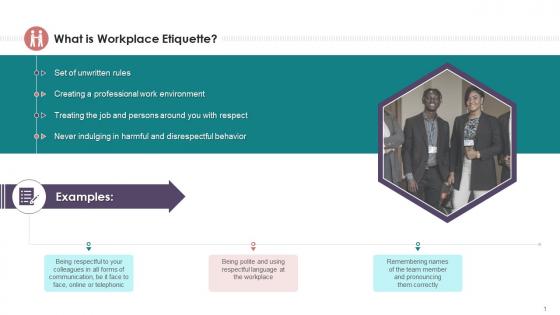
This slide explains the meaning and examples of workplace etiquette.
Slide 2
This slide explains the reasons why an organization should give importance to workplace etiquette in the business culture. It also states that incorporating good culture leads to better workplace relations, enhanced impression of the organization, promotes business growth, and kindness and confidence in the employees.
Instructor’s Notes:
- Enhances Workplace Relations: Following etiquettes will help you eliminate distractions associated with office culture, such as gossips, forming groups or personality clashes. Etiquette make sure that the employee relations at the workplace stay professional, and they do not mix their personal and professional life. Individuals should make sure that their personal issues or feelings do not affect their workplace behavior
- Enriches Impression: In business, Individuals are primarily judged based on their social and professional behavior. They should know how to greet, communicate, and respect people at the workplace or come across as unprofessional. The more the individuals deal with people, the more they will learn how things happen at the workplace and the appropriate etiquette. Before communicating with someone in business, you should look confident and make them feel easy
- Promotes Business Growth: Good knowledge about business etiquette can open up multiple professional opportunities for individuals. They will be judged on their skills, confidence, behavior, and how they treat others present at the workplace. An individual who stays calm, confident and comfortable in diverse situations will gain trust more quickly than someone who get anxious
- Enhances Kindness and Confidence: When an individual gets a basic understanding of workplace manners and its impact on the professional and personal life, he/she becomes more confident. Confidence and kindness will not only polish his behavior skills but also help build good relationships at the workplace
Slide 3
This slide covers the consequences if business etiquette is not followed at the workplace. It might cause anger, stress, and strained relationships amongst employees.
Instructor’s Notes:
- Anger or Irritation: When an employee is rude or irritated at the workplace, he/she starts ignoring the basic rules of social and workplace etiquette. Such behavior might affect his/her own work and that of co-workers
- Stress: Another consequence of a bad environment at the workplace is stress. Stressed employees are less productive in their daily work than the happy employees
- Strained Relationships: Strained relationships at the workplace lower productivity levels of employees and creates a negative image of the organization and its culture
Slide 4
This slide mentions a case study on workplace ethics.
Workplace Etiquette Definition Significance Consequences And Case Study Training Ppt with all 20 slides:
Use our Workplace Etiquette Definition Significance Consequences And Case Study Training Ppt to effectively help you save your valuable time. They are readymade to fit into any presentation structure.











FAQs for Workplace Etiquette Definition Significance Consequences And Case
Professional communication encompasses clear messaging, active listening, respectful tone, appropriate channels, and timely responses. These elements streamline collaboration by reducing misunderstandings, enhancing team productivity, and building stronger client relationships, with many organizations finding that structured communication protocols ultimately deliver improved project outcomes and competitive advantage in increasingly complex business environments.
Maintaining respectful tone during difficult workplace conversations involves active listening, using "I" statements instead of accusations, acknowledging different perspectives, and focusing on solutions rather than blame. Through clear communication and emotional regulation, professionals can navigate challenging discussions while preserving relationships, ultimately fostering collaborative problem-solving and strengthening team dynamics in increasingly complex organizational environments.
Body language significantly influences workplace interactions by conveying confidence, engagement, and professionalism through posture, eye contact, facial expressions, and gestures. These nonverbal cues enhance communication effectiveness, build trust with colleagues and clients, and support career advancement, with many organizations finding that employees with strong body language awareness create more positive team dynamics and deliver better client experiences.
Employees should handle coworker conflicts through direct, respectful communication, active listening, focusing on specific behaviors rather than personalities, and seeking common ground or compromise when possible. Professional mediation through HR or supervisors becomes valuable when direct resolution fails, with many organizations finding that structured conflict resolution processes ultimately strengthen team dynamics, improve collaboration, and maintain productive workplace relationships.
Professional email etiquette includes clear subject lines, concise messaging, appropriate greetings and closings, timely responses, and proper formatting with correct grammar. These practices streamline workplace communication by reducing misunderstandings, enhancing professional relationships, and improving operational efficiency, with many organizations finding that structured email protocols ultimately deliver faster decision-making and stronger client interactions.
Navigating cultural differences in workplace etiquette requires observing communication styles, understanding hierarchy expectations, respecting meeting protocols, and adapting to feedback approaches across diverse teams. Organizations increasingly find that cross-cultural training, mentorship programs, and inclusive policies streamline collaboration, enhance team dynamics, and ultimately deliver stronger business outcomes in global markets.
Punctuality and time management demonstrate respect for colleagues' time, enhance productivity, and build professional credibility through consistent reliability. These practices streamline workflows, reduce project delays, and strengthen team collaboration, with many organizations finding that employees who prioritize timeliness ultimately deliver superior results and earn greater advancement opportunities.
Effective feedback should be specific, timely, and constructive, focusing on behaviors rather than personalities, while recipients should listen actively, ask clarifying questions, and view input as growth opportunities. This approach creates psychological safety and continuous improvement, with many organizations finding that regular, respectful feedback exchanges enhance team performance, reduce conflicts, and ultimately build stronger collaborative relationships that drive business success.
Appropriate workplace celebrations for personal milestones include brief team acknowledgments during meetings, shared treats or lunch gatherings, small desk decorations, and optional group cards or gifts. These celebrations enhance team bonding and workplace culture while maintaining professionalism, with many organizations finding that modest, inclusive recognition fosters employee engagement and strengthens relationships without disrupting productivity.
Creating an inclusive environment involves establishing clear communication guidelines, promoting active listening practices, encouraging diverse viewpoint sharing, implementing bias-awareness training, and fostering psychological safety for all team members. These approaches streamline collaboration by reducing misunderstandings, enhancing creative problem-solving, and building stronger team dynamics, with many organizations finding that inclusive practices ultimately deliver improved employee retention, innovation, and competitive advantage in increasingly diverse markets.
Workplace dress codes vary by industry, company culture, and client interaction levels, ranging from formal business attire in banking and law firms to business casual in tech companies and creative casual in startups. These guidelines help organizations maintain professional standards, enhance brand image, and ensure employee comfort, with many companies increasingly adopting flexible dress policies that balance professionalism with employee satisfaction and productivity.
Personal phone calls and texting should be minimized during work hours, reserved for emergencies or breaks, and handled discreetly when necessary. Most organizations find that establishing clear digital boundaries enhances workplace productivity, professional relationships, and team focus, while brief personal communications during lunch or designated break times maintain work-life balance without compromising operational efficiency.
Social media impacts workplace professionalism by blurring personal and professional boundaries, creating new communication channels, and requiring updated behavioral standards across digital platforms. While it enables enhanced networking, brand building, and team collaboration, it also presents challenges around privacy, appropriate content sharing, and maintaining consistent professional representation, with many organizations finding that clear social media policies help employees navigate this increasingly connected landscape effectively.
Employees can show appreciation through personalized thank-you notes, public recognition during meetings, celebrating achievements with small gestures, offering specific feedback about contributions, and nominating colleagues for awards or opportunities. These approaches enhance workplace morale, strengthen team relationships, and foster collaborative environments, with many organizations finding that consistent peer recognition significantly improves employee engagement and retention rates.
Effective work-life balance strategies include setting clear boundaries between professional and personal time, prioritizing tasks through strategic scheduling, communicating availability expectations with colleagues, and leveraging technology to streamline workflows. Many organizations increasingly recognize that employees who maintain structured boundaries while respecting collaborative needs deliver higher productivity and enhanced team performance, ultimately creating sustainable workplace cultures.
-
Out of the box and creative design.
-
Making a presentation has never been this easy for me. Thank you SlideTeam for offering a splendid template library.