


Workplace Etiquette In Business Communication Training Module On Business Communication Edu Ppt




Try Before you Buy Download Free Sample Product
 Impress Your
 Audience
 100%
100% Editable
 Save Hours
 of Time


This PowerPoint training deck in-depth covers the concept of Workplace Etiquette in Business Communication. It includes slides on the definition and significance of workplace etiquette. Also, it covers the consequences of lack of workplace etiquette along with the multiple principles of workplace etiquette. The PPT module also contains key takeaways, discussion questions, MCQs, case studies, and memes to make the training session interactive. Further, it includes additional slides on about us, vision, mission, goal, 30-60-90 days plan, timeline, roadmap, training completion certificate, energizer activities, detailed client proposal, and training assessment form.
People who downloaded this PowerPoint presentation also viewed the following :
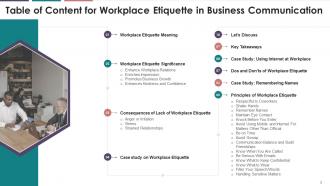
Content of this Powerpoint Presentation
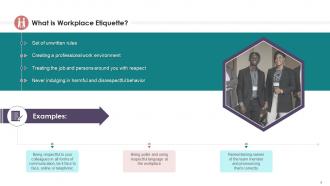
Slide 4
This slide explains the meaning and examples of
workplace etiquette.
Slide 5
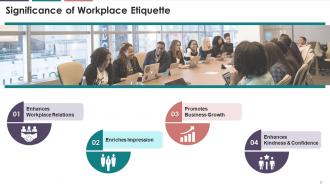
This slide explains the reasons why an organization
should give importance to workplace etiquette in the business culture. It also
states that incorporating good culture leads to better workplace relations,
enhanced impression of the organization, promotes business growth, and kindness
and confidence in the employees.
Instructor’s Notes:
·
Enhances Workplace Relations: Following
etiquette will help you eliminate distractions associated with office culture,
such as gossips, forming groups or personality clashes. Etiquette make sure
that the employee relations at the workplace stay professional, and they do not
mix their personal and professional life. Individuals should make sure that
their personal issues or feelings do not affect their workplace behavior
·
Enriches Impression: In
business, Individuals are primarily judged based on their social and
professional behavior. They should know how to greet, communicate, and respect
people at the workplace or come across as unprofessional. The more the
individuals deal with people, the more they will learn how things happen at the
workplace and the appropriate etiquette. Before communicating with someone in
business, you should look confident and make them feel easy
·
Promotes Business Growth: Good
knowledge about business etiquette can open up multiple professional
opportunities for individuals. They will be judged on their skills, confidence,
behavior, and how they treat others present at the workplace. An individual who
stays calm, confident and comfortable in diverse situations will gain trust
more quickly than someone who get anxious
·
Enhances Kindness and Confidence: When
an individual gets a basic understanding of workplace manners and its impact on
the professional and personal life, he/she becomes more confident. Confidence
and kindness will not only polish his behavior skills but also help build good
relationships at the workplace
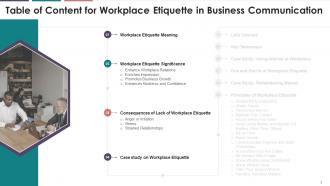
Slide 6
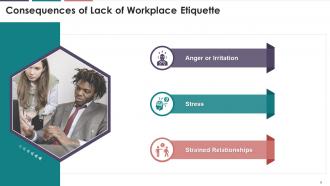
This slide covers the consequences if business
etiquette is not followed at the workplace. It might cause anger, stress, and
strained relationships amongst employees.
Instructor’s Notes:
·
Anger or Irritation: When an employee is rude
or irritated at the workplace, he/she starts ignoring the basic rules of social
and workplace etiquette. Such behavior might affect his/her own work and that
of co-workers
·
Stress: Another
consequence of a bad environment at the workplace is stress. Stressed employees
are less productive in their daily work than the happy employees
·
Strained Relationships: Strained
relationships at the workplace lower productivity levels of employees and
creates a negative image of the organization and its culture
Slide 7
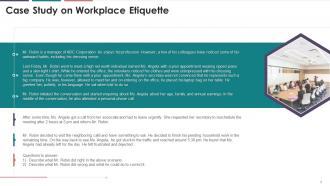
This slide mentions a case study on workplace ethics.
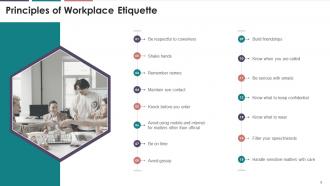
Slide 9
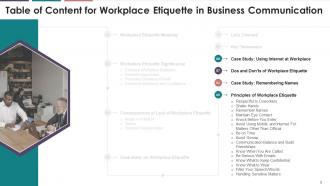
This slide covers the general principles that should be
followed as a part of workplace etiquette. The person should respect the
co-workers, maintain eye contact, know what to wear, know what to say, greet
others properly by shaking hands, remember names, knock before entering
senior’s cabin, etc.
Instructor’s Notes:
·
Be respectful to co-workers: An
individual should treat all colleagues with due respect. A person should learn
to acknowledge other people’s religious views, political opinions, and sexual
preferences.
·
Shake hands: Giving
someone a firm handshake when you meet them is a sign of respect. A person
should make sure that the grip should not be too strong to cause pain, but a
gentle handshake to show confidence and respect is enough
·
Remember names: Whenever
we meet someone, exchanging names is one of the first things done. A person
should make sure that he/she gives his/her full name rather than the nickname.
The person should also make sure that he remember the names and pronounces them
correctly
·
Maintain eye contact: The
person should make constant eye contact with the members throughout the
conversation, and especially while greeting, as it reflects trust and interest
·
Knock before you enter: A
person should always knock on the door before entering, even when the other
person is aware of the arrival. It looks rude and disrespectful when you walk
into someone’s cabin without announcing or taking permission
·
Avoid using mobile and internet for
matters other than official: An employee should make
sure that they do not use their mobile phone unnecessarily, especially when at
the office. They should use it only for official purposes or when any urgency
occurs. Also, they should make sure that they use the internet only for
official matters, and do not surf any unofficial sites during office hours
·
Be on time: The
person should consider reaching the workplace before time, take a few minutes
to get ready, and avoid causing any delay for the scheduled meeting/event. In
case of online communication, he should make sure that he/she joins the meeting
at least 2-3 minutes before the scheduled time
·
Avoid gossip: Whether
you are new to an organization, or have been there for years, talking about
co-works or other members is considered unprofessional and should be avoided
·
Build friendships: When
a person follows proper workplace etiquette, it becomes easier for him/her to
connect with other employees of the organization. He/ she then finds working at
the office more comforting and gains more interest in the work
·
Know when you are called: Whenever
you find two persons communicating, do not interrupt unless you are called
upon. You can look at them with a smile on your face and pass by. If they want
you to contribute to the conversation, they will call you. Also, when you are
in a meeting, speak only when you are asked to or when you think is the right
time to speak. Your viewpoint will be respected only when given on the right
time and place
·
Be serious with emails: An
employee should learn how to draft, send and receive an email, especially at
the workplace. Before sending the email, he/she should read it aloud 2-3 times
to make sure that it is grammatically correct, clearly drafted, and without any
spelling errors
·
Know what to keep confidential: An
employee should properly read the confidentiality agreement while joining the
workplace. They should make sure that they maintain confidentiality as demanded
by the organization and do not disrespect any of the rules
·
Know what to wear: An
individual should dress up professionally at the workplace. If the workplace
has any specific dress code, it is always favorable for the employees to stick
to it
·
Filter your speech/words: Every
workplace has members with different aspirations, attitudes, and personalities.
Every member working for a common purpose but with a different perspective and
working styles leads to clashes. The easiest way to avoid conflicts at the
workplace is to measure and filter your words before they are delivered. A
person should ensure that his/her words are not offensive and personal
·
Handling sensitive matters: An
employee should know how to handle sensitive matters at the workplace. He
should listen to all the members involved, understand them critically, and then
take any decision. They should make sure that their decision does not hurt the
sentiments of any person
Slide 10
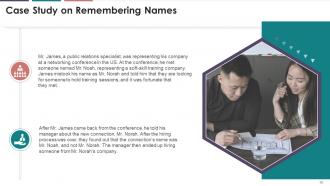
This slide covers a case study highlighting the
importance of remembering names.
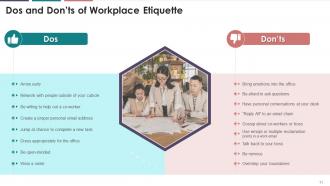
Slide 11
This slide explains various things that should be
performed (Dos) and avoided (Don’ts) at a workplace.
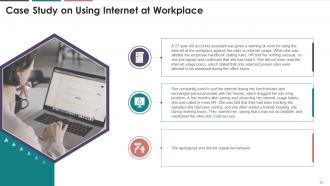
Slide 12
This slide highlights the importance of being careful
at workplace and understanding the terms and conditions of work before joining.
Slide 14
This slide covers the main considerations for workplace
etiquette.
Slide 28 to 39
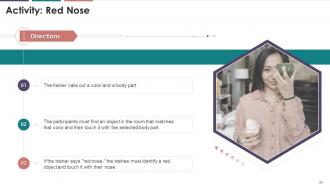
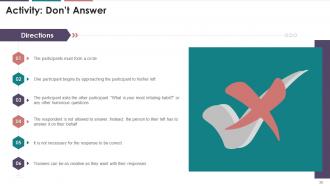
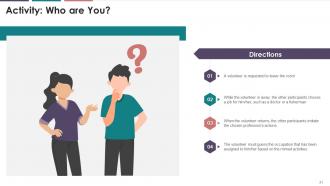
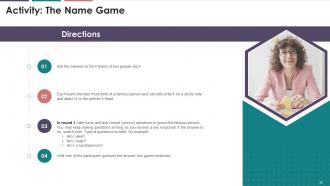
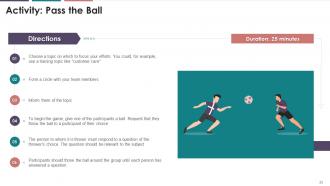
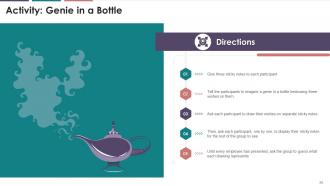
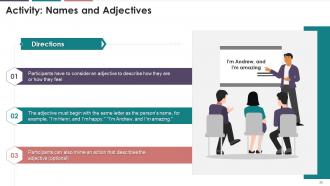
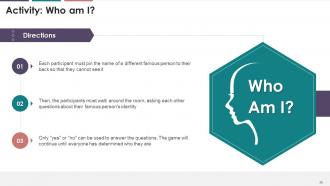
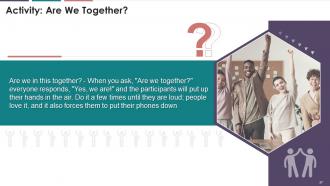
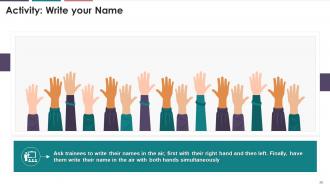
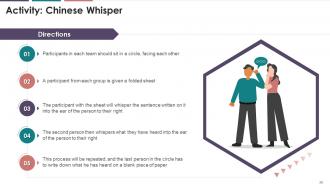
These slides depict energizer activities to engage the
audience of the training session.
Slide 42
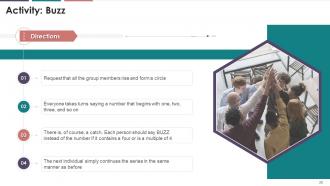
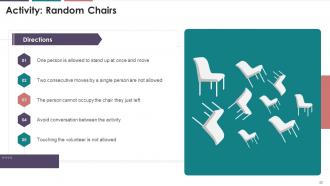
The above slide displays the activity for the team
members found less energetic and enthusiastic. It will ensure an increase in
energy levels and the productivity of employees at the workplace.
Instructor's Notes:
·
Multiple chairs are to be adjusted in the
empty and spacious room in a random order
·
The chairs should be put in a manner that
every chair points in a different direction and all the chairs are occupied
Now,
·
Ask for a volunteer from the batch. (Batch
may include a maximum of 15 people for a regular size room)
·
The volunteer is supposed to walk slowly
and approach his/her empty chair and sit down. If the chair is already
occupied, then he/she is expected to occupy the other/next alternative empty
chair available
·
All other members will try to stop the
person from approaching the relevant chair
Strategy Formulation:
·
Multiple teams can be made to conduct the
activity
·
Each team can be allotted 2 minutes for
planning
·
Each round is to be reviewed for the
outcomes achieved from the activity
·
Each team should have a different
volunteer, preferably the person with the lowest energy levels from the batch
·
The volunteer should move cautiously so as
to not bump into any of the props or persons in the room
Activity Review/Outcomes:
·
How did the activity influence the teamwork
and engagement skills of all the participants?
·
How was the experience while planning and
working with 15-20 members at a time?
·
Was everybody clear about the purpose and
conduct of the respective activity?
·
Did you observe any flaws that you wish to
improve? Or any other instructions you want to include to make the activity
conduct easier?
Slide 44
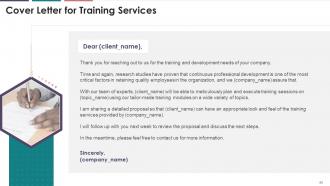
This slide highlights the cover letter for the training
proposal. It includes details regarding what the company providing corporate
training can accomplish for the client.
Slide 47
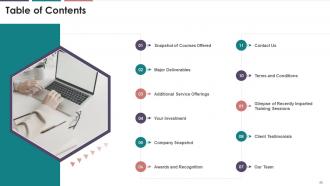
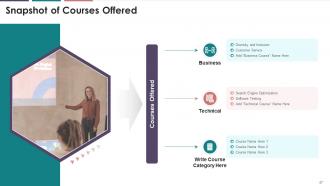
The purpose of this slide is to showcase the multiple
types of courses offered by the training company.
Slide 49
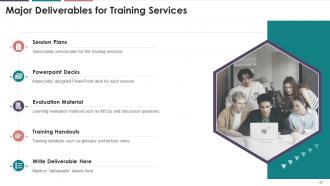
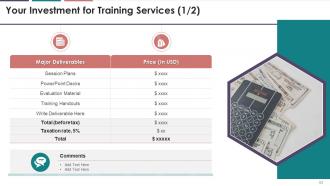
This slide indicates the major deliverables that the
corporate training firm will provide to the client. The key deliverables
highlighted are session plans, PowerPoint deck, evaluation material, and
training handouts.
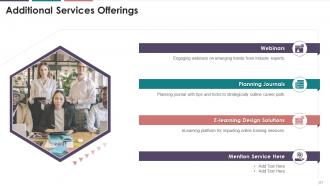
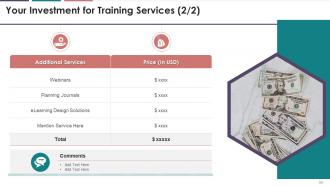
Slide 51
This slide represents the multiple additional services
offered by the training firm to the client, such as webinars, planning
journals, and e-learning design solutions.
Slide 53
This slide tabulates the major deliverables offered by
the training company to the client along with their associated costs.
Slide 54
The purpose of this slide is to highlight the multiple
additional services offered by the training firm along with their cost details.
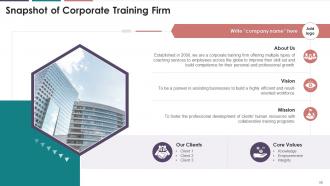
Slide 56
This slide provides an overview of the corporate
training firm's vision and mission statements, core values, and key clients.
Slide 58
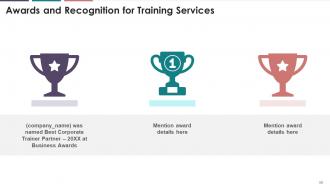
This slide highlights the major awards and recognition
won by the training firm for their exceptional service to clients.
Slide 60
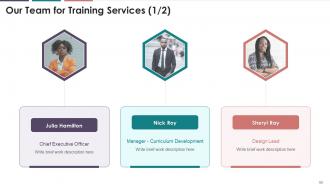
The slide provides information regarding the team
members that would be providing the training services to the client. It
includes details of the trainer and their respective designations
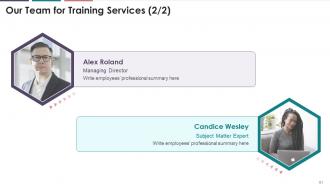
Slide 61
The slide provides information regarding the team
members that would be providing the training services to the client. It
includes details of the employees names and their respective designations.
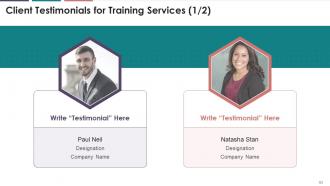
Slide 63
This slide provides information pertaining to testimonials
given by satisfied clients of the training firm.
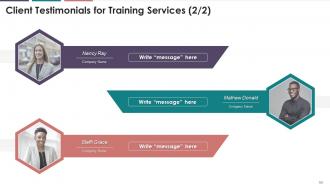
Slide 64
This slide highlights the testimonials from multiple
satisfied clients of the training firm providing information regarding
congratulatory messages, client name, and company details.
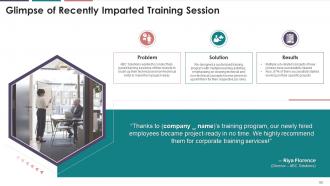
Slide 66
This slide showcases the case study for the training
proposal. It includes information regarding the problem faced by the client and
solutions offered by the training firm. It also covers details of the results
and client testimonial.
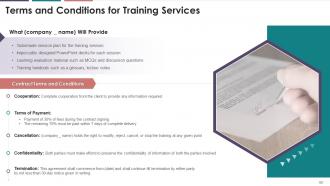
Slide 68
This slide provides information regarding the contract
terms and conditions of the training proposal. It also includes details of
deliverables that the training company will provide to the client.
Slide 70
The purpose of this slide is to provide the contact
information of the corporate training firm. It includes the firm’s official
address, contact number, and email address.
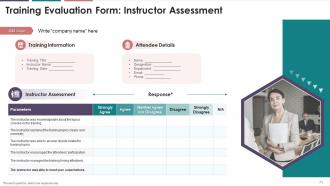
Slide 71
This slide highlights the training evaluation form for
instructor assessment. It also includes sections to fill details of training information
and attendee details.
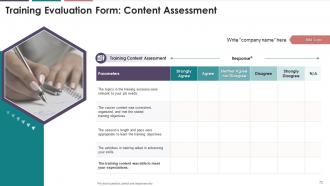
Slide 72
This slide showcases the questions for the assessment
of the training content by the attendees.
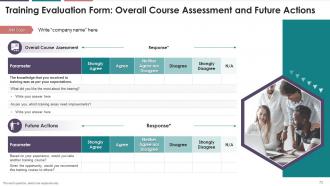
Slide 73
The slide indicates the evaluation form for course
assessment. It also includes questions pertaining to the future actions of the
attendees.
Workplace Etiquette In Business Communication Training Module On Business Communication Edu Ppt with all 78 slides:
Use our Workplace Etiquette In Business Communication Training Module On Business Communication Edu Ppt to effectively help you save your valuable time. They are readymade to fit into any presentation structure.






FAQs for Workplace Etiquette In Business Communication Training Module On Business
Honestly? Just be clear and don't be a jerk about it. So much workplace BS happens because people write confusing emails - like, just say what you mean! Match your tone to who you're talking to though. Your work bestie gets different energy than the big boss, obviously. Listen as much as you talk too. And please actually respond when people message you (I'm terrible at this but trying lol). Maybe start small - I've been working on better subject lines lately instead of just "hey" for everything.
Okay so the main thing is stick to the actual problem, not attacking the person. Like instead of "you always do this," try "I get stressed when this happens." Sounds cheesy but it actually works lol. Really listen to their side too - sometimes there's stuff you don't know about. Stay chill even if they're getting worked up. Taking a break is totally fine if things get intense. Oh and definitely write down what was discussed afterward, especially if it's serious. HR exists for a reason if you need backup.
Honestly, body language is everything at work. Like, you could be saying the smartest thing ever, but if you're slouched with your arms crossed, nobody's buying it. I've watched so many meetings where someone's posture just killed their credibility before they even finished talking. Eye contact matters too - makes you seem way more trustworthy. Oh, and leaning in slightly when someone's speaking? Game changer. Next time you're in a meeting, check out how everyone's sitting. Then mirror the engaged people, not the ones who look like they'd rather be anywhere else.
Honestly, the hardest part is not getting defensive when someone's criticizing you - but just listen and ask questions if you're confused. Thank them even if it sucks to hear. For giving feedback, be super specific about what they actually did, not their personality. Like "when you interrupted me three times in the meeting, I couldn't finish my point" instead of "you're always rude." Don't let stuff build up either or you'll explode later. Handle it quickly but privately. Oh and definitely check back in a week or so to see how it's going. Makes the whole thing feel less attacky.
Oh man, where do I start? First off, PLEASE mute yourself when you're not talking - nobody needs to hear your dog going crazy or your kids having a meltdown. Your lighting probably sucks too if you look like a vampire on screen. Don't obviously multitask either, like we can all see you scrolling Instagram. Test your camera beforehand because waiting around while someone figures out their tech is the worst. Being late without warning is just rude. And maybe don't munch on chips during important calls? Honestly, just pretend it's a real meeting and you'll be good.
Oh man, this stuff is wild once you start paying attention to it. Like, what feels polite to you might come across as rude to someone else - or way too wishy-washy. I had this coworker who thought I was being aggressive because I made eye contact during meetings, but in my family that's just how you show you're listening. Some places are super formal with titles and hierarchy, others are all first names and casual vibes. Don't even get me started on punctuality expectations! Honestly, just watch how people interact first, then ask if you're confused.
Okay so first thing - make your subject lines actually useful so people know what you want. Professional greetings matter too, save the casual stuff for friends. Get to your point fast because honestly everyone's drowning in emails already. Try responding within a day or two, but if you can't just shoot back a quick "I'll get back to you by Friday" thing. Always proofread before sending - typos just look bad. Oh and please think before hitting reply all. Nobody needs to see every single response, especially about random stuff like lunch orders.
Just wait for them to breathe, then say something like "can I jump in here?" or "I'd love to add something." Lean forward a bit or catch their eye - body language works. Honestly timing is everything with this stuff, which is annoying but true. If it's actually urgent, go with "sorry to interrupt but..." and explain real quick why it can't wait. For meetings I just raise my hand like we're back in school lol. Or use chat if it's virtual. Being direct but nice about it usually works better than trying to squeeze yourself in. Most people get it when you're upfront about wanting to say something.
Being on time and showing up consistently is honestly one of the easiest ways to look professional. Your coworkers and boss will trust you more when they know you're reliable. Nobody wants to be that person sneaking into meetings five minutes late - it's just awkward for everyone. It also affects how well you work with others since people need to know they can actually count on you for deadlines. I learned this the hard way at my last job. If you're having trouble with this, try setting multiple alarms or adding buffer time to your calendar for travel. Those little tricks actually work.
Honestly just dress one notch above whatever everyone else is doing. If your office is business casual, go for the nicer end of that. I used to stress about this constantly lol. Look at people who are doing well at your level or higher - what are they wearing? Then adapt that to fit your style and what you can afford. Good fit and being well-groomed matters way more than expensive brands, trust me. Better to be slightly overdressed than under. Pick one thing in your current wardrobe to upgrade first and work from there.
Okay so first thing - don't touch your phone and wait for the host to start eating. Pretty basic stuff but people mess this up all the time. Order something that won't make you look like a caveman trying to eat it (learned this the hard way with ribs once). Talk to everyone, not just the big shots - you never know who knows who. At networking events, firm handshake obviously, but honestly just listen more than you ramble. The real work happens in your follow-up emails within 48 hours anyway.
Honestly, just use people's actual names and pronouns - sounds basic but it matters way more than you'd think. When someone shares a different perspective, actually listen instead of planning what you'll say next. Don't assume stuff about their background or what they can handle based on appearance. Oh, and make sure you're not accidentally leaving people out of conversations or after-work stuff. We all mess this up sometimes (I definitely have), but just own it when you do and try harder next time. Really comes down to seeing everyone as individuals, you know?
Honestly, your social media is pretty much part of your work reputation now. Colleagues and bosses can see your posts, likes, all of it - privacy settings don't always work and people love taking screenshots. I'd skip posting work drama or anything too controversial. My rule? Don't post what you wouldn't say in front of your CEO. Maybe clean up your profiles once in a while too. Oh, and Google yourself sometime - you'd be surprised what shows up when employers search for you.
Honestly, start with basic written guidelines covering communication, dress codes, meeting stuff. Make etiquette part of onboarding so new people learn it right away. Interactive workshops work way better than boring lectures - trust me on this one. Management has to actually follow the rules though, otherwise it's pointless. Oh, and pair new hires with experienced employees who can show them the ropes. Those unwritten workplace rules are sometimes more important than the official ones anyway.
Honestly, just be the person you want them to be. Show up on time, actually listen when people talk, treat everyone decent no matter what their job title is. People notice weird stuff too - like if you're always on your phone during conversations, they'll do the same thing. Say please and thank you (sounds basic but half the managers I know forget this). Give credit when someone does good work. Don't let conflicts fester, but handle them without being a dick about it. Pick whatever your team sucks at most and start there.
-
Well-designed and informative templates. Absolutely brilliant!
-
“Thank you to the SlideTeam. Your presentations look really skillful and have made my life so much easier.”