Workplace Safety Dashboard To Monitor Incidents Best Practices For Workplace Security

Rating:
100%
Workplace Safety Dashboard To Monitor Incidents Best Practices For Workplace Security
Slide 1 of 7
Favourites Favourites

Try Before you Buy Download Free Sample Product

Audience Impress Your
Audience
Editable 100%
Editable
Time Save Hours
of Time
The Biggest Sale is ending soon in
0
0
:
0
0
:
0
0
Rating:
100%
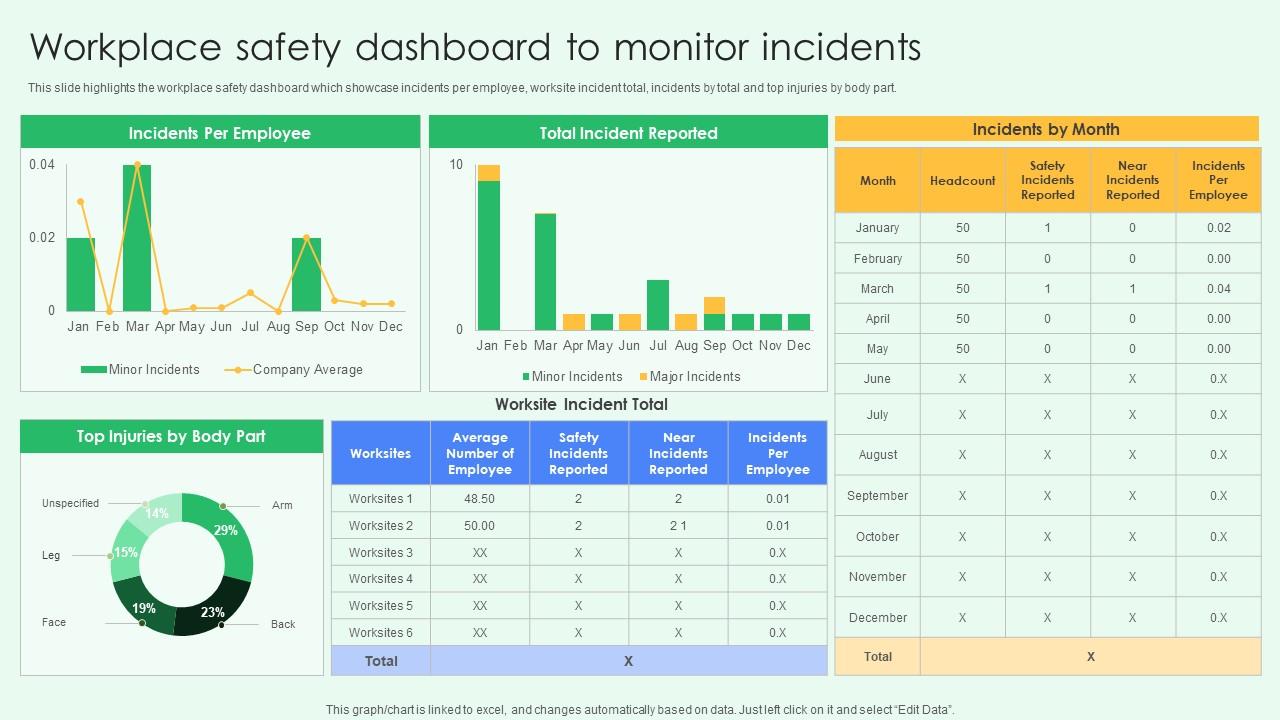
This slide highlights the workplace safety dashboard which showcase incidents per employee, worksite incident total, incidents by total and top injuries by body part.Present the topic in a bit more detail with this Workplace Safety Dashboard To Monitor Incidents Best Practices For Workplace Security. Use it as a tool for discussion and navigation on Incidents Reported, Incidents Employee, Total Incident. This template is free to edit as deemed fit for your organization. Therefore download it now.

People who downloaded this PowerPoint presentation also viewed the following :

FAQs for Workplace Safety Dashboard To Monitor Incidents Best Practices

Key elements of an effective workplace safety program include comprehensive risk assessments, regular safety training, clear protocols and procedures, incident reporting systems, and ongoing safety audits. These components work together by identifying potential hazards, educating employees on prevention measures, and establishing accountability frameworks, with many organizations finding that systematic implementation significantly reduces workplace accidents while enhancing operational efficiency.

Organizations assess safety training effectiveness through incident rate tracking, employee knowledge assessments, behavioral observations, safety audit scores, and feedback surveys. These evaluation methods enable companies to identify training gaps, measure behavior changes, and demonstrate ROI, with many manufacturing and construction firms finding that comprehensive assessment programs reduce workplace accidents by 30-40% while enhancing regulatory compliance.

Employee feedback serves as a critical foundation for identifying safety hazards, assessing protocol effectiveness, evaluating training gaps, and uncovering near-miss incidents that management might otherwise overlook. This direct input from frontline workers enables organizations to refine safety measures, enhance training programs, and create more comprehensive risk mitigation strategies, with many companies finding that employee-driven safety insights significantly reduce workplace incidents and improve overall operational safety.

Technology enhances workplace safety through IoT sensors, AI-powered risk assessment, wearable devices, automated safety protocols, and real-time monitoring systems. These solutions streamline hazard detection, enable predictive maintenance, and deliver instant alerts, with manufacturing plants and construction sites finding that automated systems significantly reduce accidents while improving compliance and operational efficiency.

Common misconceptions about workplace safety regulations include believing they're only for high-risk industries, that compliance is too expensive, that regulations stifle productivity, and that accidents are inevitable regardless of precautions. These misconceptions often prevent organizations from recognizing that strategic safety investments actually enhance operational efficiency, reduce long-term costs, and deliver competitive advantages through improved employee retention and reduced liability exposure.

Leadership fosters safety culture by demonstrating visible commitment, implementing comprehensive training programs, encouraging open communication about hazards, and recognizing safe behaviors consistently. Through regular safety meetings, transparent incident reporting systems, and adequate resource allocation, organizations like manufacturing plants and construction companies create environments where employees actively participate in safety initiatives, ultimately reducing workplace accidents and enhancing operational efficiency.

Conducting thorough safety risk assessments involves identifying potential hazards, evaluating their likelihood and severity, documenting findings, implementing control measures, and establishing regular review protocols. Manufacturing facilities, construction sites, and healthcare institutions increasingly use systematic approaches like hazard mapping and employee feedback sessions, ultimately delivering reduced incidents, regulatory compliance, and enhanced worker confidence across operations.

Businesses can ensure OSHA compliance through regular safety audits, comprehensive employee training programs, proper documentation of incidents, hazard identification protocols, and establishing clear safety procedures. Manufacturing companies and construction firms increasingly find that systematic compliance management streamlines operations, reduces liability costs, and enhances workplace culture, ultimately delivering competitive advantage through reduced insurance premiums and improved employee retention.

Companies can adopt ergonomic best practices including adjustable workstations, proper monitor positioning, supportive seating, regular movement breaks, and comprehensive employee training programs. These initiatives streamline workplace health by reducing repetitive strain injuries, enhancing productivity, and minimizing healthcare costs, with many organizations finding that strategic ergonomic investments ultimately deliver improved employee satisfaction and reduced absenteeism.

Mental health integration involves comprehensive wellness programs, stress management training, employee assistance programs, regular mental health screenings, and creating psychologically safe work environments. These strategies enhance workplace safety by reducing stress-related accidents, improving decision-making capabilities, and fostering open communication about mental health challenges, with many organizations finding that addressing psychological wellbeing ultimately delivers lower absenteeism rates and enhanced overall safety performance.

The most effective methods for communicating safety policies include visual displays, regular training sessions, digital platforms, multilingual materials, and interactive demonstrations. These approaches enhance understanding by combining visual reinforcement, hands-on practice, and accessible formats, with many organizations finding that layered communication strategies significantly reduce workplace incidents while ensuring compliance across diverse employee populations.

Incidents and near misses provide critical data for identifying hazards, analyzing root causes, and implementing preventive measures before serious accidents occur. Through systematic reporting and investigation processes, organizations across manufacturing, construction, and healthcare sectors can strengthen safety protocols, enhance employee training programs, and reduce future risks, ultimately creating safer work environments while minimizing operational disruptions and liability costs.

Personal protective equipment serves as the critical last line of defense in workplace safety, including helmets, gloves, safety glasses, respirators, and protective clothing that shield workers from specific hazards. This equipment significantly reduces injury rates across industries like construction, manufacturing, and healthcare, with many organizations finding that comprehensive PPE programs, combined with proper training and maintenance protocols, ultimately deliver measurable reductions in workplace accidents and workers' compensation claims.

Businesses achieve this balance by implementing integrated safety management systems, conducting regular risk assessments, providing comprehensive employee training, and leveraging safety technology for real-time monitoring. This strategic approach enhances operational efficiency while minimizing workplace incidents, with manufacturing and construction companies finding that proactive safety measures ultimately reduce downtime, lower insurance costs, and improve employee morale, delivering sustained competitive advantage.

Remote work transforms traditional workplace safety by shifting focus from physical hazard prevention to ergonomic assessments, cybersecurity protocols, mental health support, and home office equipment standards. While companies lose direct control over work environments, they're developing virtual safety training programs, digital wellness initiatives, and remote ergonomic consultations, ultimately creating more comprehensive employee wellbeing approaches that address both physical and psychological safety across distributed workforces.

Ratings and Reviews

100% of 100
Review Form
Write a review
Most Relevant Reviews
  1. 100%

    by Edison Rios

    Unique design & color.
  2. 100%

    by Deshawn Schmidt

    My team has been relying on SlideTeam’s professional PPT designs for a while now. It has greatly sped up quality work at my organization. So thanks!

2 Item(s)

per page: