0314 annual financial growth graph
Try Before you Buy Download Free Sample Product
Audience
Editable
of Time
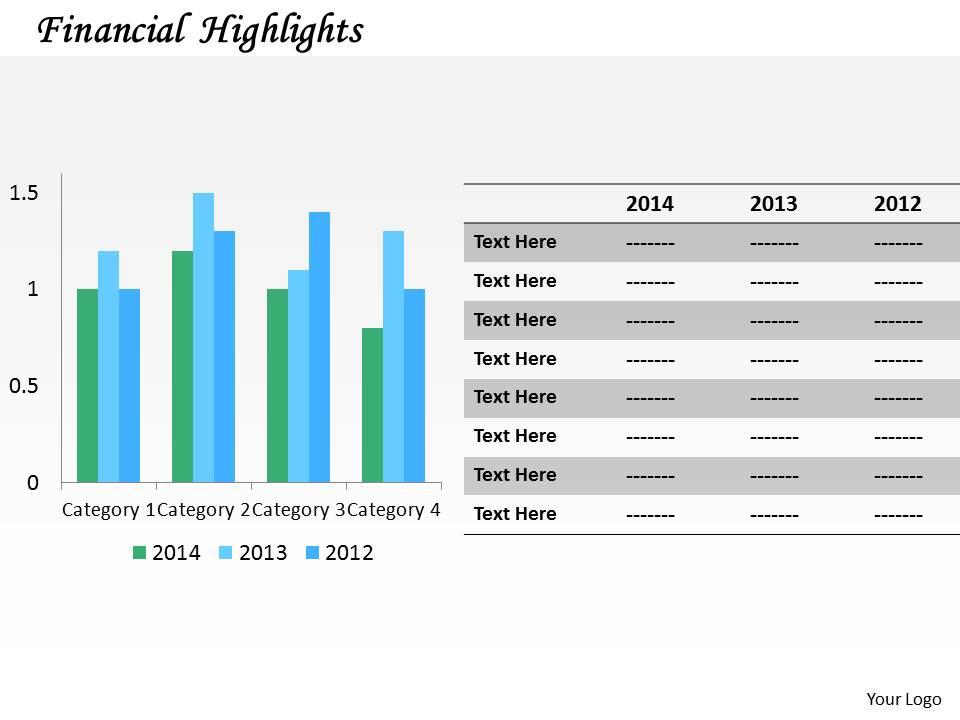
A company’s work force is its engine. Without aware employees, no PowerPoint ideas are feasible, leading to challenges that obstruct its progress. Are you a businessman looking for the perfect assisting tool for your organization? Do you feel frustrated when you are not able to lay hands on such efficient and apt Presentation visual aids? Create business reports in a flash with our PPT slides. They are to the point and appropriate for every professional scenario. Click and employ the annual financial growth graph PowerPoint layout. This slide depicts vertical bar graphs displaying financial key points for different years. The accompanying table data can be used to highlight important points for these years. In addition, you can download more PPT icons from our massive online icons library. Alter the existing PPT infographics and change data according to your specific needs. By using this PPT slide, you have the power to make big business decisions with a click of a button. Reward your ideas with our 0314 Annual Financial Growth Graph. Their flawless logic merits the best.
People who downloaded this PowerPoint presentation also viewed the following :
0314 annual financial growth graph with all 5 slides:
Fortify yourself with our 0314 Annual Financial Growth Graph. Acquire the courage to express without fear.
FAQs for 0314 annual
Businesses should track revenue growth rate, profit margins, return on investment (ROI), cash flow metrics, and customer acquisition costs to measure annual financial growth effectively. These KPIs enable organizations across retail, manufacturing, and financial services to identify operational efficiency opportunities, optimize resource allocation, and make strategic decisions that drive sustainable growth and competitive advantage.
Businesses can effectively compare their annual financial growth against industry benchmarks by analyzing revenue growth rates, profit margins, return on assets, and market share expansion using industry reports, financial databases, and peer analysis tools. Through platforms like Bloomberg, IBISWorld, and industry association data, companies identify performance gaps, validate strategic decisions, and adjust operational focus, ultimately enabling more informed resource allocation and competitive positioning in increasingly dynamic markets.
Budgeting serves as the foundation for forecasting annual financial growth by establishing revenue targets, expense controls, and resource allocation frameworks that guide strategic decision-making. Through detailed budget analysis, organizations can identify growth opportunities, anticipate market challenges, and adjust operational strategies, with many companies finding that systematic budgeting enhances forecasting accuracy and ultimately delivers sustainable competitive advantage.
Seasonal trends significantly impact annual financial growth through fluctuating consumer demand, inventory cycles, and cash flow variations that can create revenue peaks and valleys. Businesses should prepare by developing flexible budgets, diversifying product offerings across seasons, building strategic cash reserves during high-revenue periods, and implementing demand forecasting systems, ultimately enabling smoother operations and sustained growth throughout varying market conditions.
Companies should employ diversified revenue streams, strategic reinvestment in innovation, operational efficiency improvements, market expansion initiatives, and strong customer retention programs to ensure sustainable annual financial growth. These strategies work synergistically by reducing dependency on single income sources, enhancing competitive positioning, and building long-term value, with many organizations finding that consistent reinvestment in technology and talent ultimately delivers compounding returns and market resilience.
Technology and data analytics enhance annual financial growth tracking by automating data collection, providing real-time performance dashboards, and delivering predictive insights through advanced algorithms. These tools streamline financial reporting processes, enable faster decision-making, and identify growth opportunities that manual analysis might miss, with many organizations finding significantly improved accuracy and strategic visibility.
Common pitfalls include overestimating market demand, underestimating operational costs, ignoring seasonal fluctuations, overlooking competitive pressures, and failing to account for economic uncertainties. These estimation errors often stem from optimistic bias and insufficient data analysis, with many organizations finding that conservative forecasting combined with scenario planning delivers more accurate projections and sustainable growth strategies.
A diversified revenue stream reduces dependency on single markets or products, providing stability during economic fluctuations, seasonal variations, and industry-specific downturns. This strategic approach enables organizations to maintain steady cash flow across multiple channels, with companies in sectors like technology, healthcare, and retail finding that balanced portfolios deliver more predictable growth trajectories and enhanced investor confidence.
Employee productivity significantly impacts annual financial growth by driving revenue increases, reducing operational costs, and enhancing competitive positioning through improved output quality and efficiency. Higher productivity enables organizations to scale operations without proportional increases in labor costs, with many companies finding that strategic investments in employee development and workplace optimization deliver measurable improvements in profit margins and sustainable growth trajectories.
Businesses can leverage customer feedback to drive annual financial growth by identifying product improvement opportunities, enhancing service delivery, reducing churn rates, and developing targeted marketing strategies. Through systematic feedback analysis, companies in retail, healthcare, and financial services streamline operations, increase customer retention by up to 25%, and ultimately deliver higher revenues and competitive market positioning.
Key ratios include revenue growth rate, earnings per share growth, return on equity, operating margin expansion, and free cash flow growth. These metrics collectively reveal operational efficiency, profitability trends, and cash generation capabilities, with many investors finding that companies demonstrating consistent improvement across multiple ratios deliver stronger long-term performance and competitive positioning.
Mergers and acquisitions influence annual financial growth by expanding market reach, consolidating operational efficiencies, diversifying revenue streams, and eliminating redundant costs. These strategic combinations enable companies to achieve economies of scale, access new customer bases, and leverage combined resources, with many organizations finding that well-executed M&A delivers accelerated growth beyond organic capabilities.
Effective cash flow management contributes to annual financial growth by optimizing working capital, reducing borrowing costs, and enabling strategic reinvestment opportunities. Through systematic monitoring and forecasting, companies can minimize cash shortfalls, negotiate better supplier terms, and allocate resources toward high-return initiatives, ultimately delivering improved profitability and sustainable expansion.
Economic downturns significantly impact annual financial growth projections through reduced consumer spending, decreased investment flows, supply chain disruptions, and market volatility. While these challenges present immediate concerns, they also create opportunities for strategic cost optimization, market repositioning, and operational efficiency improvements, with many organizations finding that adaptive planning during downturns ultimately strengthens competitive positioning.
Businesses can analyze historical revenue trends, profit margins, cash flow patterns, and expense ratios to identify growth drivers and operational inefficiencies. By examining past performance across different market conditions, companies can develop targeted strategies for market expansion, resource allocation, and investment priorities, ultimately enabling more accurate forecasting and sustainable growth trajectories.
-
Helpful product design for delivering presentation.
-
Really like the color and design of the presentation.