Angola country powerpoint maps
Try Before you Buy Download Free Sample Product
Audience
Editable
of Time
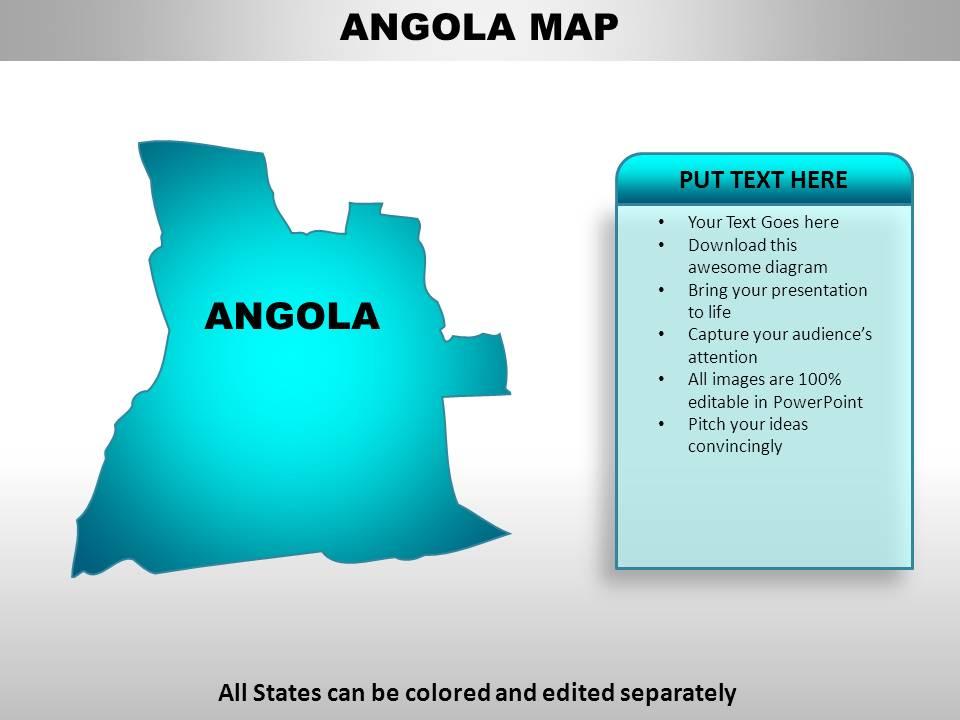
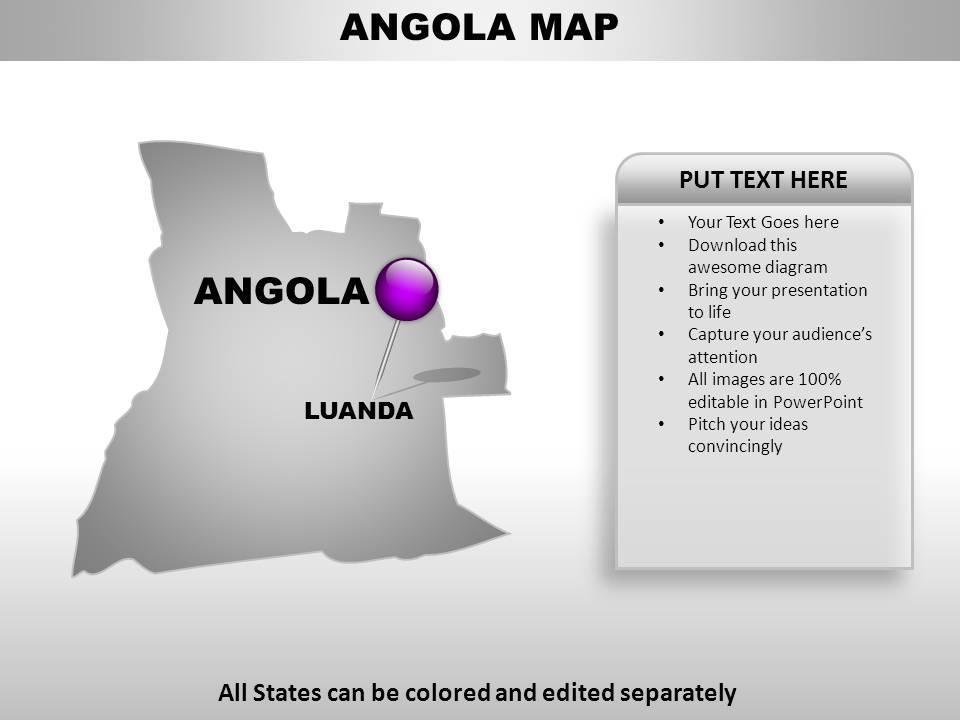
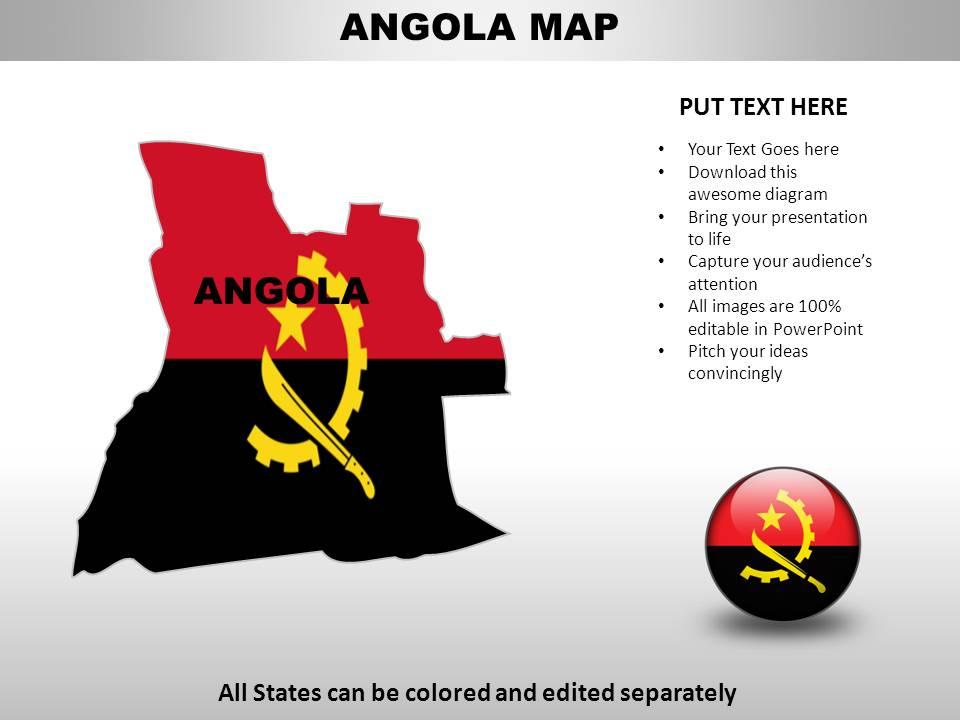
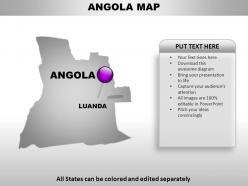
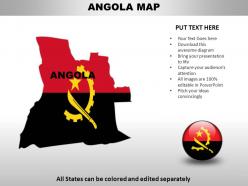
Do you want to represent the features of Angola country? You can easily do that by using our Editable Angola Country PowerPoint Map Template. This pre-designed slide has a map which can be easily used to highlight the importance of Angola and its cities for your business operations. You can easily move the pins and showcase your business policies and trends just as we have highlight the capital city of Angola i.e. Luanda. This PPT Slide can be beneficial for tourist companies as they can attract the tourists by defining the rich history, vibrant contrasts and varied cultures of the country. Such a diverse country with distinct climatic regions, including wet, tropical northern jungle, a dryer and cooler central plateau can offer several different travel experiences to the tourists. Also, there are many fabulous beaches to visit and outstanding dinner cruises that will take you to beautiful Mussulo Island in Angola. So, start exploring the benefits of visiting and trading in this beautiful country with our PowerPoint Template. Cook up a feast with our Angola Country Powerpoint Maps. Satiate the innermost desires of your audience.
People who downloaded this PowerPoint presentation also viewed the following :
Angola country powerpoint maps with all 7 slides:
Lay a firm base with our Angola Country Powerpoint Maps. Your thoughts will tower over others.
FAQs for Angola
Online maps of Angola include political boundary maps, topographical terrain maps, economic resource maps, transportation network maps, and demographic distribution maps. These mapping resources enhance research, business planning, and educational projects by providing detailed geographic information, administrative divisions, and infrastructure data, with many organizations finding them invaluable for strategic analysis and operational planning across various sectors.
Historical Angola maps often showed incomplete or inaccurate territorial boundaries, limited topographical detail, and colonial administrative divisions that don't reflect current provincial structures. Contemporary maps utilize satellite imagery, GPS technology, and advanced surveying methods, providing precise geographical coordinates, detailed infrastructure networks, and accurate natural resource locations, with many government agencies and international organizations finding that modern mapping technologies enable better resource management, urban planning, and economic development strategies.
Topographical maps reveal Angola's elevation changes, terrain features, geological formations, watershed patterns, and climate zones across its plateau regions, coastal plains, and river valleys. These detailed geographical tools enable mining companies, agricultural planners, and infrastructure developers to assess land suitability, optimize resource extraction, and plan transportation networks, ultimately delivering strategic advantages for economic development and environmental management.
Thematic maps of Angola highlight socio-economic factors through specialized visual techniques, color coding, proportional symbols, gradient shading, and data overlays that emphasize specific metrics like population density or mineral distribution. These mapping approaches enable government agencies, international development organizations, and resource companies to identify strategic opportunities, optimize infrastructure investments, and enhance resource allocation decisions, ultimately delivering clearer insights for economic planning and competitive positioning.
Interactive maps enhance learning about Angola's geography by enabling dynamic exploration of topographical features, climate zones, natural resources, provincial boundaries, and major cities through clickable layers and zoom functionality. These digital tools allow students and researchers to visualize complex geographical relationships, compare regional variations across Angola's diverse landscapes, and access real-time data, ultimately delivering more engaging educational experiences than traditional static maps.
Angola's most significant geographical regions include the Atlantic coastal plain, the central highlands plateau, the northern rainforest territories, the eastern savanna lands, and the southern desert regions. These areas are distinctly represented in topographical maps through elevation contours, political maps showing provincial boundaries, and thematic maps highlighting natural resources, with many educational and business applications finding that regional mapping enhances understanding of Angola's diverse economic opportunities and strategic development potential.
Angola's political history has significantly influenced its mapping through colonial Portuguese cartography, post-independence Soviet-style geographical documentation, and civil war-era restricted access to accurate territorial data. During different political periods, maps reflected varying ideological perspectives, resource exploration priorities, and administrative boundaries, with many governmental institutions and international organizations finding that contemporary Angolan mapping increasingly emphasizes economic development zones and infrastructure planning.
Cartographers creating accurate Angola maps face challenges including limited ground survey data, difficult terrain access in remote regions, rapid urbanization changes, outdated infrastructure records, and inconsistent geographic databases. Many mapping organizations find that Angola's diverse landscapes, from dense forests to coastal areas, require strategic combinations of satellite imagery, local partnerships, and advanced GPS technology, ultimately delivering more comprehensive geographic information for development planning.
Satellite maps provide insights into environmental changes in Angola by tracking deforestation patterns, monitoring drought conditions, analyzing land use shifts, and measuring vegetation health over time. Through advanced remote sensing technology, researchers and policymakers can identify habitat loss, agricultural expansion impacts, and climate-related changes, ultimately enabling more strategic environmental management and conservation planning across Angola's diverse ecosystems.
Cadastral maps in Angola serve urban planning by defining property boundaries, land ownership records, taxation assessments, infrastructure development zones, and zoning regulations. These detailed mapping systems streamline municipal planning processes, enhance property registration efficiency, and support economic development initiatives, with many Angolan cities finding that accurate cadastral data ultimately delivers improved land management and reduced property disputes.
Cultural maps of Angola showcase its rich ethnic tapestry through distributions of the Ovimbundu, Kimbundu, Bakongo, and other indigenous groups, alongside their traditional languages, customs, and historical territories. These comprehensive mapping tools enable organizations, educational institutions, and cultural preservation societies to understand regional heritage patterns, facilitate targeted community development programs, and ultimately enhance cultural tourism strategies while supporting Angola's diverse communities in maintaining their distinctive identities.
**INPUT**: What digital tools are most effective for creating custom maps of Angola? **OUTPUT**: Digital mapping tools for Angola include ArcGIS, QGIS, Google Earth Pro, Mapbox, and Adobe Illustrator, each offering specialized features for geographic visualization. These platforms streamline custom map creation by providing satellite imagery, demographic overlays, and interactive capabilities, with many organizations finding that combining GIS accuracy with design flexibility ultimately delivers compelling visual presentations for business intelligence and strategic planning. **Word count: 60 words**
GIS technology revolutionizes Angola's map-making by enabling real-time data collection, satellite imagery integration, precise coordinate mapping, and automated updates across vast territories. Through digital surveying and GPS positioning, government agencies and development organizations can create accurate infrastructure maps, monitor agricultural zones, and track urban expansion, ultimately delivering faster resource allocation and improved planning for Angola's growing economy.
Angola's border maps significantly influence diplomatic relations through territorial clarity, resource allocation agreements, cross-border trade facilitation, and regional security cooperation frameworks. These cartographic representations enable enhanced diplomatic dialogue by establishing clear jurisdictional boundaries for oil reserves and mineral rights, with neighboring countries like Zambia and Democratic Republic of Congo finding that accurate mapping streamlines bilateral negotiations and ultimately strengthens regional partnerships.
Maps of Angola enhance disaster management through hazard identification, evacuation route planning, resource allocation mapping, and emergency shelter location analysis. These geographic tools enable government agencies, NGOs, and international relief organizations to coordinate responses more effectively during floods, droughts, and other emergencies, ultimately delivering faster assistance and improved community resilience across Angola's diverse regions.
-
Thanks for all your great templates they have saved me lots of time and accelerate my presentations. Great product, keep them up!
-
Editable templates with innovative design and color combination.