Brand Specifications Comparison Ratings Chart
Try Before you Buy Download Free Sample Product
Audience
Editable
of Time
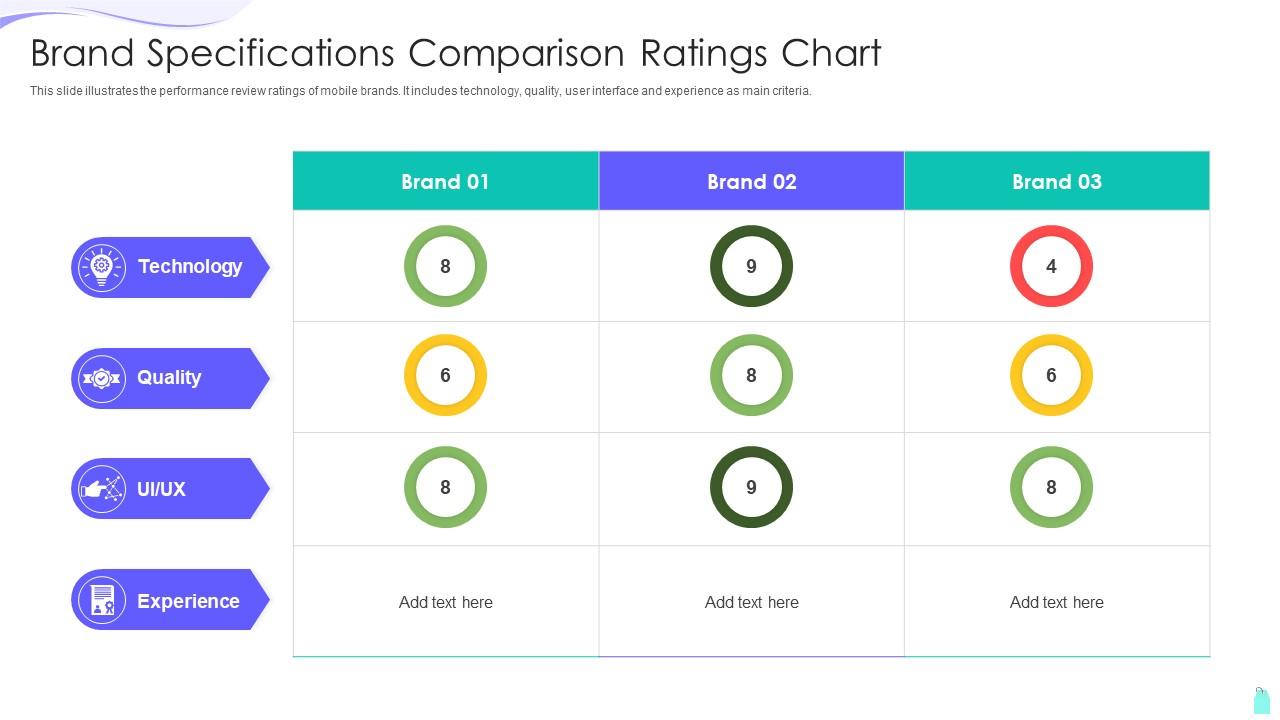
This slide illustrates the performance review ratings of mobile brands. It includes technology, quality, user interface and experience as main criteria
People who downloaded this PowerPoint presentation also viewed the following :
Brand Specifications Comparison Ratings Chart with all 6 slides:
Use our Brand Specifications Comparison Ratings Chart to effectively help you save your valuable time. They are readymade to fit into any presentation structure.
FAQs for Brand Specifications
Essential brand specifications include logo variations and usage guidelines, color palettes with specific codes, typography hierarchies, imagery styles, and spacing requirements. These elements work together by ensuring consistent visual communication across all touchpoints, with companies like Nike and Apple finding that comprehensive brand specifications streamline design processes, reduce production costs, and ultimately deliver stronger brand recognition and customer trust.
Brand specifications significantly influence target audience perception by establishing visual consistency, emotional connections, and professional credibility across all touchpoints. When companies maintain coherent brand standards in their logos, colors, typography, and messaging, audiences develop stronger trust and recognition, with many organizations finding that consistent brand presentation increases revenue by up to 23% while enhancing customer loyalty and market positioning.
Color palettes serve as foundational elements in brand specifications, establishing visual identity, emotional connection, recognition consistency, psychological impact, and market differentiation across all touchpoints. These strategic color choices significantly influence consumer behavior by triggering specific emotions, enhancing brand recall, building trust through consistency, and driving purchase decisions, with many retail and hospitality brands finding that cohesive color implementation increases customer engagement and loyalty.
Businesses ensure brand specification adaptability by creating flexible design systems with scalable logos, modular color palettes, versatile typography hierarchies, and format-specific guidelines for digital and print applications. These comprehensive brand frameworks enable consistent visual identity across PowerPoint presentations, sales decks, and marketing materials, while allowing creative teams to maintain brand integrity regardless of platform constraints, ultimately delivering cohesive customer experiences.
Common mistakes include inconsistent visual elements across platforms, overly complex guidelines that teams can't follow practically, failing to define clear usage scenarios, neglecting digital application requirements, and creating specifications without stakeholder input. These oversights often result in brand dilution, confused messaging, and implementation challenges, with many organizations finding that streamlined, comprehensive guidelines enhance brand consistency and ultimately deliver stronger market recognition and customer trust.
Typography choices in brand specifications significantly impact readability through font size, spacing, and character clarity, while simultaneously enhancing brand recognition through distinctive typeface selection, consistent application, and memorable visual identity. Strategic typography decisions enable companies to communicate more effectively with their audiences, streamline brand consistency across touchpoints, and ultimately deliver stronger market presence, with many organizations finding that well-defined typographic guidelines improve both customer engagement and brand recall.
Brand specifications enhance marketing presentation effectiveness by ensuring consistent visual identity, messaging alignment, typography standards, color accuracy, and logo usage across all materials. These guidelines streamline content creation, reinforce brand recognition, and deliver cohesive customer experiences, with many organizations finding that standardized specifications significantly reduce production time while ultimately strengthening market positioning and competitive advantage.
Companies maintain brand specification consistency by establishing comprehensive brand guidelines, implementing centralized asset management systems, conducting regular audits, and providing standardized templates across all touchpoints. These strategic approaches streamline brand governance through automated approval workflows, real-time collaboration tools, and cross-platform integration, with many organizations finding that centralized brand management ultimately delivers enhanced customer recognition and competitive market positioning.
Testing and refining brand specifications involves conducting focus groups, A/B testing marketing materials, gathering stakeholder feedback, and piloting implementations across select touchpoints. Many organizations streamline this process by testing specifications in controlled environments like retail locations or digital campaigns, collecting performance data and customer responses, ultimately ensuring brand consistency and market resonance before full-scale deployment.
Digital brand specifications focus on RGB color profiles, screen resolutions, interactive elements, and responsive design guidelines, while print specifications emphasize CMYK color modes, DPI requirements, bleed areas, and physical material considerations. These distinctions are crucial because improper color translation between mediums can result in brand inconsistencies, with many organizations finding that unified specifications across both channels streamline production workflows while ensuring consistent brand recognition.
Cultural nuances are critically important in global brand specifications, as they directly influence consumer perception, engagement, and purchasing decisions across different markets. Brands must adapt their visual identity, messaging, color schemes, and communication styles to respect local customs and preferences, with companies like McDonald's and Coca-Cola successfully tailoring their specifications regionally while maintaining core brand integrity, ultimately delivering stronger market penetration and customer loyalty.
**INPUT**: What are some examples of successful brands with well-defined specifications, and what can we learn from them? **OUTPUT**: Successful brands with well-defined specifications include Apple's minimalist design standards, Coca-Cola's consistent red branding, McDonald's golden arches uniformity, and Starbucks' green color palette across all touchpoints. These companies demonstrate that consistent brand specifications streamline customer recognition, enhance trust through predictable experiences, and ultimately deliver competitive advantage, with many organizations finding that disciplined brand standards significantly accelerate market penetration and customer loyalty.
Small businesses can leverage brand specifications to compete by creating consistent, professional brand experiences that build trust, differentiate their offerings, and establish memorable market positioning. Through strategic brand guidelines covering visual identity, messaging, and customer touchpoints, small retailers and service providers can deliver cohesive experiences that rival larger competitors, ultimately enabling them to command premium pricing and foster customer loyalty.
Tools for creating and enforcing brand specifications include brand management platforms like Frontify and Brandfolder, design software such as Adobe Creative Suite, digital asset management systems, brand guideline templates, and automated compliance tools. These resources streamline brand consistency by centralizing assets, automating approval workflows, and providing real-time monitoring capabilities, ultimately delivering enhanced brand integrity and operational efficiency across organizations.
Companies should revisit brand specifications every 2-3 years or during major business changes, market shifts, and strategic pivots. Through regular audits, organizations can ensure their visual identity, messaging guidelines, and brand standards reflect evolving customer expectations, competitive landscapes, and business objectives, ultimately maintaining market relevance and competitive advantage.
-
SlideTeam’s pool of 2Million+ PPTs has really benefited my team, everyone from the IT department to HR. We are lucky to have crossed ways with them.
-
“I always have a wonderful experience with SlideTeam. It's my ""go to"" when I need a template.”