

Business pie chart with annual sales





Try Before you Buy Download Free Sample Product
 Impress Your
Audience
 100%
Editable
 Save Hours
of Time


Our Business Pie Chart With Annual Sales are explicit and effective. They combine clarity and concise expression.
People who downloaded this PowerPoint presentation also viewed the following :
Content of this Powerpoint Presentation
Description:
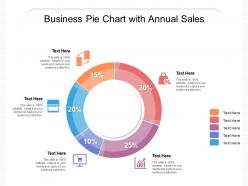
The image is of a PowerPoint slide entitled "Business Pie Chart with Annual Sales," which features a central pie chart divided into five colored segments, each with a corresponding percentage value indicating a share of the total. These segments are as follows:
1. A red segment at 30%,
2. A pink segment at 25%,
3. A blue segment at 20%,
4. An orange segment at 15%,
5. A light blue segment at 10%.
To the left and right of the pie chart are text placeholders accompanied by small icons, indicative of the type of data or category that each pie chart segment represents. The icons include a shopping cart, a factory, a lock, and others that are not fully visible, each suggesting a potential application such as sales channels, product types, or security measures. The text placeholders read "Text Here," signaling the presenter to insert specific information pertinent to the data displayed on the chart.
At the bottom of the slide, there is another text placeholder for additional descriptions or data interpretation. Each text box on the slide includes a note that the slide is "100% editable," emphasizing the customizable nature of the presentation to suit different needs and to attract the audience's focus.
Use Cases:
The pie chart is a common visual tool used for displaying proportions and can be applied across various industries:
1. E-commerce:
Use: Showcasing revenue by product category.
Presenter: E-commerce Manager.
Audience: Marketing Team, Investors.
2. Automotive:
Use: Breaking down sales by vehicle model.
Presenter: Sales Director.
Audience: Dealership Owners, Sales Teams.
3. Consumer Goods:
Use: Illustrating market share of different product lines.
Presenter: Brand Manager.
Audience: Retail Partners, Marketing Department.
4. Hospitality:
Use: Displaying room sales by category.
Presenter: Revenue Manager.
Audience: Hotel Staff, Management.
5. Pharmaceuticals:
Use: Reporting sales of medications by therapeutic area.
Presenter: Business Analyst.
Audience: Executives, R&D Teams.
6. Energy:
Use: Visualizing sales distribution across energy types.
Presenter: Marketing Strategist.
Audience: Stakeholders, Policy Makers.
7. Telecommunications:
Use: Demonstrating revenue from various service packages.
Presenter: Financial Planner.
Audience: Management, Investor Relations.
Business pie chart with annual sales with all 2 slides:
Give your audience a fulfilling experience. They will find our Business Pie Chart With Annual Sales elevating.
FAQs for Business pie chart
Honestly, just start with where your customers actually hang out and shop - that's like 80% of it right there. Budget matters tons since every middleman takes their slice. What you're selling changes things too - fresh stuff needs faster channels, complicated products might need specialty stores that actually get it. Direct sales let you control everything but you're kinda stuck with limited reach. Retail partnerships can scale fast but then you're dealing with their rules and timelines. Oh, and don't forget geography if you're trying to go wide. I'd literally map out your customer's shopping habits first, then figure out the cheapest way to reach them there.
Look at where your customers actually buy stuff first - that's huge. Some products crush it online, others need that in-person pitch. I've watched so many companies blow their budget on Amazon when their customers were shopping at specialty stores instead. Your margins matter too since going direct costs more upfront but you keep control. Maybe try both? Like direct sales for your big clients and retail partnerships for the smaller volume stuff. Oh and test small first - way better than going all-in on the wrong approach.
Dude, you'll want to start with a solid CRM to track what your partners are actually doing. Analytics tools show you which distributors are crushing it vs just sitting on inventory. Automated workflows handle the boring stuff - order processing, commission calcs, all that. The reporting features alone will save you from spreadsheet nightmare fuel every week (trust me on this). Oh, and integration platforms sync everything so your sales team isn't making decisions off stale data. Map out your worst bottlenecks first, then find tools that fix those specific headaches.
Track your sales numbers first - volume, market penetration, cost per channel, how fast you're getting to market. But honestly? The soft stuff matters just as much. Customer satisfaction scores and what your partners are actually telling you can reveal way more than spreadsheets sometimes. Set up quarterly reviews so you catch problems early. Compare everything against your original goals and see how competitors are doing if you can. Oh, and don't forget time-to-market across different paths - that one's sneaky important.
Look, going direct means you keep all the profit and control every customer interaction - no one's taking their slice. Problem is, it's a grind to scale up and costs way more upfront. With indirect sales through partners, you can hit way more markets faster without bleeding cash, but you're giving up margin and control. Plus those partners sometimes end up competing with each other which gets messy. Honestly though, most smart companies I know just do both - direct for their big important clients, indirect everywhere else.
Honestly, analytics changed everything for me - no more shooting in the dark with sales stuff. You'll actually see which channels are crushing it and which ones are just burning money. Track your pipeline bottlenecks before they bite you in the ass. I used to try measuring everything at once (huge mistake) but now I just focus on 2-3 metrics that actually move the needle. The forecasting gets way more accurate too. You can finally figure out which territories need help instead of just hoping for the best. It's wild how much clearer everything becomes once you have real data.
Yeah, e-commerce is totally changing how distribution works. Traditional channels are scrambling to keep up or they're getting left behind. Companies are going straight to customers now, which sucks for wholesalers and retail partners obviously. The delivery expectations are insane too – people want stuff same-day when it used to take forever through normal channels. Honestly though, most companies I've seen do better with a mix of both. Don't ditch your existing partnerships completely, but you really need to start building your own online stuff. The hybrid approach seems to work best from what I've noticed.
Set up regular check-ins from the start - weekly or every other week works best. Shared dashboards help everyone stay on the same page with real-time tracking. Most partnership disasters I've witnessed? People just stop talking between those big quarterly meetings. Your distributors know what's happening in the field better than anyone, so actually listen when they share intel about competitors or market changes. Give them direct contact info and commit to response times. Oh, and standardized reporting saves everyone headaches later. It's really about making communication flow both ways instead of just dumping info on them.
Track your revenue per channel and conversion rates - that's the bread and butter stuff. Sales velocity matters too, like how quickly deals actually close in each channel. Partner engagement is where it gets interesting though - some partners are just naturally better at following up on leads and finishing training modules. Honestly, I've seen so many companies get obsessed with volume when they should focus on which channels actually make money. Oh, and if you're dealing with physical products, don't ignore inventory turnover. Set up a simple dashboard so you can see what's working at a glance.
Honestly, you gotta stay on top of where your customers actually shop and pivot when they do. Survey them, check your sales data, watch their digital habits - that stuff tells the real story. Shifting online? Time to upgrade your e-commerce setup. Want faster shipping? Maybe look into local partnerships or those micro-fulfillment places. Consumer preferences change crazy fast these days, so don't get married to doing things the old way. It's exhausting sometimes, like chasing your tail. Start by comparing what channels you're using versus how customers actually behave. Stay flexible with your mix.
Get a system that shows you inventory everywhere in real time - online, retail stores, distributors, all of it. Then set minimum stock levels for each channel based on how fast they sell. When things get tight, you need rules already in place about who gets priority so you're not panicking. Honestly, most people overcomplicate the forecasting part when they should focus on the basics first. Track everything properly, set clear allocation rules, then worry about the fancy stuff later. Makes your life way easier.
Yeah, you basically can't just copy-paste what works in the US to other markets - learned that the hard way watching companies fail overseas. Different regions have completely different consumer habits, regulations, and logistics setups. Germans want every single product detail spelled out, while Americans just want to buy fast and move on. It's wild how different preferences can be. What I'd do is build one solid framework first, then tweak it for each market instead of reinventing everything. Way less headache when you're trying to scale up.
Honestly, the worst part is when your channels start fighting each other for the same customers. Pricing gets all mixed up between different partners, and your inventory system? Total disaster waiting to happen. I watched one company's warehouse turn into complete chaos because of this. Brand control becomes impossible too - you can't control how partners represent you. Plus tracking customer data across everything gets super messy. Oh, and the confusion customers feel when they see different messages everywhere is rough. Set up solid partner agreements from day one and get decent integration software. Seriously, don't cheap out on the tech part.
Honestly, I'd start with Instagram or Facebook since you can sell directly through posts now. LinkedIn's your best bet for B2B partnerships though. TikTok is... well, it's chaos but if you figure it out, the traffic is insane. The smart move? Support your existing distributors on social. Share their stuff, run campaigns together, give them content they can actually use in their area. Way more effective than going solo. Pick one platform where your customers already spend time and test selling there first. Don't spread yourself too thin right away.
Honestly, customer complaints about distribution are like having a cheat sheet for your business. They'll straight up tell you "I can't find this anywhere" or "why does shipping take three weeks?" - and boom, you know exactly what to fix. Track those complaints religiously because they're showing you where you're losing sales. Some feedback might even point you toward channels you never considered. The tricky part is figuring out which problems to tackle first (hint: go for whatever affects the most customers). Set up a simple system to collect this stuff regularly. Trust me, it beats guessing what's broken.
No Reviews