Business Referral Program Performance Metrics Dashboard

Rating:
90%
Business Referral Program Performance Metrics Dashboard
Slide 1 of 7

or

Favourites Favourites

Try Before you Buy Download Free Sample Product

Audience Impress Your
Audience
Editable 100%
Editable
Time Save Hours
of Time
The Biggest Sale is ending soon in
0
0
:
0
0
:
0
0
Rating:
90%
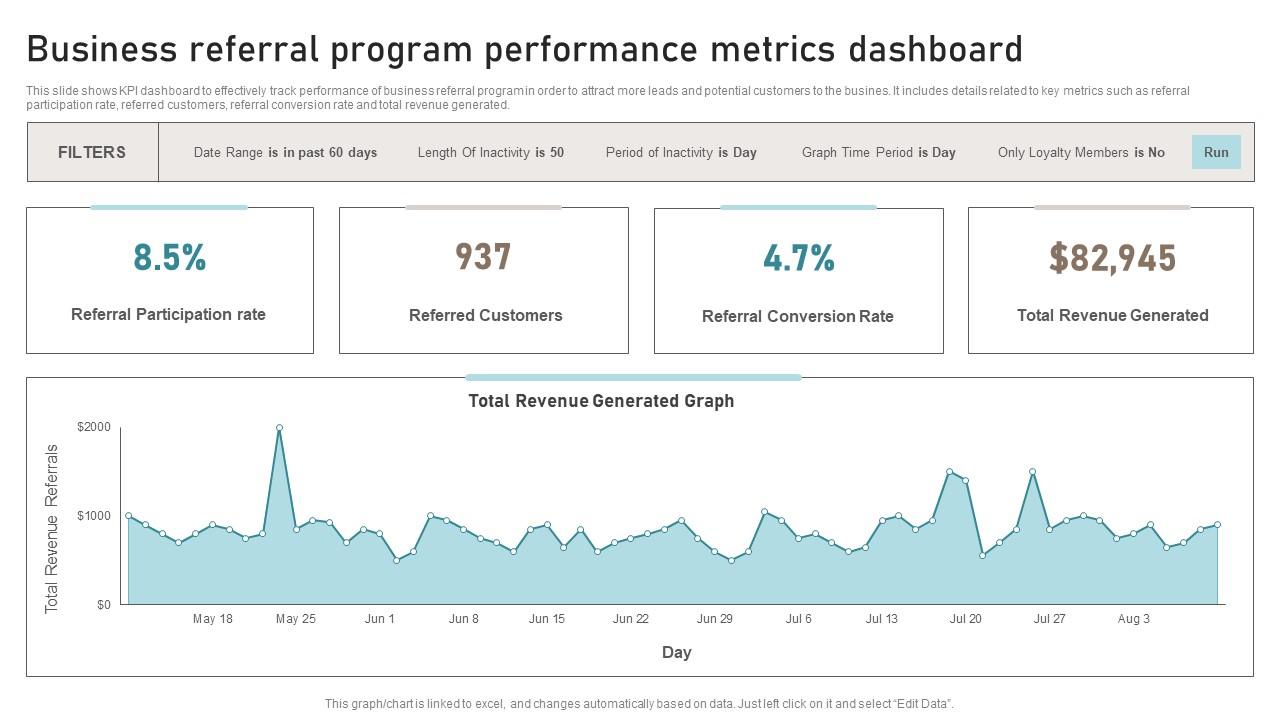
This slide shows KPI dashboard to effectively track performance of business referral program in order to attract more leads and potential customers to the busines. It includes details related to key metrics such as referral participation rate, referred customers, referral conversion rate and total revenue generated. Presenting our well structured Business Referral Program Performance Metrics Dashboard. The topics discussed in this slide are Referral Participation, Referred Customers, Conversion Rate. This is an instantly available PowerPoint presentation that can be edited conveniently. Download it right away and captivate your audience.

FAQs for Business Referral Program

Key performance indicators for business referral programs include referral conversion rate, customer acquisition cost, lifetime value of referred customers, referral participation rate, and program ROI. These metrics enable organizations to optimize their programs by identifying high-performing referral sources, reducing acquisition costs, and maximizing revenue generation, with many companies finding that referred customers deliver 25% higher retention rates and increased profitability.

Businesses can measure referred customer LTV by tracking long-term revenue, retention rates, purchase frequency, and average order values across customer acquisition channels. Through CRM analytics and cohort analysis, companies like subscription services and retail brands consistently find that referred customers demonstrate 25-50% higher lifetime values, longer retention periods, and increased cross-selling opportunities compared to traditional acquisition channels.

Effective CRM referral data collection methods include automated tracking codes, referral source fields during customer onboarding, post-purchase surveys, integration with referral program software, and customer self-reporting mechanisms. These approaches streamline data capture by embedding collection points throughout the customer journey, enabling businesses to automatically track referral sources, measure program effectiveness, and optimize reward systems, ultimately delivering enhanced customer insights and improved referral program ROI.

Referral conversion rates directly reduce customer acquisition costs by leveraging existing customers to acquire new ones at minimal expense, while simultaneously accelerating business growth through higher-quality leads. Organizations with strong referral programs often see acquisition costs drop by 50-70% compared to traditional marketing channels, with referred customers typically demonstrating higher lifetime value, faster onboarding, and greater retention rates, ultimately delivering sustainable competitive advantage.

Customer satisfaction serves as the foundation for referral program success, directly influencing referral rates, quality, and program sustainability. Satisfied customers become authentic advocates who generate higher-quality referrals, with many organizations finding that customers with satisfaction scores above 8/10 produce 3x more referrals, ultimately delivering lower acquisition costs and stronger long-term growth.

Businesses can approach referral source segmentation by categorizing sources based on customer lifetime value, acquisition costs, conversion rates, and referral quality scores. Through systematic analysis of these metrics, organizations in retail, financial services, and healthcare can identify their highest-performing channels, reallocate resources strategically, and optimize outreach efforts, ultimately delivering improved ROI and sustainable growth.

Effective referral incentives include monetary rewards like cash or credits, exclusive access to premium features or early releases, tiered benefits that increase with referral volume, and experiential rewards such as special events or personalized services. These incentives work best when they align with customer preferences and provide value to both referrers and new customers, with many businesses finding that combining immediate rewards with long-term benefits significantly increases participation rates and referral quality.

Industries vary significantly in referral tracking, with financial services emphasizing compliance-heavy metrics like customer lifetime value and acquisition costs, while retail focuses on conversion rates and social sharing analytics. Healthcare and B2B sectors prioritize long-term relationship metrics and account-based measurements, ultimately tailoring their approaches to regulatory requirements, customer behaviors, and industry-specific competitive advantages.

**INPUT**: What tools and technologies can streamline the monitoring of referral metrics? **OUTPUT**: Referral tracking tools include CRM platforms, marketing automation software, analytics dashboards, referral program platforms, and customer data management systems. These technologies streamline monitoring by automating data collection, providing real-time performance insights, and enabling comprehensive tracking across multiple channels, with many organizations finding that integrated solutions deliver enhanced operational efficiency and strategic competitive advantage. **Word count: 55 words**

Social media metrics inform referral program effectiveness by tracking engagement rates, click-through rates, conversion rates, share frequencies, and reach amplification across platforms. These metrics enable businesses to identify which social channels generate the highest-quality referrals, optimize content strategies, and measure viral coefficients, with many organizations finding that social-driven referrals deliver significantly higher lifetime customer value than traditional acquisition methods.

Referral metrics influence product development by revealing customer satisfaction patterns, feature preferences, and pain points that drive recommendations, while informing marketing strategies through identification of high-value customer segments and optimal messaging approaches. These insights enable companies to prioritize product enhancements, refine targeting strategies, and allocate resources more effectively, ultimately delivering improved customer experiences and sustainable growth through data-driven decision making.

Understanding referral source demographics enables businesses to identify their most valuable referrer segments, optimize targeting strategies, and customize incentive programs for different audience groups. By analyzing demographics like age, location, industry, and spending patterns, companies can tailor messaging, adjust reward structures, and focus resources on high-performing segments, ultimately increasing referral conversion rates and maximizing program ROI.

Common pitfalls include tracking vanity metrics instead of revenue impact, failing to measure referral quality versus quantity, ignoring customer lifetime value differences, and not accounting for attribution windows. Many organizations focus solely on referral volume while overlooking conversion rates, customer retention from referred users, and program ROI, ultimately missing opportunities to optimize their referral strategies for sustainable growth.

Businesses should analyze referral metrics monthly for comprehensive program evaluation, with weekly monitoring of key performance indicators like conversion rates, customer acquisition costs, and referral velocity. This strategic combination of frequent pulse checks and deeper monthly reviews enables organizations to quickly identify trends, optimize incentive structures, and adjust targeting strategies, ultimately delivering improved program ROI and sustained referral growth.

Referral program branding significantly enhances customer engagement and loyalty by creating memorable experiences, building emotional connections, and reinforcing brand values throughout the referral journey. Strong branding increases participation rates by 40-60%, with companies like Dropbox and Airbnb finding that consistent, appealing program design drives higher referral completions and strengthens long-term customer relationships.

Ratings and Reviews

90% of 100
Review Form
Write a review
Most Relevant Reviews
  1. 80%

    by Curtis Herrera

    Use of icon with content is very relateable, informative and appealing.
  2. 100%

    by Charley Bailey

    I didn’t expect such a good service for the money I am paying. But, they exceed my expectations. Great work SlideTeam.

2 Item(s)

per page: