Career ladder chart of management trainee
Try Before you Buy Download Free Sample Product
Audience
Editable
of Time
Our Career Ladder Chart Of Management Trainee are topically designed to provide an attractive backdrop to any subject. Use them to look like a presentation pro.
People who downloaded this PowerPoint presentation also viewed the following :
Content of this Powerpoint Presentation
When encouraging employees to see and exploit the better career advancement opportunities in their company, HR professionals often use the career ladder curve and showcase this diagram through a document. It helps management trainees get an idea of what their professional life could look like in a few years. In fact, during the hiring process, it is mandatory for some organizations to present a complete career progression graph before candidates, which also includes promotion details as well.
This chart puts forward steps of an employee’s occupation, which gives an all-round perspective. In this blog, we will learn about stages involved in the career ladder chart of management trainees. This can also guide hiring managers in explaining professional these graphs in a well-documented slide.
Career Ladder Chart of Management Trainee
You can edit this chart as per the career development graph of any company. According to your requirements, you can change the layout, font, and add or remove stages included in the career ladder slide.
If you are an software engineer or working in relevant field, do check out this career ladder of software engineer.
Now, let us discuss the chart which can +direct management trainees towards a vision that aligns with the specific job role, their skills and experiences.
Template 1: Career Ladder Chart of Management Trainee

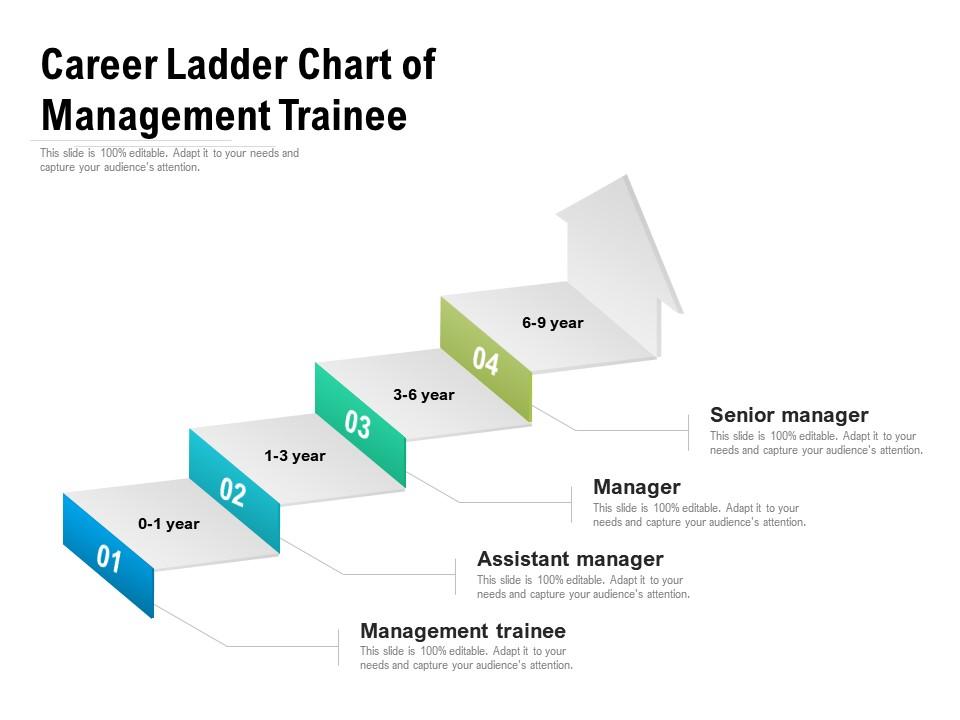
This PPT Template depicts four career ladder steps, which are basically opportunities or promotions that a trainee can look forward to for the next decade. This helps candidates plan for the following promotions mapped to the time as shown.
-
Management Trainee - First year position (0-1 year)
-
Assistant Manager - Promotion in the next two years (1-3 years)
-
Manager - Promotion in the next three years ( 3-6 years)
-
Senior Manager - Promotion in the next three years ( 6-9 years)
Depending on the organization and their line of work, these stages can be modified and the number of years are also not set in stone.
For more details, take a look at this employee career development and job ladder slide which will give you an overall idea of how the employment curve looks like.
PROFESSIONAL GROWTH OUTLINED
To sum up, to give a proper employment roadmap, we have designed this visually appealing guide mentioning the stages involved in it. These forward steps and jumps in the career ladder of management trainee highlights his employment graph, henceforth providing a lot of significance to his professional front. So, what are you waiting for, grab this eye catchy document and start planning your long term goals, thereby achieving great professional heights.
PS: To showcase the growth and development of one's career, go through this Professional Career Ladder For Employee Growth Implementing Effective Career Management Program. Understanding this program can give an extra push to your professional journey.
Career ladder chart of management trainee with all 2 slides:
Use our Career Ladder Chart Of Management Trainee to effectively help you save your valuable time. They are readymade to fit into any presentation structure.
FAQs for Career ladder chart
So it really depends on your field, but most programs rotate you through different departments. Retail ones usually cover operations, merchandising, customer service - plus you'll learn P&L stuff. Tech companies love having you shadow department heads and work on random cross-functional projects. Finance is heavy on analysis and client work, with tons of compliance training thrown in. Manufacturing gets pretty intense honestly - supply chain, quality control, safety protocols, the whole nine yards. Short sentences feel weird to write but whatever. The whole point is exposing you to everything before you pick a specialty, which actually makes sense when you think about it.
Start by volunteering for stuff nobody else wants to do - sounds boring but it gets you noticed. Help your teammates when they're stuck, and actually follow through when you say you'll do something (seriously, this alone puts you ahead of like half the people out there). Speak up in meetings with real ideas, not just generic comments. Mentoring new people is huge too. Oh, and document everything you do for performance reviews later. Once you've proven you're reliable, then you can push for leading actual projects or organizing team stuff. Baby steps but they add up.
So they're really looking for leadership stuff and communication skills - like can you actually work with people and influence them? Analytical thinking matters too, plus being adaptable and genuinely curious about business. Don't let the "trainee" label fool you though, these spots are super competitive. You gotta show initiative through concrete examples - times you led projects, solved problems, drove actual results. Quick learning and taking ownership are huge. Oh and make sure your resume has specific examples of when you stepped up and made stuff happen, not just vague descriptions.
So it really comes down to startup vs big company vibes. Startups throw you into everything at once - you're bouncing between departments super fast which is kinda cool but also chaotic as hell. Big corporations are way more structured with their rotations. Like, you'll do 3 months here, 4 months there, with actual mentors assigned to you. Startups let you text the CEO directly but good luck figuring stuff out on your own. Corporate has more hand-holding but you won't see real decisions being made for months. Definitely ask about their rotation setup when you interview though - some programs are amazing, others are just fancy busy work.
Hey! So these programs usually hit you with rotations through different departments first - honestly that's the gold part because you actually see how everything connects. They'll throw leadership workshops at you, assign a mentor, plus project management and presentation training. Oh and some kind of finance bootcamp too. Most programs give you "stretch assignments" where you lead small teams or projects. Super random tip but write stuff down during rotations! I kept referencing my notes for like two years after. The whole thing sounds overwhelming but the rotation experience alone makes it worth it.
Dude, networking is seriously everything as a management trainee. Like, I can't stress this enough - it'll make or break your whole career path. Coffee chats with people a level or two up from you are gold. They'll give you the real scoop on how things actually work, not just what's in the employee handbook. Senior leaders definitely notice trainees who put themselves out there across different departments. I get that it feels super weird at first (I used to hate it), but just think of it as making genuine connections. Your skills got you hired, but those relationships? That's what gets you promoted fast.
Honestly? The learning curve is brutal - you'll feel like you're drowning for the first few months. Imposter syndrome kicks in hard when you're sitting in meetings with VPs making six figures. Ask ALL the questions, even the ones that feel stupid. I cannot stress this enough. Set up weekly check-ins with your manager because expectations are usually muddy at best. Find someone who's been through the program already - they'll save your sanity. Oh, and write down your wins somewhere. Sounds cheesy but when you're questioning everything at 2am, you'll need proof you're actually learning stuff.
Definitely find mentors in your program and other departments too. They're amazing for figuring out office politics and learning faster. I seriously wish I'd been more strategic about this early on! Ask about their career journey, get feedback on your work, and watch how they deal with tricky situations. Good mentors will connect you with their network and push you toward opportunities you didn't even know existed. Don't just wait around for formal programs either - reach out for coffee chats. Worst they can say is no, right?
Track the concrete stuff first - project completion rates, budget accuracy, team engagement scores, plus whatever KPIs matter in your rotation departments. But don't sleep on the feedback side either. Your 360 reviews, mentor comments, stretch assignments you're getting offered - that stuff tells you how you're really doing. Skill certs and leadership moments count too. Honestly, I'd just make a basic monthly tracker where you dump all this data plus random wins or "oh shit" learning moments. Trust me, when review time comes you'll be so glad you have actual examples instead of trying to remember what you did six months ago.
Definitely check what learning platforms your company already pays for - you might be shocked what's just sitting there unused! The personalized training modules are actually pretty solid, and you can do them whenever. VR leadership sims are weirdly fun too, like playing a game but you're practicing difficult conversations. Real-time feedback tools help track where you're improving (or not lol). Virtual mentorship is huge - you can shadow senior managers without awkwardly hovering around their office. Plus digital collaboration gets you into cross-functional projects you'd never normally touch. Honestly, the analytics dashboards make it feel less overwhelming when you can see actual progress happening.
Look, getting feedback is seriously crucial when you're a management trainee. Think of it like having a GPS - you need input from your boss, coworkers, even people under you to figure out what's actually working. Otherwise you're just shooting in the dark, which honestly sounds exhausting. The smartest trainees I know don't wait around for formal reviews. They bug their managers weekly for specific feedback after projects or rotations. Quick course corrections beat developing terrible habits later. Oh, and actually use what they tell you - I've seen people ask for advice then completely ignore it. Don't be that person.
Dude, cross-functional experience is huge for management trainees. You get that bigger picture view since you actually know how sales talks to finance (spoiler: sometimes they don't). Makes you way more adaptable down the road. Building relationships across departments is clutch too - you'll need those connections later when stuff needs to happen fast. Don't just wait around for official rotations though. Hunt down projects that involve multiple teams. Trust me, that hands-on experience beats sitting in one silo any day.
Honestly, the biggest thing is getting tight with your manager and other teams - they're usually the ones pushing for you when roles open up. Document everything you accomplish and ask for feedback regularly so you're not guessing where you stand. I've watched way too many people just sit around hoping something happens (spoiler: it doesn't). Be upfront about wanting specific roles or departments. Flexibility helps too - maybe consider different locations or functions. Every single project is basically your audition, so bring your A-game. Oh, and start those "what happens next" convos like 2-3 months before you're done. Don't wait until the last minute.
Dude, you're actually in the perfect position for this! Fresh eyes are everything - you haven't been brainwashed by "we've always done it this way" yet. Those "stupid" questions you're probably afraid to ask? They often lead to the best ideas. Since you rotate through departments, you'll spot connections that people who've been stuck in one area forever totally miss. I'd start jotting down little inefficiencies you notice during your rotations. Honestly, sometimes the most obvious improvements are invisible to people who've been doing the same job for years. Your enthusiasm for trying new stuff can actually rub off on others too. Those notes could become your first real proposals.
You definitely want both short-term wins and bigger picture goals. Take something huge like "become a director" and chop it into quarterly chunks - learn a new skill, lead some cross-team project, network with people in departments you want to move into. The companies I've seen that promote people fastest? They're super deliberate about this stuff. Actually write your goals down (I know, I know, but it works) and check them monthly. Oh, and make sure they match what your company actually rewards people for, not just what sounds cool. There's a difference.
No Reviews