


Contribution Powerpoint Presentation Slides





Try Before you Buy Download Free Sample Product
 Impress Your
 Audience
 100%
100% Editable
 Save Hours
 of Time


Burst into their imagination with our Contribution Powerpoint Presentation Slides. Inspire folks with your brilliance.
People who downloaded this PowerPoint presentation also viewed the following :
Content of this Powerpoint Presentation
Slide 1: This slide introduces Contribution. State the name of your company and begin.
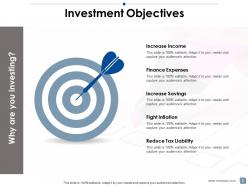
Slide 2: This slide shows Investment Objectives with arrow and target imagery and the following points- Increase Income, Finance Expenses, Increase Savings, Fight Inflation, Reduce Tax Liability.
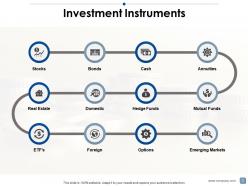
Slide 3: This slide shows Investment Instruments which include- Stocks, Real Estate, ETF’s, Annuities, Mutual Funds, Emerging Markets, Bonds, Domestic, Foreign, Cash, Options, Hedge Funds.
Slide 4: This slide shows Mutual Funds with imagery and text boxes.
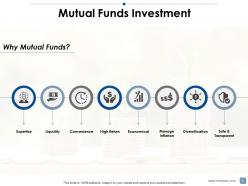
Slide 5: This slide shows Mutual Funds Investment with the following components- Convenience, Economical, Diversification, Expertise, Liquidity, High Return, Safe & Transparent, Manage Inflation.
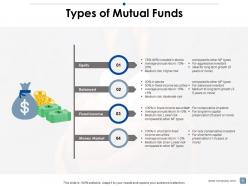
Slide 6: This slide shows Types of Mutual Funds divided into four categories- Equity, Balanced, Fixed Income, Money Market.
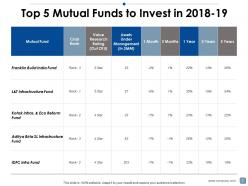
Slide 7: This slide shows Top 5 Mutual Funds to Invest in 2018-19.
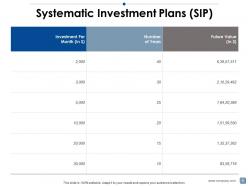
Slide 8: This slide shows Systematic Investment Plans (SIP).
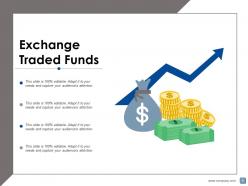
Slide 9: This slide shows Exchange Traded Funds. Add them in the given text boxes.
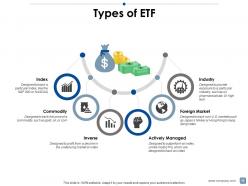
Slide 10: This slide shows Types of ETF- Commodity, Index, Industry, Inverse, Actively Managed, Foreign Market.
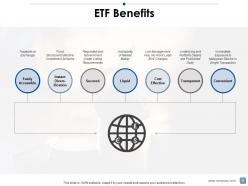
Slide 11: This slide shows ETF Benefits. Some of these are- Easily Accessible, Instant Divers-ification, Transparent, Liquid, Convenient, Secured, Cost Effective.
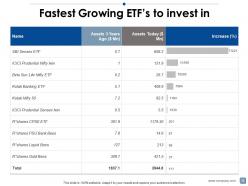
Slide 12: This slide presents a table showing Fastest Growing ETF’s to invest in.
Slide 13: This slide shows Bonds with relevant imagery and text boxes.
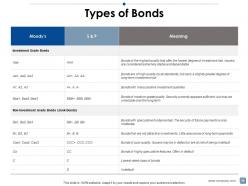
Slide 14: This slide presents a table which shows Types of Bonds.
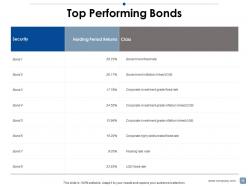
Slide 15: This slide shows Top Performing Bonds data presented in a tabular form.
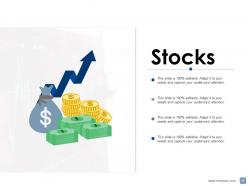
Slide 16: This slide shows Stocks which you can add as per your business requirement. You can also mention other information related to stocks in this slide.
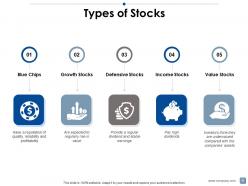
Slide 17: This slide shows Types of Stocks. We have mentioned five of them which you can use as per your requirement.
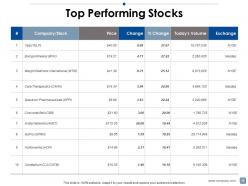
Slide 18: This slide shows Top Performing Stocks which is presented in a tabular form. You can state the data of your own stocks and analyse or compare them using this table.
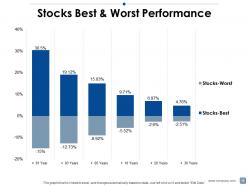
Slide 19: This slide presents Stocks Best & Worst Performance graph in terms of years.
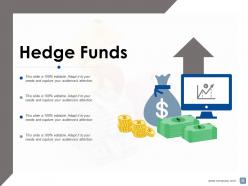
Slide 20: This slide shows Hedge Funds which you can add.
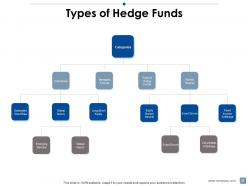
Slide 21: This slide shows Types of Hedge Funds- Directional, Managed Futures, Fund of Hedge Funds, Market Neutral, Equity Market Neutral, Event Driven, Fixed Income Arbitrage, Convertible Artbitrage, Global Macro, Long/Short Equity, Dedicated Short Bias, Emerging Markets.
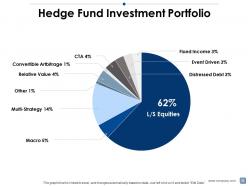
Slide 22: This slide shows the Hedge Fund Investment Portfolio.
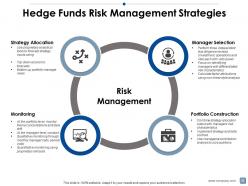
Slide 23: This slide shows Hedge Funds Risk Management Strategies. We have mentioned four of its categories which include- Strategy Allocation, Manager Selection, Monitoring, Portfolio Construction.
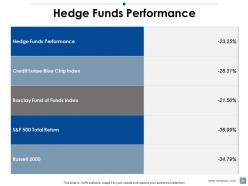
Slide 24: This slide shows Hedge Funds Performance in terms of percentage.
Slide 25: This is Contribution Icon Slide. Add/ remove icons as per your need.
Slide 26: This is a Coffee Break slide to halt. You may change it as per requirement.
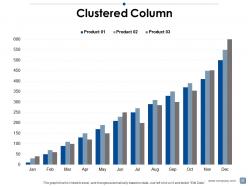
Slide 27: This is a Clustered Column slide to show product/ entity comparison, specifications etc.
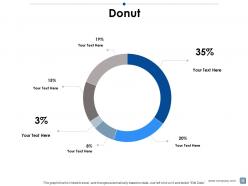
Slide 28: This slide displays a Donut Pie chart to show the percentage of entities.
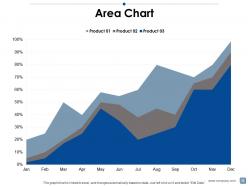
Slide 29: This is an Area Chart slide to present product/ entity comparison, information etc.
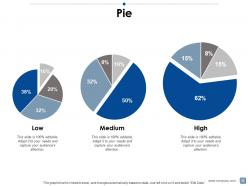
Slide 30: This is a Pie Chart slide to show product/ entity comparison, specifications etc.
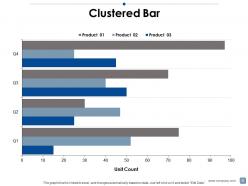
Slide 31: This is a Clustered Bar graph slide to show product/ entity comparison, specifications etc.
Slide 32: This slide is titled Additional Slides to move forward. You can change the slide content as per need.
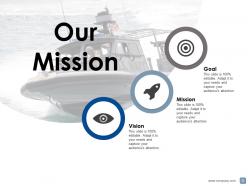
Slide 33: This slide shows Our Mission along with vision and goals.
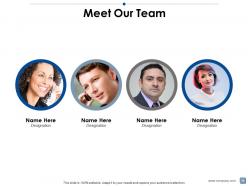
Slide 34: This slide showcases Meet Our Team with designation, text boxes and image to fill.
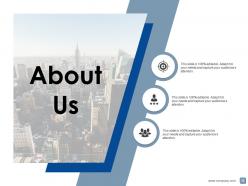
Slide 35: This an About Us slide. State your company heads, leaders, visionaries here.
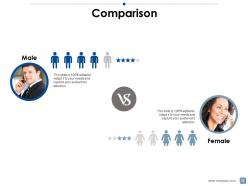
Slide 36: This slide showcases Comparison of two entities male female with imagery.
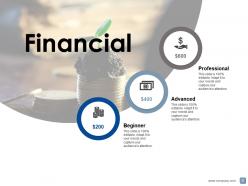
Slide 37: This is a Financial score slide. State financial aspects, information etc. here.
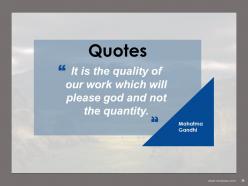
Slide 38: This is a Quotes slide. Insert a quote or whatever you desire here.
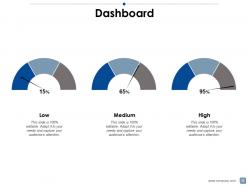
Slide 39: This is a Dashboard slide with numerals to use for presenting kpis, metrics etc.
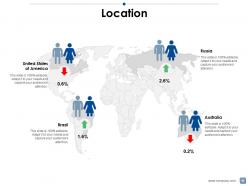
Slide 40: This slide shows a world map under the heading- Location. Compare sales, growth or any other factor in global terms.
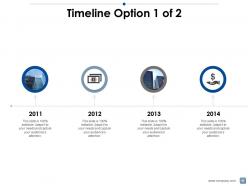
Slide 41: This is a Timeline slide to present important dates, journey, evolution, milestones etc.
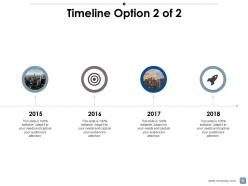
Slide 42: This is also a Timeline slide to present important dates, journey, evolution, milestones etc.
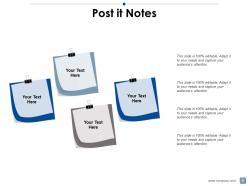
Slide 43: This is a Post It Notes slide to mark events, important information etc.
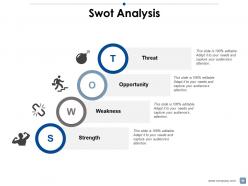
Slide 44: This slide shows Swot Analysis.
Slide 45: This is a Thank You slide with Address# street number, city, state, Contact Numbers, Email Address.
Contribution Powerpoint Presentation Slides with all 45 slides:
Create a driving force with our Contribution Powerpoint Presentation Slides. Bring about a fusion of energies.


FAQs for Contribution
Honestly, just figure out what you're actually good at first - maybe you're the research person or the one who spots all the mistakes everyone else misses. Communication is everything though. Update people regularly and don't disappear for weeks (we all hate that person). Jump in to help teammates when they're drowning, even if it's not technically your job. Short answer: be reliable and stay engaged. Oh, and speak up when you're stuck! Most people appreciate honesty over someone pretending everything's fine when it's not. Consistency beats perfection every time.
Honestly, it all comes down to whether people actually want to be there or just collecting a check. Good workplaces make you feel safe to speak up - like your ideas won't get shot down immediately. People naturally do more when they feel appreciated and trusted. Toxic places? Total opposite. Everyone just keeps their head down doing the bare minimum because speaking up feels risky. I've seen this play out so many times. If you want your team contributing more, start with genuine appreciation and building trust first. The rest kind of follows from there.
So remote work really comes down to having the right tech stack. Slack or Teams keeps everyone chatting in real-time, while Google Workspace lets you all edit docs simultaneously without chaos. Project management stuff like Asana is clutch for tracking who's doing what. Video calls are fine but honestly? The async tools do most of the heavy lifting. Cloud storage means files are accessible instantly from anywhere. Version control prevents that nightmare where everyone's working on different versions - been there, it sucks. Just make sure whatever tools you pick actually play nice together.
Set measurable goals upfront so everyone knows what counts. Then track both the hard numbers (deadlines hit, tasks done) and the softer stuff through peer feedback. Honestly, peer reviews are gold because they see things you won't as a manager. Regular check-ins help you spot who's actually driving decisions or jumping in to help teammates. Oh, and 360-degree feedback or contribution matrices work great too if you want something more formal. Just be upfront about your tracking methods from the start - nobody likes surprise evaluations.
Make people see how their work actually matters - connect the dots to the big picture. Honestly, recognition is huge... even just calling someone out in a meeting makes a difference. Mix up ways people can get involved - some want quick tasks, others dig deeper. Regular check-ins where folks can share ideas help too. Remove the annoying stuff like confusing processes or crazy time demands. Oh, and different engagement levels work well since not everyone has the same bandwidth. Bottom line: show that contributions count and make people feel valued for what they bring.
Mix public shout-outs with rewards people actually care about. Team meeting recognition works great, or just shoot them a quick "you killed it on that project" message. Public praise honestly hits different than bonuses sometimes (though cash is nice too lol). Personalize the rewards - extra PTO, training budget, gift cards, whatever they're into. Be specific about what they did instead of generic "good job" stuff. Don't wait forever to say something either. Oh and peer nominations are clutch if you want people buying in.
Your leadership style totally changes how much people actually chip in. Autocratic gets stuff done but kills creativity - everyone just follows orders. Democratic is where it's at though, people feel valued so they'll actually speak up and put in extra effort. Laissez-faire? Hit or miss - works great with motivated people but some will just coast. I've noticed the best leaders switch it up based on who they're dealing with and what's happening. Like, some people need more direction while others thrive when you back off. Watch how your team responds and adjust from there.
Yeah, this stuff gets toxic fast. High performers start resenting everyone else while the slackers just... slack. Then you've got this weird situation where only like two people know how anything works, which is a nightmare when they're swamped or take time off. Your best people burn out obviously, and you miss out on fresh perspectives from the rest of the team. Honestly? Call it out early before it becomes this whole thing. Have real conversations about who's good at what and redistribute the workload accordingly.
Figure out what everyone's actually good at first, then build roles around that instead of just throwing tasks at people randomly. Cross-pollination is huge - get your designer in tech meetings, let your analyst present to everyone. Most teams completely skip this part which is honestly wild to me. Mix up who's leading conversations so the quiet people get a chance to speak up too. Oh, and block out real time for people to teach each other what they do. Sounds basic but you'd be surprised how many teams never do it. Trust me, it makes a difference.
Honestly, it's all about psychological safety. People clam up when they think their ideas might get shot down or mocked. Past bad experiences stick with you, you know? Plus imposter syndrome is real - makes you second-guess everything. Some people are just naturally more introverted or risk-averse too, which doesn't help. But here's the thing: when someone feels actually heard and valued, they open up way more. Success breeds confidence. The trick is making "bad" ideas totally okay - like, they're just stepping stones anyway. Once you remove that fear of looking dumb, people start contributing freely.
Honestly, most teams are terrible at this - they just forget to call out who actually did the work. Start small with your team meetings by mentioning specific people and what they pulled off that week. I'd also document contributions in your project updates since everyone always skips that part. Maybe try a weekly shoutouts channel? Even just 5 minutes during standup works. The trick isn't doing something huge - it's being consistent about it. People need to see how their stuff connects to the bigger wins, so dashboards or regular roundups help too.
Just be honest about who did what - don't give someone credit for work they barely touched. I've seen too many projects where the loudest person gets all the recognition while the person who actually coded everything gets forgotten. Keep track of contributions as they happen, trust me on this one. A simple shared doc works great so you're not scrambling later trying to remember who built what feature. Also, check with people before publicly crediting them - some folks hate being in the spotlight. Give credit based on actual work, not office politics or who's been there longest. It saves so much drama.
Yeah, this stuff gets tricky with different cultural backgrounds on teams. Some cultures are all about shouting out individual wins, while others focus more on group success. What you're seeing as "low contribution" might actually be someone doing tons of behind-the-scenes work. Communication styles are huge too - some people expect you to speak up about your work, others think good work should just speak for itself. Then there's the whole hierarchy thing which varies like crazy between cultures. Honestly, I'd just have a direct convo with your team about how you define contributions. Maybe create different ways for people to show their work besides just meeting participation?
Feedback is like GPS for your team - shows people if they're on track or need to pivot. Give specific, timely input and team members know what's working, so they'll contribute more confidently. But vague or late feedback? That kills momentum fast. People either go overboard with the wrong stuff or clam up because they're unsure. Honestly, I've seen this happen way too much. Regular check-ins work best - acknowledge good work and give clear direction on what needs tweaking. Try brief weekly sessions. You'll notice both quality and participation jump pretty quickly.
Oh man, gamified challenges are where it's at! Make people compete for recognition through hackathons or bounty programs. Reddit nailed this - users post because upvotes feel amazing and they're part of something bigger. Try "contribution sprints" where everyone tackles goals together in short bursts. Micro-task platforms work too, just break everything into bite-sized pieces so it's not overwhelming. Social media contests are solid. Create contributor tiers with badges and perks - people love collecting that stuff, honestly. The trick is making it social rather than feeling like actual work.
No Reviews