Dashboard To Monitor Department Wise Budget Allocation And Usage Organization Budget Forecasting

Rating:
90%
Dashboard To Monitor Department Wise Budget Allocation And Usage Organization Budget Forecasting
Slide 1 of 7
Favourites Favourites

Try Before you Buy Download Free Sample Product

Audience Impress Your
Audience
Editable 100%
Editable
Time Save Hours
of Time
The Biggest Sale is ending soon in
0
0
:
0
0
:
0
0
Rating:
90%
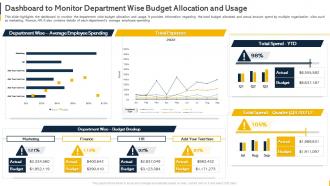
This slide highlights the dashboard to monitor the department wise budget allocation and usage. It provides information regarding the total budget allocated and actual amount spent by multiple organization silos such as marketing, finance, HR. It also contains details of each departments average employee spending. Deliver an outstanding presentation on the topic using this Dashboard To Monitor Department Wise Budget Allocation And Usage Organization Budget Forecasting. Dispense information and present a thorough explanation of Dashboard To Monitor, Department Wise Budget, Allocation And Usage using the slides given. This template can be altered and personalized to fit your needs. It is also available for immediate download. So grab it now.

People who downloaded this PowerPoint presentation also viewed the following :

FAQs for Dashboard To Monitor Department Wise Budget Allocation And Usage

Key budget dashboard metrics include actual vs. budgeted spending, variance analysis, cash flow projections, departmental cost breakdowns, and expense categorization by fixed and variable costs. These financial indicators streamline oversight by enabling real-time monitoring, identifying spending patterns, and facilitating proactive adjustments, with many organizations finding that comprehensive dashboards ultimately deliver enhanced cost control and strategic resource allocation.

Data visualization techniques enhance budgetary understanding by transforming complex financial data into intuitive charts, graphs, heat maps, and interactive dashboards that reveal spending patterns, variance trends, and resource allocation insights. These visual tools enable finance teams and executives to quickly identify budget deviations, optimize departmental spending, and make strategic decisions faster, ultimately delivering improved financial transparency and competitive operational efficiency.

**INPUT**: What software tools are best suited for creating an effective budget dashboard? **OUTPUT**: Budget dashboard software tools include Tableau, Power BI, Excel with advanced features, QuickBooks Dashboard, and specialized platforms like Adaptive Insights or Planful. These solutions streamline financial visualization by automating data integration, enabling real-time tracking, and delivering customizable reporting capabilities, with many finance teams finding that interactive dashboards significantly enhance budget monitoring and strategic decision-making processes. **Word count: 58 words**

A budget dashboard helps identify spending trends by visualizing expenditure patterns through charts, graphs, and comparative analytics across different time periods, categories, and departments. Through automated data tracking and trend analysis, organizations can quickly spot seasonal variations, cost escalations, and budget deviations, enabling proactive financial management and strategic resource reallocation for improved operational efficiency.

Common pitfalls include overcrowding with excessive metrics, poor visual hierarchy, lack of real-time data integration, insufficient user role customization, and unclear variance indicators. These design flaws undermine decision-making effectiveness by creating confusion rather than clarity, with many financial teams finding that streamlined, role-specific dashboards enhance budget monitoring accuracy and accelerate strategic responses.

Budget dashboards can be tailored through customized data granularity, visualization complexity, and access permissions that align with each organizational level's decision-making needs. Executive dashboards emphasize high-level financial summaries and strategic KPIs, departmental versions focus on operational metrics and resource allocation, while project-specific dashboards deliver detailed cost tracking and milestone progress, ultimately enabling targeted financial oversight and faster, more informed budgetary decisions across the organization.

Real-time data transforms budget dashboards from static reports into dynamic management tools, enabling immediate variance detection, proactive decision-making, and continuous financial monitoring throughout budget cycles. Through live integration with accounting systems, organizations can identify spending anomalies, adjust allocations instantly, and maintain tighter fiscal control, ultimately delivering enhanced financial transparency and strategic responsiveness.

Stakeholder engagement during budget dashboard development involves conducting workshops to understand user needs, creating prototype reviews for feedback, establishing cross-functional teams with finance and operations representatives, and implementing pilot testing phases. This collaborative approach ensures the dashboard addresses real workflow challenges, incorporates department-specific requirements, and builds user buy-in, with many organizations finding that early stakeholder involvement significantly increases adoption rates and dashboard effectiveness.

Best practices for updating and maintaining a budget dashboard include establishing regular update schedules, ensuring data accuracy through automated feeds, maintaining clear visual hierarchies, and implementing user access controls. These approaches streamline financial monitoring by reducing manual errors, enhancing real-time visibility, and enabling faster decision-making, with many organizations finding that consistent maintenance ultimately delivers improved budget accuracy and operational efficiency.

**INPUT**: How can you ensure that a budget dashboard remains user-friendly while presenting comprehensive data? **OUTPUT**: Budget dashboards balance user-friendliness and comprehensive data through intuitive design, customizable views, interactive filtering, clear visual hierarchies, and progressive disclosure techniques. These approaches enable organizations to streamline complex financial information while maintaining accessibility, with many financial institutions finding that layered dashboards ultimately deliver enhanced decision-making capabilities and improved stakeholder engagement across departments. [Word count: 54 words]

Budget dashboards provide insights including spending pattern analysis, variance identification between planned and actual costs, cash flow trends, departmental performance metrics, and seasonal expenditure fluctuations. These comprehensive analytics enable organizations to develop more accurate forecasts, optimize resource allocation, and identify cost-saving opportunities, with many financial teams finding that real-time visibility ultimately delivers improved strategic planning and enhanced competitive positioning.

A budget dashboard supports compliance and risk management by providing real-time visibility into spending patterns, automated alerts for budget variances, and comprehensive audit trails for regulatory requirements. Through integrated monitoring systems, organizations can identify potential financial risks early, ensure adherence to spending policies, and maintain transparent documentation, ultimately delivering enhanced regulatory compliance and proactive risk mitigation across all departments.

Interactive elements in budget dashboards include drill-down capabilities, real-time filtering, dynamic visualizations, customizable views, and clickable forecasting tools. These features streamline financial analysis by enabling instant data exploration, personalized reporting, and collaborative decision-making, with many finance teams finding that interactive dashboards ultimately deliver faster budget adjustments and enhanced strategic planning capabilities.

Integrating budget dashboards with other financial tools enhances decision-making by consolidating data streams, eliminating information silos, and providing real-time comprehensive visibility across all financial operations. This strategic combination enables organizations to track variances instantly, automate forecasting processes, and identify cost-saving opportunities more effectively, with many financial teams finding that integrated systems deliver faster reporting and significantly improved resource allocation accuracy.

Data accuracy in budget dashboards requires implementing automated data validation rules, establishing regular reconciliation processes, creating audit trails, and setting up real-time error alerts. These strategies work by minimizing manual entry errors, ensuring consistent data sources, and enabling quick identification of discrepancies, with many finance teams finding that automated controls ultimately deliver more reliable reporting and faster budget cycle completion.

Ratings and Reviews

90% of 100
Write a review
Most Relevant Reviews
  1. 80%

    by James Rodriguez

    Placing an order on SlideTeam is very simple and convenient, saves you a lot of your time. 
  2. 100%

    by Michael Allen

    Really like the color and design of the presentation.

2 Item(s)

per page: