


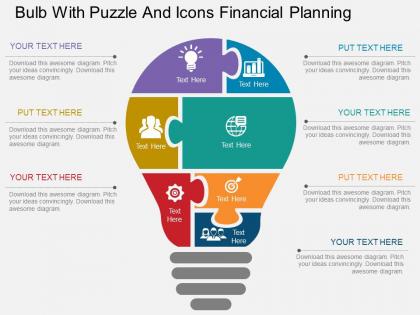
Eb bulb with puzzle and icons financial planning flat powerpoint design




Try Before you Buy Download Free Sample Product
 Impress Your
 Audience
 100%
100% Editable
 Save Hours
 of Time


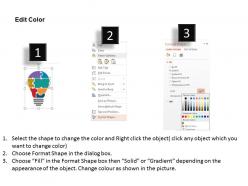
Use our bulb with puzzle and icons financial planning flat PowerPoint Design Template to highlight your financial aspects in a creative way. Our presentation designs are created by our team of professional designers. This Power Point template diagram has been crafted with graphic of a bulb comprising of colored puzzle pieces. This PPT diagram contains the concept of business idea generation and problem solving. You can also use the slide for financial planning process. Financial Planning is the process of estimating the capital required and determining it’s competition. It is the process of framing financial policies in relation to procurement, investment and administration of funds of an enterprise. Finance is required at every step of your business. Financial Planning helps in ensuring a reasonable balance between outflow and inflow of funds so that stability is maintained. With the help of our PPT Slide Graphic you can easily showcase your financial requirements and attract more investors towards your business. We have a wide range of other finance related Slide Designs which can meet your requirements. Download and use now. Get your team to play the beat. Set the rhythm with our eb Bulb With Puzzle And Icons Financial Planning Flat Powerpoint Design.
People who downloaded this PowerPoint presentation also viewed the following :
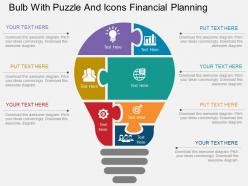
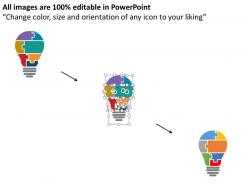
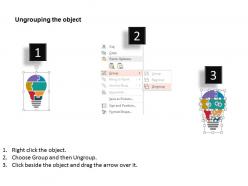
Eb bulb with puzzle and icons financial planning flat powerpoint design with all 4 slides:
Alter your approach as per the demand with our eb Bulb With Puzzle And Icons Financial Planning Flat Powerpoint Design. Acquire the flexibility that you desire.
FAQs for Eb bulb with puzzle and icons financial planning
So a good financial plan hits six key things: budgeting/cash flow, emergency fund (3-6 months expenses), debt management, investing, insurance, and retirement planning. Estate planning too if you've got kids or decent assets - though most people avoid that like the plague. My advice? Start with budgeting and emergency savings first. Don't jump into everything at once because you'll just stress yourself out. I made that mistake early on. Review stuff regularly since your situation changes. Life's funny that way - what matters at 25 isn't the same at 35.
So first thing - figure out your net worth by adding up everything you own minus what you owe. Then track your monthly money flow for like a month or so. I use Mint but honestly any spreadsheet works fine. Quick red flags: spending more than you make (duh), no emergency fund saved up, and your debt payments eating up too much of your income. You want 3-6 months expenses stashed away and try to save 10-15% for retirement if you can swing it. Once you see where your money's actually going, the problem areas become pretty obvious.
Honestly, budgeting changed everything for me. You'll actually see where your money disappears to each month - it's wild how those little purchases add up. I always thought it'd be this huge restriction, but it's the opposite? Like, now I know if I can swing that weekend trip without stressing about rent later. Start super basic - just write down what comes in and what goes out for like a month. Track your big goals too, whether it's a house down payment or killing credit card debt. Trust me, catching overspending early beats that panic when your card gets declined.
Honestly, just picture your portfolio dropping 30% overnight - would you freak out and sell everything, or stay chill? That's your real risk tolerance right there. Your age plays into it too since younger people have way more time to bounce back from crashes. Think about your emergency fund, job stability, all that practical stuff. Those online quizzes are kinda meh tbh. What really matters is being honest about how you'd actually react when things get ugly. I'd say start conservative and see how you handle the bumps - you can always get more aggressive later once you know what you're working with.
Definitely max out your 401(k) match first - seriously, it's free money. After that, maybe open an IRA for extra tax benefits. I know everyone says this, but starting early really does make a huge difference because of compound interest. Oh, and set up automatic contributions so you don't even think about it. Whenever you get a raise, bump up your savings rate a bit. Even $50 a month is better than nothing when you're starting out. The whole "pay yourself first" thing actually works.
First thing - actually track where your money goes for like a week. You'll be shocked at the random stuff adding up (looking at you, DoorDash). Once you know that, set real goals with deadlines. "We want $30k for a house in 18 months" beats vague saving plans every time. Break it into monthly chunks you won't hate hitting. Separate accounts are clutch - keeps you from accidentally spending wedding money on concerts. Add 10-15% extra to whatever you think you'll need because life happens and prices change. Oh, and automate everything right after payday. Trust me, relying on motivation to save is a recipe for disappointment.
Look, a good financial advisor saves you tons of time since you don't have to become a tax expert yourself. They'll catch deductions you'd miss and actually build a portfolio that makes sense for your situation. Honestly, the mental relief alone is worth it - no more stressing about whether you're doing everything wrong. Having someone check in also keeps you accountable instead of just winging it. Just make sure they're a fiduciary (they have to put your interests first) and are upfront about what they charge. Ask around for recs or check their credentials on FINRA's site.
Honestly, getting the right apps changed everything for me with money stuff. I used to be terrible at tracking expenses but now Mint or YNAB just handle it automatically - they'll categorize your spending and bug you when you're going overboard. Investment apps are pretty sweet too since you can start with like $5 instead of needing thousands. Everything syncs up so you don't have to manually enter a bunch of receipts and bank statements (thank god). Maybe start with just one budgeting app first though? You can always add investment tools later once you've got the hang of it.
Ugh, taxes are such a pain but they totally mess with your money plans. Like, you need to know what you're actually keeping after Uncle Sam takes his cut. Max out your 401k and IRA first - that's easy money saved right there. Then there's all the capital gains stuff which honestly changes every few years and makes my head spin. But yeah, basically every big money move you make should have you thinking "wait, how will this screw me tax-wise?" I'd say look at what you're paying now and see if there's obvious stuff you're missing.
You definitely need an emergency fund - basically money set aside for when stuff hits the fan. Most people say 3-6 months of expenses, which honestly sounds terrifying at first. Don't stress about that number though. Just start with $500 or $1000, whatever feels doable. Then keep chipping away at it each month. I'd put it in a high-yield savings account so it's not just sitting there earning nothing, but you can still grab it quickly. My cousin learned this the hard way when her car died last year. Start somewhere, even if it's just $50 a month.
So there are two main approaches - debt avalanche and snowball. Avalanche hits your highest interest rates first, which saves you the most money. Snowball goes after smallest balances for quick wins. I'm personally team avalanche, but honestly snowball works if you need those motivation boosts to keep going. List out everything with balances and rates first - that way you'll see the full picture. Oh, and definitely set up autopay for minimums so you don't get hit with late fees. Maybe look into consolidation loans too if you can snag a better rate. Just pick one method and stick with it.
Look, the old rule is your age minus 100 for your stock percentage - so at 30 you'd do 70% stocks, 30% bonds. But honestly? That feels super conservative now that we're all gonna live forever lol. I'd probably bump up the stock allocation a bit. Throw in some REITs and international stuff too - diversification is your friend. Index funds are perfect when you're starting out since the fees won't eat you alive. Just don't forget to rebalance once a year or you'll end up with a mess.
Look, insurance isn't just another bill - it's protecting what you're working toward. Health insurance is absolutely mandatory because one hospital stay can wreck you financially. If people rely on your paycheck, get life insurance. Disability coverage is something most people ignore, but honestly? You're way more likely to get injured than die in your 20s or 30s. Don't forget property stuff for your house and car either. Find that sweet spot between decent coverage and what won't break your budget. Check everything once a year when life changes.
Honestly? I do mine twice a year now because stuff changes so fast. Most people say annually but that feels too long to me. Big life stuff is when you really need to look at it though - marriage, kids, new job, house buying, whatever. Those quarterly check-ins are clutch for staying on track without doing a full deep dive. Oh and set a phone reminder right now or you'll totally forget. I learned that the hard way! Your goals shift more than you think they will.
Khan Academy has this solid personal finance course that's totally free. Your library probably has workshops too - people always forget about that option. Credit unions do classes sometimes, and community colleges have cheap ones. Planet Money's a good podcast if you're into that format, or Mint for basic budgeting stuff. Honestly though, just pick one thing and actually use it instead of downloading like 15 apps and never opening them. That's what I always end up doing lol. The National Endowment for Financial Education site is decent too if you want something more official.
-
i have Student so please provide student based ppt version free base.
thanks other all ppt are very good. its all beatifull slides -
I really love the slides
-
Great quality product.
-
The content is very helpful from business point of view.