HR Analytics To Track Employees Information
Try Before you Buy Download Free Sample Product
Audience
Editable
of Time
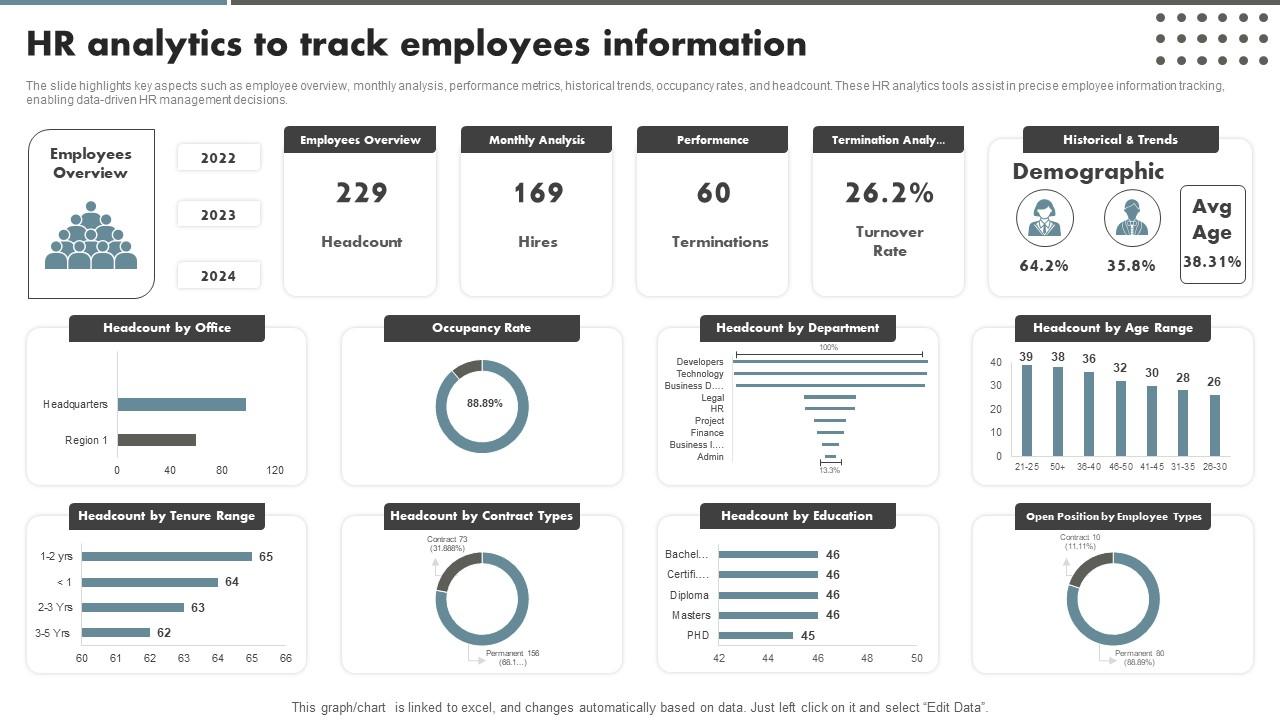
The slide highlights key aspects such as employee overview, monthly analysis, performance metrics, historical trends, occupancy rates, and headcount. These HR analytics tools assist in precise employee information tracking, enabling data driven HR management decisions.
People who downloaded this PowerPoint presentation also viewed the following :
HR Analytics To Track Employees Information with all 10 slides:
Use our HR Analytics To Track Employees Information to effectively help you save your valuable time. They are readymade to fit into any presentation structure.
FAQs for HR Analytics To
Honestly, focus on four things: good data setup, tying everything back to actual business goals, having people who can translate numbers into HR decisions, and - this is huge - getting managers to actually do something with the insights. Clean data is non-negotiable because crappy data gives you crappy answers. Don't get caught up in vanity metrics that just make pretty charts. I'd say pick one area where you can show real impact first, then build from there. The most sophisticated analysis in the world won't help if leadership ignores it anyway.
So basically, you can catch people before they bail by watching engagement scores, performance reviews, PTO patterns - that kind of stuff. Exit interviews are gold for finding common threads btw. Look for which teams lose people most and what correlates with departures. Sometimes the data shows you things that are stupidly obvious in hindsight! Predictive models help flag who's at risk early. Then you can actually do something about it - better career convos, pay bumps, or dealing with terrible managers. Start with your exit data first.
Honestly? Excel still handles like 70% of what most HR teams actually need. For the fancy visualization stuff, everyone's using Tableau or Power BI. SQL's pretty much essential if you want to pull your own data instead of bugging IT constantly. Workday Analytics and BambooHR are solid if you're already on those platforms. Python or R if people are feeling ambitious about predictive analytics - though let's be real, most teams aren't there yet. Oh, and Google Analytics for tracking recruitment funnels. Just make sure whatever you pick actually connects to your current HRIS. Manual exports every month will make you lose your mind.
So basically HR analytics takes all that employee data you're already collecting and actually makes it useful. Like, instead of wondering why Sarah from accounting quit, you can spot patterns in turnover and figure out what's really going on. Same with hiring - the data shows you which candidates will probably work out vs the ones who look good on paper but flame out. Honestly, most companies are sitting on goldmines of info in their systems and don't even realize it. My advice? Start small with one problem - maybe why your sales team keeps leaving - then dig into the numbers from there.
Honestly, data quality is gonna be your biggest headache. Everything's scattered across different systems and half of it's wrong or missing. Leadership buy-in is brutal too - they still think HR is all touchy-feely stuff and don't trust the analytics. Privacy issues are another pain since you're dealing with employee data. Oh, and good luck finding someone who actually gets both HR and data analysis. That's like finding a unicorn. Start with something small that fixes an obvious problem first. Once you show results, everything else gets easier.
So basically you'd look at your past hiring data and turnover rates to predict future needs. Seasonal stuff matters too - like if you always hire more people in Q4. I'd grab at least 2-3 years of data to start building models. They can get surprisingly accurate once you factor in department turnover patterns and planned growth. The cool part is you're not just forecasting headcount but actual skill gaps too. Like maybe you'll need three developers but also someone for succession planning. Honestly took me forever to realize how much this beats just winging it with hiring.
Look, HR analytics is honestly a game changer for employee engagement stuff. Instead of just guessing what's wrong, you'll actually have real data showing you which teams are struggling and which managers are killing it. Those pulse surveys? Pure gold for spotting problems before people walk out the door. I love that you can finally prove your engagement programs are worth the budget instead of crossing your fingers. Oh, and you can see exactly what's bombing vs. what actually works. Start simple though - just pick one thing like eNPS and track it religiously.
Honestly, start with productivity stuff - revenue per employee and whether people are hitting their goals. That's your bread and butter. Employee Net Promoter Score is clutch too, it basically tells you if your culture sucks or not. Engagement and retention rates are obvious but super important. Oh, and track time-to-hire and how often people are calling out sick - catches problems before they blow up. Internal mobility is good too if you have the bandwidth. But seriously, don't go crazy with like 20 different metrics. Pick maybe 4-5 that actually matter for your business and go from there.
Look, pull your performance reviews and training records first - even the messy ones. Map what skills you've got against what you actually need for business goals. When you visualize this stuff, it's wild how obvious the gaps become! You'll spot which departments are missing key skills and who needs upskilling. Plus you can predict future needs based on growth plans. Honestly beats throwing training money around blindly. The data shows you exactly where to focus your budget - way better than just guessing where problems might be hiding.
So machine learning basically finds all these hidden patterns in your HR data that you'd never catch otherwise. You can predict who's about to quit, spot your future star employees early, and cut down on hiring bias by seeing what actually makes people succeed at your company. Honestly, the predictive stuff is way more useful than just reporting on what already happened. It gets better as you add more data too. My advice? Don't try to do everything at once - maybe start with turnover prediction since that's usually the biggest headache. Build from there once you see how it works.
Honestly, start small - pick like 2-3 metrics you'll actually track consistently instead of going crazy with data. Look at your hiring funnel first - are diverse candidates dropping off somewhere specific? That's usually telling. Pay gap analysis is huge too, and employee survey sentiment can show you if people actually feel like they belong (which matters way more than surface-level stuff). Oh, and track promotion rates by demographic - I've seen companies with great hiring diversity but terrible advancement numbers. The cool thing about HR analytics here is the data cuts through all the corporate BS. You can see what's working and what isn't pretty clearly.
Honestly, privacy and bias are your biggest headaches here. Don't analyze super personal stuff without asking first - that's just basic decency. Also, double-check your algorithms aren't screwing over certain groups because the legal drama isn't worth it. Be upfront about what data you're grabbing and why. People hate feeling like lab rats being watched in secret. Oh, and transparency goes a long way too. You've gotta find that sweet spot between getting decent insights and not being creepy about it. I'd start by looking at what you're already doing and writing down some actual rules.
Honestly, just get their consent upfront - I can't stress this enough. Strip out any identifying info or use fake IDs instead of real names. Only give access to people who actually need it, not everyone in HR. Be upfront about what you're collecting and why. Check your local laws too - GDPR is a pain but you don't want those fines. Train your team on handling this stuff properly because one slip-up can be costly. Oh, and audit everything regularly. Basically treat their data how you'd want yours treated. Companies that skip the consent part always end up kicking themselves later.
You should totally look into Google's Project Oxygen - they figured out which manager behaviors boosted team performance by 75%. Wild, right? Walmart cut turnover by 25% using predictive stuff, and IBM saved $100M by spotting employees who were about to bail. Microsoft redesigned their whole performance review thing with analytics and people actually liked it better. Oh, and check SHRM's database if you haven't already - they've got a bunch of case studies with real numbers you can steal for your business case.
So demographic variables are like the foundation of HR analytics - they show patterns in turnover, performance, all that stuff across different employee groups. Age, gender, tenure, education, department... they create these really clear clusters in your data. Super cool once you get into it, honestly. Just don't fall into the trap of mixing up correlation with causation - I've seen people do that way too much. Oh, and watch for bias in how you're reading the data. Start by breaking everything down by key demographics first, then see what story emerges about equity and engagement. That's usually where the good insights are hiding.
-
The quality of PowerPoint templates I found here is unique and unbeatable. Keep up the good work and continue providing us with the best slides!
-
Innovative and attractive designs.