


Integrated Logistics Management Strategies Of The Company Integrated Logistics Management Strategies




Try Before you Buy Download Free Sample Product
 Impress Your
 Audience
 100%
100% Editable
 Save Hours
 of Time


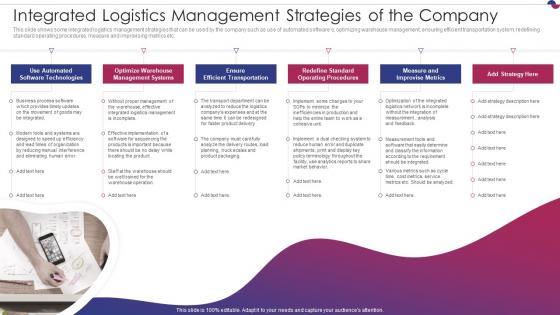
This slide shows some integrated logistics management strategies that can be used by the company such as use of automated softwares, optimizing warehouse management, ensuring efficient transportation system, redefining standard operating procedures, measure and improvising metrics etc.
People who downloaded this PowerPoint presentation also viewed the following :
Integrated Logistics Management Strategies Of The Company Integrated Logistics Management Strategies with all 6 slides:
Use our Integrated Logistics Management Strategies Of The Company Integrated Logistics Management Strategies to effectively help you save your valuable time. They are readymade to fit into any presentation structure.






FAQs for Integrated Logistics Management Strategies Of The Company Integrated
Key components of integrated logistics management include demand forecasting, inventory optimization, transportation coordination, warehouse management systems, and real-time tracking technologies. These systems streamline operations by synchronizing procurement, distribution, and customer delivery processes, enabling companies across retail, manufacturing, and e-commerce sectors to reduce costs, minimize delays, and enhance customer satisfaction while maintaining competitive advantage.
Technology enhances integrated logistics management efficiency by automating supply chain processes, providing real-time visibility, and enabling predictive analytics for demand forecasting. Through AI-powered systems and IoT sensors, organizations streamline inventory management, optimize route planning, and accelerate decision-making, with many manufacturers and retailers finding significantly reduced operational costs and improved customer delivery experiences.
Organizations face challenges including system integration complexities, data silos across departments, resistance to process changes, technology compatibility issues, and coordination difficulties with multiple suppliers and partners. While these obstacles can initially slow implementation, many companies find that strategic planning, phased rollouts, and cross-functional collaboration ultimately deliver streamlined operations and enhanced competitive advantage.
Integrated logistics management reduces costs by streamlining transportation routes, consolidating shipments, optimizing inventory levels, and eliminating redundant processes across the supply chain. Through strategic coordination of warehousing, distribution, and procurement activities, companies achieve significant operational efficiencies, minimize storage costs, and enhance resource allocation, ultimately delivering competitive advantage in increasingly complex markets.
Data analysis enhances integrated logistics decision-making by providing real-time visibility into supply chain performance, identifying bottlenecks and inefficiencies, and enabling predictive insights for demand forecasting. Through advanced analytics, organizations streamline route optimization, inventory management, and resource allocation, with many logistics companies finding that data-driven strategies ultimately deliver faster deliveries and reduced operational costs.
Integrated logistics management enhances customer service by streamlining order processing, optimizing inventory levels, and coordinating seamless delivery networks across multiple touchpoints. Through real-time tracking systems and automated fulfillment processes, companies deliver faster shipping times, accurate order status updates, and proactive issue resolution, ultimately creating superior customer experiences that drive loyalty and competitive advantage.
Best practices for collaborating with third-party logistics providers include establishing clear performance metrics, maintaining transparent communication channels, implementing shared technology platforms, conducting regular performance reviews, and developing strategic partnerships rather than transactional relationships. These collaborative approaches streamline supply chain operations by enhancing visibility, reducing operational costs, and improving delivery reliability, with many manufacturers and retailers finding that integrated partnerships ultimately deliver competitive advantages and superior customer experiences.
Sustainability integrates into logistics management through green transportation modes, renewable energy adoption, waste reduction programs, circular supply chain design, and carbon footprint monitoring systems. These strategies enable organizations to minimize environmental impact while reducing operational costs, with many manufacturing and retail companies finding that sustainable logistics practices ultimately deliver competitive advantages, improved brand reputation, and long-term operational efficiency.
Global trade significantly impacts integrated logistics management by requiring enhanced coordination across borders, standardized processes, and advanced tracking systems to manage complex international supply chains. Through strategic partnerships and technology integration, organizations streamline customs procedures, optimize multi-modal transportation, and enhance visibility across global networks, ultimately delivering improved efficiency and competitive advantage in increasingly interconnected markets.
Integrated logistics management enables small businesses to streamline operations by coordinating inventory, transportation, and warehousing through unified systems, reducing costs and improving efficiency. Many small retailers and manufacturers find that these strategies deliver faster customer fulfillment, lower operational expenses, and enhanced competitive positioning against larger competitors, ultimately scaling their market reach.
Key trends include AI-powered predictive analytics, autonomous vehicles, IoT-enabled real-time tracking, blockchain for supply chain transparency, and sustainable green logistics practices. These technologies streamline operations by reducing delivery times, minimizing costs, and enhancing visibility across the entire supply chain, with many logistics companies finding that strategic integration ultimately delivers competitive advantage and improved customer experiences.
Integrated logistics management enhances supply chain risk management by providing real-time visibility, diversifying supplier networks, and enabling rapid response protocols across all operations. Through centralized coordination and data analytics, organizations can identify potential disruptions earlier, maintain strategic inventory buffers, and quickly reroute shipments, ultimately delivering greater resilience and operational continuity.
Key metrics for evaluating integrated logistics management effectiveness include order fulfillment accuracy, inventory turnover rates, transportation costs per unit, warehouse efficiency ratios, and customer delivery performance indicators. These measurements enable organizations to assess operational efficiency, cost optimization, and service quality across their supply chain, with many companies finding that comprehensive metric tracking delivers improved resource allocation and enhanced competitive advantage.
Regulatory compliance requirements significantly shape integrated logistics management strategies by mandating specific documentation protocols, safety standards, environmental controls, and cross-border procedures. These requirements drive organizations to implement advanced tracking systems, automated compliance monitoring, and strategic partnerships with certified carriers, ultimately delivering enhanced transparency, reduced risk exposure, and streamlined operations across global supply chains.
Integrated logistics management drives innovation by fostering cross-functional collaboration, enabling real-time data sharing, implementing predictive analytics, and streamlining end-to-end processes through automated workflows. This strategic approach allows organizations to develop responsive distribution networks, optimize inventory management systems, and create adaptive supply chain models, with companies in manufacturing and retail finding that integrated strategies ultimately deliver enhanced operational efficiency and competitive market positioning.
-
This visual representation is stunning and easy to understand. I like how organized it is and informative it is.
-
“Slides are formally built and the color theme is also very exciting. This went perfectly with my needs and saved a good amount of time.”