IT Operation Monitoring Dashboard For Immediate Response

Rating:
80%
IT Operation Monitoring Dashboard For Immediate Response IT Operation Monitoring Dashboard For Immediate Response
Slide 1 of 7

or

Favourites Favourites

Try Before you Buy Download Free Sample Product

Audience Impress Your
Audience
Editable 100%
Editable
Time Save Hours
of Time
The Biggest Sale is ending soon in
0
0
:
0
0
:
0
0
Rating:
80%
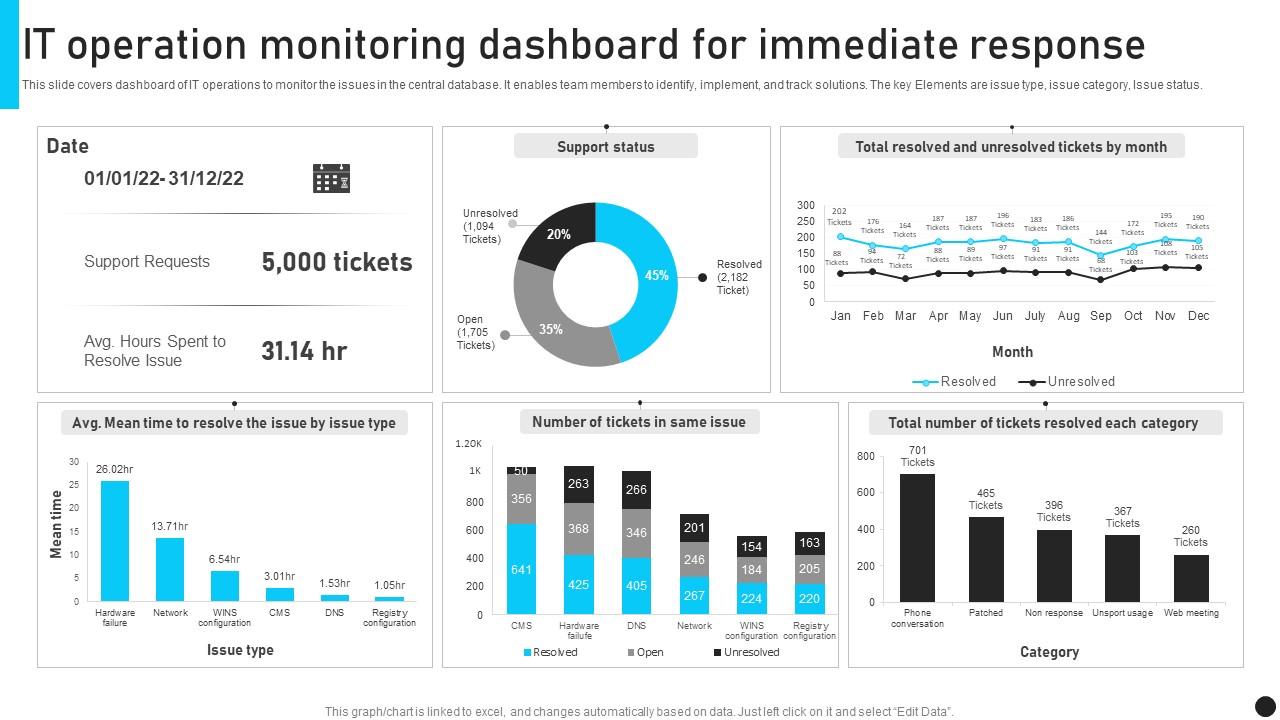
This slide covers dashboard of IT operations to monitor the issues in the central database. It enables team members to identify, implement, and track solutions. The key Elements are issue type, issue category, Issue status. Presenting our well structured IT Operation Monitoring Dashboard For Immediate Response. The topics discussed in this slide are Support Status, Operation Monitoring, Immediate Response. This is an instantly available PowerPoint presentation that can be edited conveniently. Download it right away and captivate your audience.

FAQs for IT Operation Monitoring Dashboard

Organizations should focus on system availability, response time, CPU and memory utilization, network performance, error rates, and security incidents for effective IT operations monitoring. These metrics enable IT teams to proactively identify bottlenecks, prevent downtime, and optimize resource allocation, with many enterprises finding that comprehensive monitoring ultimately delivers improved user experiences and operational efficiency.

Effective monitoring prevents service outages by detecting anomalies early, tracking system performance metrics, and providing automated alerts before issues escalate into failures. Through real-time dashboards and predictive analytics, organizations streamline incident response, minimize downtime costs, and enhance customer experiences, with many enterprises finding that proactive monitoring delivers significantly improved service reliability.

Automation enhances IT operations monitoring by enabling real-time threat detection, predictive maintenance, automated incident response, and continuous performance optimization across enterprise systems. Through machine learning algorithms and intelligent workflows, organizations streamline alert management, reduce manual intervention, and accelerate resolution times, with many financial services and healthcare institutions finding that automated monitoring delivers significantly improved uptime and operational efficiency.

AI and machine learning enhance IT operations monitoring accuracy by analyzing vast data patterns, predicting potential failures before they occur, and automatically distinguishing between normal variations and genuine anomalies. These technologies streamline incident detection, reduce false alerts, and enable proactive maintenance, with many organizations finding that predictive analytics ultimately delivers faster resolution times and significantly improved system reliability.

Common challenges in IT operations monitoring include data overload from multiple systems, false alerts creating noise, siloed monitoring tools lacking integration, skill gaps in analyzing complex metrics, and scaling monitoring across hybrid cloud environments. These obstacles often result in delayed incident response, increased operational costs, and reduced system visibility, with many organizations finding that fragmented monitoring approaches ultimately hinder their ability to maintain optimal performance and deliver seamless user experiences.

Integrating cloud-based solutions into traditional IT operations monitoring requires hybrid architectures that connect on-premises systems with cloud platforms through APIs, secure gateways, and unified dashboards. This strategic combination enables organizations to leverage cloud scalability while maintaining existing infrastructure investments, with many enterprises finding that hybrid monitoring delivers enhanced visibility, reduced operational costs, and improved service reliability across their entire IT landscape.

Effective real-time IT operations monitoring tools include Nagios, SolarWinds, Datadog, New Relic, and Splunk, each offering comprehensive infrastructure visibility, application performance tracking, and automated alerting capabilities. These platforms streamline IT management by providing predictive analytics, centralized dashboards, and proactive issue detection, with many organizations finding that strategic tool combinations ultimately deliver enhanced system reliability and significantly reduced downtime costs.

User experience is critically important in evaluating IT operations performance, as it directly reflects how effectively systems serve end-users through response times, availability, and service quality. Organizations increasingly recognize that technical metrics must align with actual user satisfaction, with many IT teams finding that user-centric monitoring delivers better business outcomes and competitive advantage.

Best practices for IT operations monitoring dashboards include centralizing key metrics, using clear visual hierarchies, implementing real-time alerting, customizing views by role, and ensuring mobile accessibility. These approaches streamline incident response by displaying critical system health indicators, network performance data, and application status in intuitive formats, with many organizations finding that well-designed dashboards reduce mean time to resolution while enhancing operational visibility.

Organizations ensure compliance while monitoring IT operations by implementing automated audit trails, role-based access controls, data encryption, and regular compliance reporting frameworks. Through strategic monitoring platforms, financial institutions and healthcare organizations streamline regulatory adherence, minimize security risks, and maintain transparent documentation, while ultimately delivering operational efficiency and reducing compliance-related costs in increasingly regulated environments.

Data overload strategies include intelligent filtering, threshold-based alerting, data aggregation, automated correlation engines, and machine learning-driven anomaly detection. These approaches streamline monitoring by reducing noise, prioritizing critical alerts, and automating routine analysis, with many organizations finding that strategic data reduction ultimately delivers faster incident response and improved operational efficiency.

Baseline performance in IT operations monitoring is defined by establishing normal operational parameters through historical data analysis, measuring key metrics like response times, throughput, and resource utilization over representative periods. These baselines enable IT teams to detect anomalies, predict capacity needs, and trigger automated alerts when systems deviate from expected performance, ultimately delivering proactive issue resolution and optimized resource allocation.

Anomaly detection is crucial for proactively identifying unusual patterns, performance deviations, security threats, and system failures before they impact business operations. It enables IT teams to minimize downtime, prevent costly outages, and enhance system reliability through automated alerts and predictive insights, with many organizations finding that early detection significantly reduces resolution time and operational costs.

IT operations monitoring contributes to capacity planning by analyzing historical performance data, tracking resource utilization patterns, and identifying bottlenecks before they impact services. Through comprehensive monitoring dashboards, organizations can predict future infrastructure needs, optimize server allocations, and streamline budget planning, ultimately delivering cost-effective scalability and enhanced operational efficiency across their technology landscape.

Future trends in IT operations monitoring include AI-driven predictive analytics, automated incident response, cloud-native monitoring solutions, observability platforms, and edge computing integration. These technologies revolutionize IT management by enabling proactive issue resolution, reducing downtime costs, and delivering seamless user experiences, with many organizations finding that predictive capabilities ultimately provide significant competitive advantages in increasingly complex digital environments.

Ratings and Reviews

80% of 100
Review Form
Write a review
Most Relevant Reviews
  1. 80%

    by Dean Dixon

    “You have the structure in place that are easy to explore new opportunities.I will be recommending your services to other people.”
  2. 80%

    by Doug Carroll

    You know what? I'm so glad I opted for this PPT design. It has been a total game-changer for me and my presentations. Thank you! 

2 Item(s)

per page: