KPI Dashboard To Evaluate Human Resources Performance Employee Relations Management To Develop Positive
Try Before you Buy Download Free Sample Product
Audience
Editable
of Time
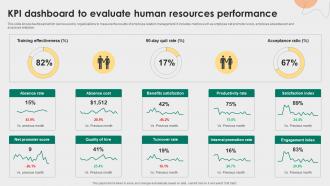
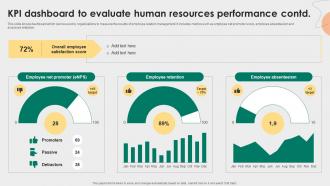
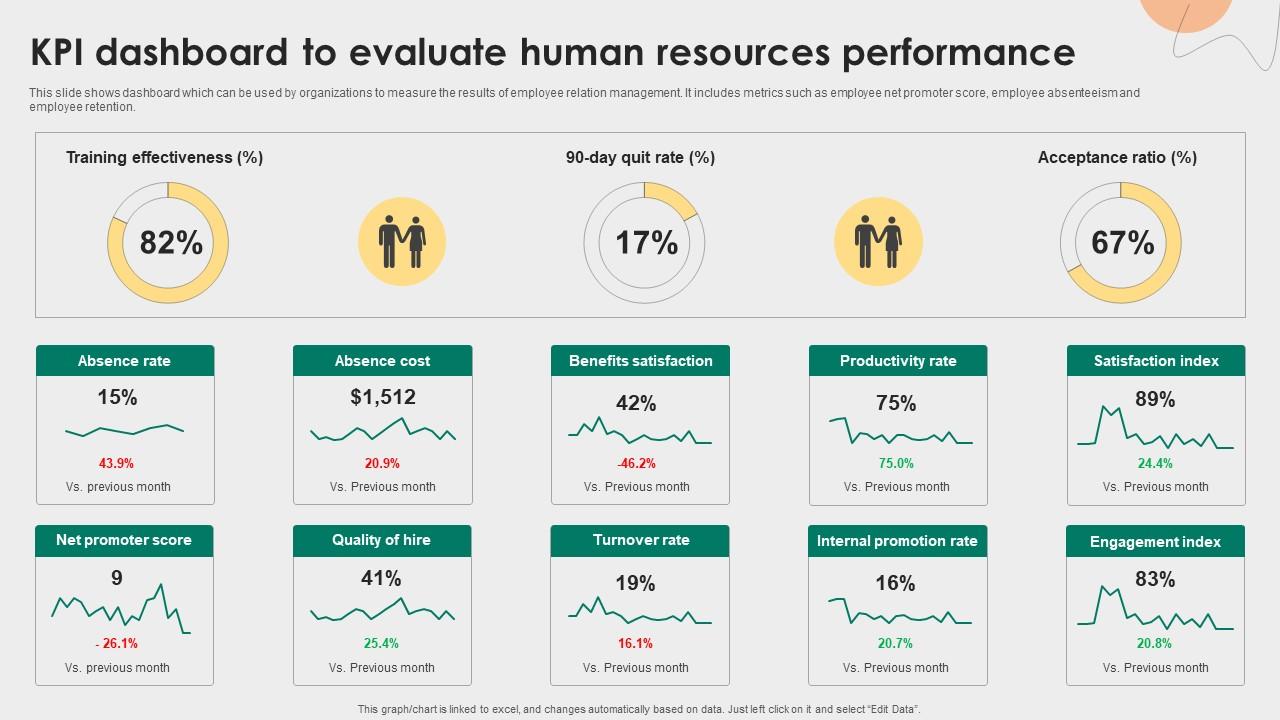
This slide shows dashboard which can be used by organizations to measure the results of employee relation management. It includes metrics such as employee net promoter score, employee absenteeism and employee retention.
People who downloaded this PowerPoint presentation also viewed the following :
KPI Dashboard To Evaluate Human Resources Performance Employee Relations Management To Develop Positive with all 11 slides:
Use our KPI Dashboard To Evaluate Human Resources Performance Employee Relations Management To Develop Positive to effectively help you save your valuable time. They are readymade to fit into any presentation structure.
FAQs for KPI Dashboard To Evaluate Human Resources Performance Employee Relations Management
Essential HR performance KPIs include employee turnover rate, time-to-hire, employee satisfaction scores, training completion rates, and cost-per-hire metrics. These indicators streamline workforce management by measuring recruitment efficiency, retention effectiveness, and development outcomes, with many organizations finding that comprehensive KPI tracking ultimately delivers enhanced talent acquisition, reduced operational costs, and improved employee engagement across departments.
Organizations can determine the most relevant KPIs by aligning metrics with strategic business objectives, conducting stakeholder interviews across departments, analyzing current HR challenges, and benchmarking against industry standards. Through this systematic approach, companies in sectors like manufacturing and healthcare streamline performance measurement, enhance resource allocation, and deliver targeted outcomes, with many finding that goal-specific KPIs ultimately drive measurable improvements in employee engagement and organizational efficiency.
Tools for creating HR KPI dashboards include business intelligence platforms like Tableau and Power BI, HR analytics software such as Workday and BambooHR, cloud-based solutions like Google Data Studio, and specialized workforce analytics tools. These technologies streamline data integration, automate reporting processes, and deliver real-time insights, with many organizations finding that comprehensive dashboards enhance decision-making capabilities and operational efficiency.
Visualizations in HR KPI dashboards enhance understanding by transforming complex workforce data into clear charts, graphs, and heat maps that reveal patterns, trends, and performance gaps at a glance. These visual tools enable HR leaders to quickly identify retention issues, track recruitment efficiency, and monitor employee satisfaction across departments, ultimately delivering faster strategic decisions and more targeted interventions that improve organizational performance.
Employee engagement significantly influences HR performance metrics by driving retention rates, productivity levels, absenteeism patterns, training effectiveness, and overall organizational culture health. Through engagement surveys and feedback mechanisms, HR departments can identify performance gaps, predict turnover risks, and optimize talent management strategies, with many organizations finding that higher engagement scores directly correlate with improved business outcomes and competitive advantage.
Turnover rates can be measured through monthly, quarterly, and annual departure percentages, voluntary versus involuntary separations, department-specific metrics, and exit interview insights. Through strategic dashboard visualization, HR teams streamline workforce planning, identify retention opportunities, and enhance employee engagement initiatives, while enabling leadership to make data-driven decisions that ultimately reduce recruitment costs and maintain organizational knowledge continuity.
Recruitment efficiency significantly impacts HR performance assessments by demonstrating strategic workforce planning capabilities, cost management effectiveness, and organizational growth support. Through streamlined hiring processes, HR departments reduce time-to-fill metrics, lower cost-per-hire ratios, and improve candidate quality scores, while enhancing manager satisfaction and employee retention rates, ultimately delivering competitive advantage in talent acquisition markets.
KPIs align with strategic objectives by mapping HR metrics to business goals, identifying talent gaps that impact growth targets, and establishing workforce indicators that directly support revenue, innovation, and operational priorities. Through strategic workforce planning, organizations streamline recruitment efficiency, enhance employee retention rates, and accelerate leadership development programs, ultimately delivering competitive advantage and measurable business outcomes.
Qualitative data complements quantitative HR KPIs by providing context through employee feedback, cultural assessments, manager observations, and exit interview insights that explain the "why" behind numerical trends. While quantitative metrics reveal performance patterns, qualitative data enables HR teams to understand underlying factors affecting engagement and productivity, ultimately delivering more comprehensive evaluations and strategic workforce decisions.
HR dashboards should be updated daily for real-time metrics like attendance and recruitment pipeline, weekly for performance reviews and employee satisfaction scores, and monthly for strategic KPIs like turnover rates and training completion. This tiered approach enables HR teams to respond quickly to immediate concerns while tracking long-term trends, ultimately delivering more responsive people management and enhanced organizational performance.
HR KPI collection challenges include inconsistent data sources, subjective performance metrics, privacy concerns, manual reporting processes, and difficulty quantifying soft skills like leadership or cultural fit. Organizations overcome these by implementing integrated HRIS systems, standardizing measurement criteria, establishing clear data governance protocols, and combining quantitative metrics with structured qualitative assessments, ultimately delivering more accurate performance insights.
HR KPI dashboards can be customized through role-based access controls, departmental filtering, hierarchical data views, personalized metric selections, and scalable visualization formats. Different organizational levels require tailored perspectives, with executives accessing company-wide talent metrics, department heads monitoring team-specific performance indicators, and individual managers tracking employee development goals, ultimately enabling strategic workforce decisions while maintaining operational efficiency across diverse business units.
Predictive analytics enhances HR KPIs by forecasting employee turnover, identifying flight risks, predicting performance trends, and anticipating skill gaps before they impact operations. Through machine learning algorithms, organizations streamline talent retention strategies, optimize recruitment processes, and proactively address workforce challenges, with many companies finding that predictive insights ultimately deliver reduced hiring costs and improved employee satisfaction.
Training program effectiveness can be quantified through completion rates, skill assessment scores, employee performance improvements, retention rates of trained employees, and training ROI calculations. These metrics enable HR teams to track knowledge transfer, measure behavioral changes, and demonstrate tangible business impact, with many organizations finding that comprehensive training dashboards ultimately enhance workforce capability while optimizing development investments.
Best practices for presenting HR KPI dashboard data include using clear visualizations, focusing on actionable metrics, providing contextual comparisons, ensuring real-time accessibility, and tailoring content to stakeholder needs. These approaches streamline decision-making by highlighting workforce trends, performance gaps, and strategic opportunities, with many organizations finding that well-designed dashboards enhance transparency, accelerate HR processes, and ultimately deliver improved talent management outcomes.
-
Eye-catching PPT designs, outstanding team, and best customer service. I’m a super satisfied customer here!
-
Excellent design and quick turnaround.