Leveraging Artificial Intelligence Stock Market Prediction Through LSTM And XAI AI SS V
Try Before you Buy Download Free Sample Product
Audience
Editable
of Time
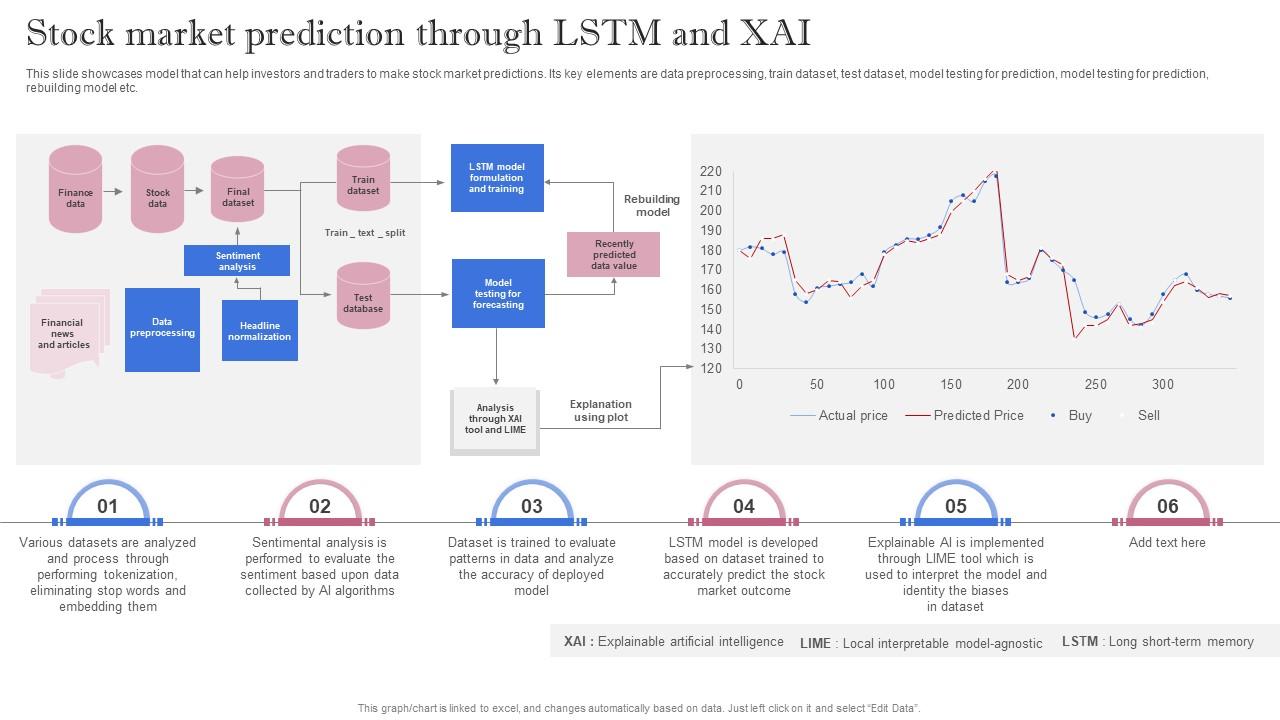
This slide showcases model that can help investors and traders to make stock market predictions. Its key elements are data preprocessing, train dataset, test dataset, model testing for prediction, model testing for prediction, rebuilding model etc.
People who downloaded this PowerPoint presentation also viewed the following :
Leveraging Artificial Intelligence Stock Market Prediction Through LSTM And XAI AI SS V with all 7 slides:
Use our Leveraging Artificial Intelligence Stock Market Prediction Through LSTM And XAI AI SS V to effectively help you save your valuable time. They are readymade to fit into any presentation structure.
FAQs for Leveraging Artificial Intelligence Stock Market Prediction Through LSTM And XAI
Key AI algorithms for stock market prediction include machine learning models like Random Forest and Support Vector Machines, deep learning networks such as LSTM and neural networks, reinforcement learning algorithms, and natural language processing for sentiment analysis. These technologies enhance trading strategies by analyzing vast datasets, identifying complex patterns, and processing real-time market information, ultimately delivering more informed investment decisions and competitive advantages for financial institutions.
Machine learning improves stock price forecasting accuracy by analyzing vast datasets, identifying complex patterns, and processing real-time market signals that traditional methods miss. Through neural networks and algorithmic trading systems, financial institutions can detect market anomalies, predict volatility trends, and execute faster trading decisions, ultimately delivering more precise predictions and competitive advantages in increasingly dynamic markets.
AI stock market prediction faces several key limitations, including market volatility influenced by unpredictable external events, data quality issues, and the inherent complexity of human behavioral factors. While AI excels at pattern recognition, financial markets are affected by geopolitical developments, sudden news events, and emotional trading decisions that algorithms struggle to anticipate, with many investment firms finding that combining AI insights with human expertise delivers more balanced portfolio management.
Sentiment analysis and natural language processing enhance market predictions by analyzing news articles, social media posts, earnings reports, and financial communications to gauge market sentiment and extract trading signals. These AI technologies enable traders to process vast amounts of textual data in real-time, identify emerging trends before they impact prices, and combine emotional market indicators with traditional technical analysis, ultimately delivering more comprehensive prediction models and faster response to market-moving events.
Historical data serves as the foundation for training AI models in stock forecasting, providing patterns of price movements, trading volumes, market volatility, and economic indicators across various market cycles. Through analyzing decades of financial data, AI systems learn to identify correlations between market conditions and stock performance, enabling more accurate predictions, with many investment firms finding that comprehensive historical datasets significantly enhance their algorithmic trading strategies and risk management capabilities.
AI identifies hidden market trends through pattern recognition algorithms, sentiment analysis of news and social media, cross-market correlation analysis, and high-frequency data processing that exceeds human cognitive capacity. These technologies enable financial institutions to detect subtle market signals, emerging sector rotations, and predictive indicators across global markets, ultimately delivering faster trading decisions and enhanced portfolio performance in increasingly complex financial environments.
AI-driven investment strategies raise ethical concerns including algorithmic bias, market manipulation risks, transparency in decision-making processes, fairness in market access, and potential systemic risks from widespread automation. These considerations present both challenges and opportunities, with many financial institutions finding that implementing robust governance frameworks, regular bias audits, and transparent disclosure practices ultimately delivers enhanced investor trust and regulatory compliance.
Real-time data significantly enhances AI stock prediction models by enabling immediate pattern recognition, reducing lag between market events and analysis, and improving response accuracy to volatility spikes. Financial institutions increasingly leverage streaming data feeds to capture millisecond-level price movements, news sentiment shifts, and trading volume changes, ultimately delivering faster algorithmic decisions and competitive advantages in high-frequency trading environments.
AI assists investors in risk management through portfolio diversification analysis, real-time market monitoring, predictive modeling, automated stop-loss execution, and volatility assessment algorithms. These technologies streamline risk evaluation by identifying potential threats across multiple asset classes, enabling faster response times, and optimizing position sizing, with many financial institutions finding that AI-driven systems ultimately deliver enhanced protection and more consistent returns.
Feature selection significantly enhances stock market prediction models by identifying the most relevant variables, reducing noise, eliminating redundant data, and improving computational efficiency. Through strategic selection of technical indicators, economic metrics, and market sentiment data, financial institutions can develop more accurate models that minimize overfitting, accelerate processing speeds, and ultimately deliver more reliable trading signals and investment insights.
Alternative data sources like social media sentiment, news feeds, satellite imagery, web scraping analytics, and consumer behavior patterns enhance AI predictions by providing real-time market insights, early trend detection, and comprehensive context beyond traditional financial metrics. These diverse data streams enable algorithms to capture market psychology, anticipate earnings surprises, and identify emerging opportunities, with many financial institutions finding that integrating alternative data significantly improves prediction accuracy and competitive advantage.
Various sectors respond differently to AI predictions based on their inherent volatility patterns, regulatory environments, and data availability, with technology and healthcare sectors showing higher responsiveness due to rapid innovation cycles. Financial services and energy sectors typically demonstrate more measured responses to AI signals, while consumer goods and utilities sectors often require longer validation periods, ultimately enabling traders to develop sector-specific strategies that enhance portfolio diversification and risk management.
**INPUT**: What benchmarks can be used to evaluate the performance of AI stock prediction systems? **OUTPUT**: AI stock prediction systems are evaluated using accuracy metrics, risk-adjusted returns, Sharpe ratios, maximum drawdown measurements, and directional accuracy assessments. These benchmarks enable financial institutions and investment firms to measure performance against market indices while minimizing portfolio volatility, with many organizations finding that comprehensive evaluation frameworks ultimately deliver more consistent trading strategies and enhanced investment outcomes.
Algorithmic trading leverages AI technologies like machine learning, neural networks, and predictive analytics to analyze market data, identify patterns, and execute trades automatically. These systems process vast amounts of real-time information, from price movements to news sentiment, enabling financial institutions to make faster, data-driven decisions while minimizing human error and emotional bias, ultimately delivering enhanced market efficiency and competitive trading advantages.
Future AI advancements transforming stock market forecasting include quantum computing integration, advanced neural networks, real-time sentiment analysis, and multimodal data fusion capabilities. These technologies enhance prediction accuracy by processing vast datasets simultaneously, analyzing social media trends, and incorporating alternative data sources like satellite imagery, with many financial institutions finding that quantum-enhanced algorithms deliver significantly faster and more precise market insights.
-
Loved the fact that SlideTeam provides clean, high-definition, and professional PowerPoint products.Â
-
What an exhaustive collection of templates you guys have there in slideteam. Impressive!!!