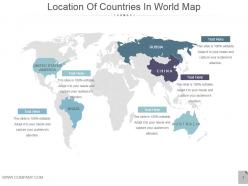
Location of countries in world map powerpoint slides

Rating:
90%
Slide 1 of 5
Favourites Favourites

Try Before you Buy Download Free Sample Product

Audience Impress Your
Audience
Editable 100%
Editable
Time Save Hours
of Time
The Biggest Sale is ending soon in
0
0
:
0
0
:
0
0
Rating:
90%
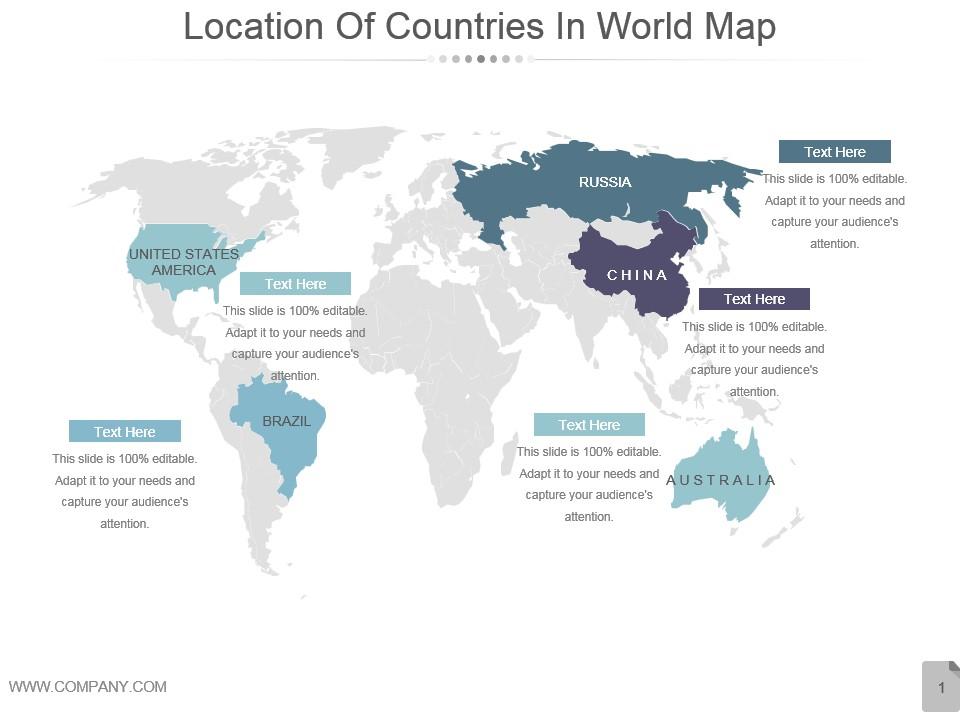
Presenting location of countries in world map powerpoint slides. This is a location of countries in world map powerpoint slides. This is a five stage process. The stages in this process are united states america, brazil, russia, china, australia.

People who downloaded this PowerPoint presentation also viewed the following :

FAQs for Location of countries in world

So borders are usually rivers, mountains, or coastlines - stuff that makes sense geographically. Like Spain and France have the Pyrenees between them, and the Rio Grande splits the US from Mexico. Russia's borders are wild because that country is absolutely massive, so they use the Urals and random rivers. Island nations obviously just use their coastlines. But here's the thing - tons of African and Middle Eastern borders are these weird straight lines because European colonizers just drew them with rulers. Next time you look at a map, you can totally tell which borders follow natural features and which ones are just artificial lines someone made up.

So most borders got shaped by wars, colonization, and cultural stuff over centuries. European colonizers literally just drew lines on maps in Africa and Asia for their own convenience - totally ignoring where different tribes actually lived. That's why you see those weird straight borders cutting right through communities. Wars and treaties kept changing everything too. Some countries formed more naturally around shared languages or religions though. Rivers and mountains make sense as borders, but then you've got these random straight lines that look super artificial. Honestly it's kinda wild when you think about it. Next time you're looking at a map, try spotting which borders seem natural vs completely made up.

Oh man, this happens to everyone! Austria and Australia are the worst - they're literally on opposite sides of the planet but people mix them up constantly. Slovenia and Slovakia always get me confused since they're both in that same European region. Then you've got Niger and Nigeria in Africa, plus Uruguay and Paraguay (honestly those two still trip me up sometimes). Switzerland and Sweden too, though I'm not sure why since one's got the Alps and the other's way up north. Quick tip - just pull up Google Maps when you're stuck. Looking at what countries are nearby usually clears it up fast.

So country borders aren't actually determined by natural resources - that's all historical stuff like wars and colonization. But resources totally shape how countries develop once they exist. Look at oil-rich places like Saudi Arabia or Norway - they got crazy wealthy from what's in the ground. Dense populations usually cluster around fertile land or mineral deposits too. It's pretty obvious when you think about it. Countries don't just relocate to chase resources, but if you've got them, you're gonna develop differently. Try mapping resource locations against population centers - the patterns are wild.

Dude, migration has totally flipped demographic maps on their head. The US, Canada, Australia - they're way more diverse now, especially in cities. Parts of Africa and Latin America? They've got weird age gaps from young people leaving for work elsewhere. It's wild how much people have moved around in just 50 years - like, my grandparents would be shocked. When you're looking at population data, check migration patterns first. Seriously, they explain changes way better than just birth and death rates alone.

So the big ones recently: South Sudan split from Sudan in 2011 after all that civil war mess. Russia grabbed Crimea from Ukraine in 2014 - still a huge deal obviously. Kosovo declared independence from Serbia in 2008, though half the world still doesn't recognize it which is awkward. Brexit changed how the UK deals with EU borders in 2020. Most other stuff has been pretty minor territorial tweaks here and there. Oh, and honestly things move fast with geopolitics so this could all look different next year.

Dude, satellite images are way better than regular maps for checking out countries. You get to see the actual terrain, borders, cities - all the real stuff as it exists right now. Google Earth is insane for this. Zoom in and you'll spot landmarks you know! Plus you can track how things change over time, like cities growing or forests disappearing. The 3D view makes everything click better than flat maps ever could. I spent like an hour yesterday just exploring disputed border areas - you can actually see why countries fight over certain spots.

Climate totally controls where people cluster up. Most big cities are in temperate spots - Europe, eastern US, eastern China - because the weather's decent and crops actually grow. Deserts and Arctic places? Basically empty. India's interesting though - some tropical areas work if they're not swampy disease factories. I always found it wild how clear the patterns are. Just look at any population map next to climate data and you'll see it immediately. The correlations are honestly pretty obvious once you notice them.

So basically, sea boundaries decide who gets to control which waters and all the resources in them. Think about all that drama in the South China Sea - that's this exact issue causing problems. Countries with good maritime borders can totally control shipping lanes and charge fees or block access if they want. Meanwhile, landlocked countries are stuck depending on everyone else for ocean trade access. The main numbers you need to know are 12 nautical miles for territorial waters and 200 miles for economic zones. Honestly, whenever there's some supply chain mess in the news, I always wonder if there's some maritime dispute behind it. Those boundary fights mess up trade routes more than people realize.

So basically time zones follow longitude lines - each one covers about 15 degrees of Earth's rotation. Most countries try to keep their whole territory in one zone even if it gets a bit weird geographically. China's massive but uses just one time zone for political reasons, which honestly must be confusing for people on the edges. Russia though? They said screw it and use 11 zones because they're enormous. Countries bend the boundaries all the time to match their borders or trade partners. When you're scheduling international calls, definitely check both a regular map and time zone map - the differences are pretty wild.

Oh man, GPS changed everything! Old maps were literally miles off because cartographers had to use ground measurements and star observations - sounds like torture, right? Now satellites pinpoint stuff within meters. We've got GIS layering data, radar that sees through clouds, constant real-time updates. You should totally compare an old atlas to Google Maps sometime - the difference is insane. My dad still has this road atlas from the 90s and half the streets don't even exist anymore.

Oh this is actually pretty clever! Countries basically turn their maps into ads by showing off their coolest geography. Like New Zealand always features those insane fjords, and Greece makes sure you see all their scattered islands. Way better than boring political boundary maps, right? Tourism boards get really strategic about this - they'll emphasize coastlines, mountains, whatever makes people want to book a trip. It's visual storytelling but with cartography. Next time you see an official tourism map, you'll totally notice what they think their best geographical features are.

Dude, disputed territories are such a nightmare for diplomacy. Countries literally can't agree on who owns what, so everything gets messy - trade deals, UN stuff, you name it. Check out how Kashmir shows up totally different depending on which country made the atlas. Wild, right? Other nations end up having to pick sides or do this weird neutral dance. Bilateral relationships just freeze up completely. Oh, and if you're ever working internationally? Do your homework on territorial stuff first. Using the wrong map in a presentation can absolutely wreck negotiations before you even sit down.

Honestly, the trick is getting kids moving around instead of just staring at a wall map. Get a big floor map or use those digital ones where they can actually click around and explore stuff. I used to hate those giant classroom maps - so intimidating! But they're perfect for group work. Have teams race to find countries, or get them tracing trade routes with their fingers. Works great when you're covering current events or history too. The hands-on approach beats lecturing every time. Oh, and comparing country sizes always blows their minds for some reason.

Honestly, QGIS is where I'd start - it's free and handles most geographical stuff really well. If you've got money to burn, ArcGIS is the gold standard. Tableau's great for business mapping, and Google Earth Pro is way more useful than people give it credit for (I probably overuse it tbh). Web-based options? Mapbox and Leaflet are solid if you don't mind coding a bit. Even Excel has mapping now which is kinda wild. Just grab QGIS first though. Import your shapefiles, add some layers, and you can make decent-looking maps without spending anything. Perfect for country-level data.

Ratings and Reviews

90% of 100
Review Form
Write a review
Most Relevant Reviews
  1. 80%

    by Williams Morales

    Excellent design and quick turnaround.
  2. 100%

    by Columbus Vasquez

    Amazing product with appealing content and design.

2 Item(s)

per page: