category-banner

Market Potential Zapier Investor Funding Elevator Pitch Deck

Rating:
90%
Market Potential Zapier Investor Funding Elevator Pitch Deck
Slide 1 of 10
Favourites Favourites

Try Before you Buy Download Free Sample Product

Audience Impress Your
Audience
Editable 100%
Editable
Time Save Hours
of Time
The Biggest Sale is ending soon in
0
0
:
0
0
:
0
0
Rating:
90%
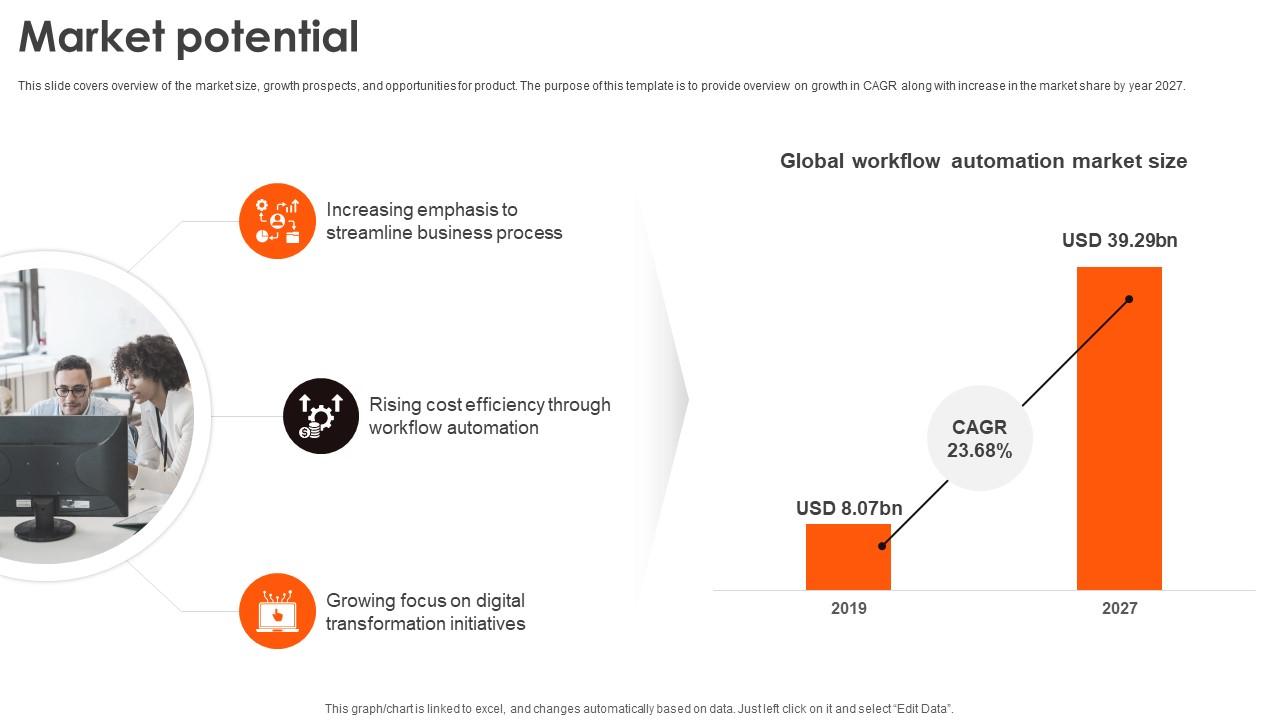
This slide covers overview of the market size, growth prospects, and opportunities for product. The purpose of this template is to provide overview on growth in CAGR along with increase in the market share by year 2027. Present the topic in a bit more detail with this Market Potential Zapier Investor Funding Elevator Pitch Deck. Use it as a tool for discussion and navigation on Market Potential, Market Size, Growth Prospects, Opportunities, Global Workflow Automation. This template is free to edit as deemed fit for your organization. Therefore download it now.

People who downloaded this PowerPoint presentation also viewed the following :

FAQs for Market Potential Zapier Investor Funding

Zapier's investor funding success stemmed from its proven business model, strong recurring revenue growth, massive market opportunity in automation, exceptional customer retention rates, and strategic positioning in the expanding no-code movement. The company's bootstrapped profitability and sustainable unit economics demonstrated operational discipline, with many investors finding that Zapier's asset-light model and scalable platform deliver compelling returns while addressing increasingly critical workflow automation needs.

Zapier's strategic funding approach, including early bootstrapping and selective venture capital rounds, has enabled sustainable growth while maintaining product focus and customer-centric development. This disciplined capital allocation has allowed the company to scale its automation platform methodically, expand integration partnerships, and strengthen its market position against competitors, ultimately delivering consistent revenue growth and establishing itself as the leading no-code automation solution for businesses.

Product-market fit demonstrates that a startup like Zapier has validated demand for its solution, proven customer retention, and achieved sustainable growth metrics that investors actively seek. This alignment between product capabilities and market needs enables startups to showcase scalable revenue models, reduced customer acquisition costs, and strong user engagement, ultimately delivering the predictable growth trajectories and competitive positioning that attract significant investor funding.

Investor expectations significantly influence Zapier's strategic decisions through growth targets, market expansion requirements, and profitability benchmarks that guide product development, acquisition opportunities, and operational scaling. These expectations drive leadership to prioritize sustainable revenue growth, international market penetration, and platform diversification, while balancing investor demands with maintaining Zapier's remote-first culture and automation-focused mission, ultimately delivering long-term value creation.

**INPUT**: What are the common metrics investors examine when evaluating Zapier's financial health? **OUTPUT**: Investors typically examine Zapier's monthly recurring revenue (MRR), customer acquisition cost (CAC), lifetime value (LTV), churn rates, and gross revenue retention when assessing financial health. These SaaS metrics enable investors to evaluate sustainable growth, profitability potential, and market positioning, with many finding that strong unit economics and predictable revenue streams ultimately deliver competitive advantage in the automation software landscape. [Word count: 60 words]

Zapier has strategically utilized its funding to enhance automation capabilities, expand integrations, improve platform reliability, develop advanced workflow features, and strengthen API infrastructure. Through these investments, the company has scaled from hundreds to thousands of app integrations while delivering faster automation services, enhanced user experiences, and more sophisticated no-code solutions, ultimately enabling businesses across industries to streamline operations.

Zapier's funding has significantly enhanced its competitive position by enabling strategic platform expansions, advanced AI integrations, and enterprise-grade security features that rival established players like Microsoft Power Automate and Salesforce. This financial backing allows Zapier to accelerate product development, attract top talent, and scale infrastructure capabilities, with many automation-focused businesses finding that these improvements deliver faster integrations, more reliable workflows, and ultimately stronger competitive advantages in an increasingly automated marketplace.

Zapier's funding rounds evolved from seed capital focused on product-market fit with angel investors and early-stage VCs, to Series A emphasizing growth metrics with institutional investors, to later Series B rounds targeting market expansion with larger venture firms. Each stage attracts increasingly sophisticated investor profiles, with seed rounds prioritizing foundational automation technology, while later rounds focus on scaling enterprise solutions and market dominance, ultimately delivering enhanced competitive positioning.

Zapier faced challenges including investor skepticism about their no-code automation market, remote-first culture concerns, and questions about competing with larger tech platforms. The company overcame these obstacles by demonstrating strong revenue growth, proving their distributed team's effectiveness through consistent execution, and showcasing their expanding ecosystem of integrations, ultimately securing funding while maintaining their bootstrapped culture and strategic independence.

Zapier's funding has enabled strategic hiring across engineering, product development, and customer success teams, while maintaining its remote-first culture and emphasis on work-life balance. The company has leveraged investment to attract top talent globally, enhance employee benefits, and preserve its distinctive asynchronous communication practices, ultimately delivering sustained growth while fostering innovation and employee satisfaction.

Zapier maintains investor communication through regular financial reports, quarterly business updates, strategic milestone communications, and annual investor meetings. These structured touchpoints enable transparency around revenue growth, product development progress, and market expansion plans, while many SaaS companies find that consistent investor engagement ultimately strengthens strategic partnerships and facilitates future funding rounds.

Strategic partnerships significantly enhance Zapier's investor appeal by expanding market reach, accelerating user acquisition, and demonstrating platform scalability across diverse business ecosystems. These alliances with major software providers like Salesforce, HubSpot, and Microsoft validate Zapier's integration capabilities while reducing customer acquisition costs, ultimately delivering stronger revenue growth potential and competitive positioning that investors find compelling.

Current tech funding trends affecting Zapier include increased scrutiny of unit economics, preference for profitable growth over rapid expansion, rising interest rates impacting valuations, and investor focus on AI integration capabilities. These shifts encourage automation platforms like Zapier to demonstrate sustainable revenue models, emphasize operational efficiency, and showcase AI-enhanced features, ultimately positioning them for strategic partnerships and selective funding rounds that prioritize long-term value creation.

Zapier's investor demographics significantly influence growth strategy, with angel investors providing early validation and mentorship while venture capitalists deliver scaling capital, strategic partnerships, and market expansion capabilities. This strategic combination enables Zapier to balance product innovation with aggressive market penetration, ultimately delivering enhanced automation solutions and competitive positioning in an increasingly integration-focused business landscape.

Startups can learn from Zapier's bootstrap-first approach, focusing on product-market fit, sustainable revenue growth, and customer validation before seeking external funding. This strategy enables founders to maintain greater control, negotiate from strength, and demonstrate proven business models to investors, with many tech startups finding that profitability-first approaches ultimately deliver better valuations and strategic partnerships.

Ratings and Reviews

90% of 100
Write a review
Most Relevant Reviews
  1. 80%

    by Curt Bryant

    I faced no difficulty while searching for the slide I wanted. Honestly, the website’s interface is easy to use and can be navigated easily!
  2. 100%

    by Taylor Hall

    If you are looking for satisfactory PowerPoint services, SlideTeam is your go-to place. I am fully contented with their research and development team.

2 Item(s)

per page: