

Market segmentation evaluation segment size and growth potential ppt background




Try Before you Buy Download Free Sample Product
 Impress Your
 Audience
 100%
100% Editable
 Save Hours
 of Time


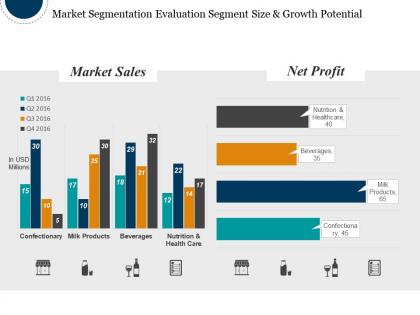
Elucidate the process of market analysis with the help of this Market Segmentation Evaluation Segment Size And Growth Potential PPT Background icon. This market division PowerPoint presentation contains net sales across different food products such as beverages, confectionery, etc. Take advantage of this business segmentation layout and show the various kinds of grouping such as geographic, demographic, behavioral and psychographic segmentation. This demographic targeting infographic can be used to evaluate the concept of brand loyalty. Highlight the bases of the market formation such as gender, age group, income, place, occupation, etc. in this market grouping slideshow. Create a niche market to concentrate on a particular product to get better revenue and sales from it through effective marketing promotion with this product positioning visual. Download this market background now and counter every challenge in the creation of markets and select the best market for increased revenue.
People who downloaded this PowerPoint presentation also viewed the following :
Market segmentation evaluation segment size and growth potential ppt background with all 5 slides:
Our Market Segmentation Evaluation Segment Size And Growth Potential Ppt Sample File have great carrying capacity. They can handle a heavy burden.
FAQs for Market segmentation evaluation segment size and growth
Key criteria for defining market segments include demographic characteristics, geographic location, behavioral patterns, psychographic profiles, and purchasing power. These segmentation approaches enable organizations to identify distinct customer groups by analyzing age, income, lifestyle preferences, and buying habits, with many companies finding that strategic combination of multiple criteria delivers more targeted marketing strategies and enhanced competitive advantage.
Demographic variables significantly influence market segmentation strategies by enabling businesses to categorize consumers based on age, income, education, gender, and family status, creating targeted approaches for distinct groups. These variables help companies tailor product features, pricing strategies, and marketing messages, with retailers like Target using age demographics and financial services leveraging income segmentation to deliver personalized experiences and maximize conversion rates.
Psychographic segmentation analyzes consumer lifestyles, values, attitudes, interests, and personality traits to reveal deeper behavioral motivations beyond demographics alone. This approach enables brands to craft targeted messaging, develop personalized products, and create emotional connections with specific consumer groups, with retail and automotive companies finding that psychographic insights significantly enhance customer engagement and drive higher conversion rates.
Geographic segmentation enhances marketing efforts by enabling businesses to tailor campaigns based on regional preferences, local climate conditions, cultural differences, and economic variations. Companies like McDonald's adapt menus regionally, while retailers adjust inventory seasonally by location, ultimately delivering more relevant customer experiences, reducing marketing waste, and achieving higher conversion rates through localized messaging strategies.
Behavioral segmentation offers advantages like real-time insights into actual customer actions, predictive capabilities for future purchases, and personalized targeting based on usage patterns, while traditional demographic methods provide broader market understanding and easier implementation. However, behavioral approaches require sophisticated data collection and analysis systems, whereas traditional methods, though less precise, deliver faster insights and simpler execution, with many retailers finding that combining both approaches ultimately enhances customer targeting effectiveness.
Companies identify niche markets by conducting detailed demographic analysis, behavioral profiling, geographic mapping, and competitive gap assessment within broader segments. Through advanced analytics and customer surveys, businesses can uncover underserved groups with specific needs, particularly in sectors like healthcare technology or sustainable products, ultimately delivering targeted solutions and competitive advantage.
Market segmentation analysis employs various tools including demographic surveys, psychographic profiling, behavioral analytics, geographic mapping, and clustering algorithms. These techniques enable businesses to identify distinct customer groups through data mining, statistical analysis, and market research platforms, with companies in retail, financial services, and healthcare finding that strategic segmentation ultimately delivers targeted marketing campaigns and enhanced customer experiences.
Data analytics enhances market segmentation accuracy by processing vast customer datasets, identifying hidden behavioral patterns, and revealing precise demographic correlations that traditional methods miss. Through machine learning algorithms and predictive modeling, retailers, financial services, and healthcare organizations can create highly targeted customer segments, ultimately delivering more personalized marketing campaigns and significantly improved conversion rates.
Common challenges include inadequate data quality, resource constraints, over-segmentation complexity, difficulty measuring ROI, and maintaining segment relevance over time. These obstacles often arise when organizations lack proper analytics infrastructure or segment too narrowly, with many businesses finding that strategic combination of technology investment and cross-departmental collaboration ultimately delivers more accurate targeting and sustainable competitive advantage.
Segmentation impacts product development by identifying specific customer needs, preferences, and pain points across different market segments, enabling companies to create targeted solutions and features. Through detailed segment analysis, organizations can prioritize development resources more effectively, accelerate innovation cycles, and deliver products that resonate with distinct customer groups, ultimately enhancing market penetration and competitive advantage.
Ethical market segmentation considerations include avoiding discriminatory practices, ensuring data privacy compliance, preventing exploitative targeting of vulnerable populations, maintaining transparency in data collection, and respecting cultural sensitivities. Organizations must balance commercial objectives with social responsibility, particularly when targeting low-income groups or sensitive demographics, ultimately building trust while delivering value that genuinely serves customer needs.
Social media analytics inform market segmentation by revealing demographic patterns, behavioral preferences, engagement trends, and content consumption habits across different audience groups. Through platforms like Facebook Insights and Twitter Analytics, businesses identify distinct customer segments, tailor messaging strategies, and optimize targeting approaches, ultimately enabling more precise marketing campaigns and enhanced customer experiences in an increasingly data-driven marketplace.
Market segmentation enables businesses to create highly targeted marketing campaigns by dividing audiences based on demographics, behaviors, preferences, and purchasing patterns, ultimately delivering more personalized messaging and improved ROI. Through strategic segmentation, companies in retail, healthcare, and financial services can allocate resources more efficiently, enhance customer engagement, and achieve significantly higher conversion rates than broad-based approaches.
Cultural differences significantly influence global segmentation strategies by requiring customized messaging, localized product positioning, and region-specific value propositions that resonate with distinct cultural norms and consumer behaviors. Companies increasingly adapt their approaches through culturally-sensitive market research, localized brand messaging, and tailored distribution channels, with many multinational organizations finding that cultural alignment ultimately delivers stronger customer engagement and competitive advantage across diverse markets.
Businesses can evaluate segmentation effectiveness through customer acquisition cost, conversion rates, customer lifetime value, segment profitability, and retention rates across different groups. These metrics enable organizations to assess whether their segmentation delivers targeted marketing efficiency, optimized resource allocation, and improved customer experiences, with many companies finding that well-defined segments significantly outperform broad-market approaches in revenue generation.
-
Understandable and informative presentation.
-
Very well designed and informative templates.