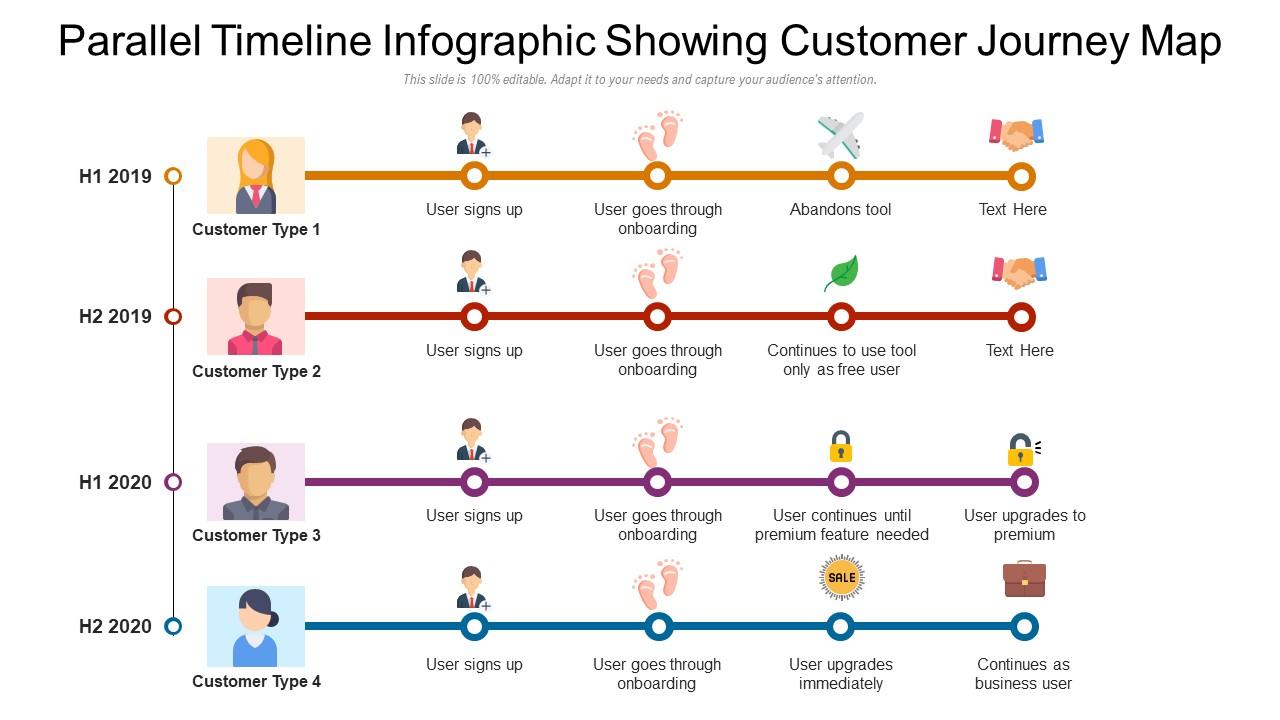
Parallel timeline infographic showing customer journey map
Try Before you Buy Download Free Sample Product
Audience
Editable
of Time
Our Parallel Timeline Infographic Showing Customer Journey Map cut across cultural boundaries. It generates appreciation on every community.
People who downloaded this PowerPoint presentation also viewed the following :
Parallel timeline infographic showing customer journey map with all 2 slides:
Our Parallel Timeline Infographic Showing Customer Journey Map generate appreciation in every community. It cuts across cultural boundaries.
FAQs for Parallel timeline infographic showing
So there are basically five stages people go through: awareness (realizing they have a problem), consideration (looking for solutions), evaluation (comparing options), purchase, and post-purchase. Real talk though - customers don't follow this neat little path. They bounce around constantly, which used to drive me crazy when I first learned this stuff. What matters is figuring out what questions they're asking at each stage and what's stopping them from moving forward. I'd start by looking at where you're currently connecting with customers and see what's missing. You'll probably find some obvious gaps pretty quickly.
Map out every spot where customers hit your business - awareness, buying, after-sales, all of it. Pull data from surveys, support tickets, analytics, sales team feedback. Here's the weird part: actually buy from yourself. I'm serious, go through your own checkout process. You'll catch stuff you never noticed. Heat maps and session recordings show you exactly where people get stuck or bail out. Then make visual maps showing how customers feel at each step. Oh, and focus on those make-or-break moments - they're what really matter for keeping relationships solid.
Honestly, UX is just your customer journey playing out in real life. People hit your website, navigate around, try to check out - and each step either keeps them moving or makes them bounce. A wonky menu can kill a sale even when someone's ready to buy. Wild how that works. Your smooth checkout might convert someone who was on the fence, while a glitchy app will send them straight to your competitor. You can map out the "perfect" journey all you want, but what actually matters is how real users feel when they're clicking around your stuff. I'd start by checking your main touchpoints for anything that's obviously annoying people.
So what I'd do is grab feedback from everywhere - surveys, support tickets, reviews, even random social media complaints. Then stick that stuff right onto your journey map at the exact spots where customers said it. Direct quotes work way better than boring charts, trust me. Look for where the complaints pile up or when people start getting annoyed. That's your goldmine right there. It's honestly kind of brutal seeing how wrong you can be about what customers actually think, but at least you'll know exactly what needs fixing first.
Honestly, Miro's probably your best bet to start - their free plan is solid and you can just drag touchpoints around super easily. Mural's similar if you want alternatives. Lucidchart's good too but feels more rigid. You could even use Google Drawings or Figma for basic stuff (sounds weird but it works). Oh, and if you want to get fancy later, Hotjar lets you overlay actual user data on your maps which is pretty cool. I'd just start simple with Miro and see what you actually need before going crazy with features.
Your different customer personas are basically taking separate routes to buy from you. Millennials might scroll through reviews and buy online. Meanwhile, boomers probably want to call or visit your store - which honestly makes tracking everything a nightmare sometimes. Pain points vary wildly between groups. Same with their preferred channels and how they actually make decisions. You'll want to map out different journey flows for each persona. That way you can tweak the touchpoints that matter most to each group. It gets messy but it's worth it.
So definitely track your conversion rates at each stage, plus customer acquisition cost and how long it takes people to actually convert. Bounce rates and engagement scores matter too - oh, and customer lifetime value is clutch. Net Promoter Score is honestly huge because pissed off customers will wreck your whole funnel. I'd also watch churn rate and support tickets since that shows you exactly where people are hitting walls. Start there, then add more specific stuff based on whatever your business actually does. Those basics will tell you most of what you need to know.
So basically omnichannel means your customers can jump between different ways of interacting with you without having to start over each time. Like they browse stuff on their phone, call you with questions, then buy it in your actual store - and each step knows what happened before. Game changer honestly. Your data has to actually connect everything though, which sounds obvious but you'd be surprised how many companies mess this up. Without that connection you're just doing multichannel, which is pretty much useless these days. Customers expect that smooth experience now where they don't have to repeat their whole story every single time.
Dude, personalization is a game changer for customer experience. Track what people actually do on your site, then customize their recommendations and emails based on that behavior. It's like having a personal shopper - way better than blasting everyone with the same boring stuff. Your engagement will shoot up because customers feel like you get them. I'd start simple though, maybe with personalized subject lines or product suggestions. Use your data to figure out what different groups respond to, then adjust your messaging. Build it up gradually from there and you'll see the difference pretty quick.
So basically you want data at every step of the customer journey to find where things go wrong. Watch how people browse your site early on, then dig into your conversion funnels. Purchase abandonment is huge - track that religiously. After they buy, support tickets tell you everything (seriously, most companies ignore this goldmine). Predictive stuff helps catch customers before they bail. The trick isn't just collecting random metrics though. You need to connect everything across touchpoints so you actually see the whole story. Oh, and start small - pick one customer segment and map their journey with real data first.
Honestly, most people bail because your site's being annoying - slow loading, confusing menus, or asking for way too much info upfront. Sketchy checkout processes are the worst though, I've ditched so many carts over that. Look at your analytics to see where people are actually dropping off. Heatmaps help too - you can literally watch where users get frustrated. Start with the obvious stuff first: speed up your pages and cut those forms down. Sometimes it's just one weird step that's killing your conversions, so don't overthink it initially.
Stories work way better than just throwing features at people. Map out your customer's real problems, then show how someone just like them actually solved it. Case studies are gold - but make them feel like mini-documentaries, not those stiff corporate testimonials nobody reads. Honestly, the biggest mistake I see is making the product the star instead of the customer. They should be the hero of every story. Weave this throughout everything - your blog posts, onboarding flow, even emails. Start with one story per major stage and you'll see the difference.
Honestly, customer service can totally make or break someone's whole experience with your business. Like, you could have the best product ever, but one crappy support call? Game over. People will remember that way more than anything good you did before. Good service turns regular customers into those people who actually recommend you to their friends - which is gold, btw. Bad service creates those brutal one-star reviews that make you want to hide under a rock. Here's the thing though: it's not just about fixing problems. Support is your chance to remind people why they picked you over everyone else.
So basically you want to match your content to where people are mentally. Post helpful stuff first to get on their radar. Then hit them with retargeting ads while they're shopping around - honestly, this part's crucial because people forget brands so fast. Customer reviews and real user posts absolutely crush generic sales content every time. When they're ready to buy, throw in some social-only deals or show detailed product videos. Oh, and don't just ghost them after purchase! Build little communities where they can chat and help each other out. Just focus your energy on whichever platform actually converts best for you.
Journey mapping workshops are your best bet - get everyone walking through touchpoints like actual customers would. Role-playing is solid too, and those "mystery customer" exercises? Game changers, honestly. Share real feedback constantly, not just during formal training (that stuff gets forgotten fast). Cross-department shadowing helps people see the bigger picture. Monthly meetings where teams swap insights about specific journey stages keep momentum going. The trick is making it stick long-term instead of being a one-and-done thing.
No Reviews