Price Analysis Dashboard For Comparison With Competitor Firms
Try Before you Buy Download Free Sample Product
Audience
Editable
of Time
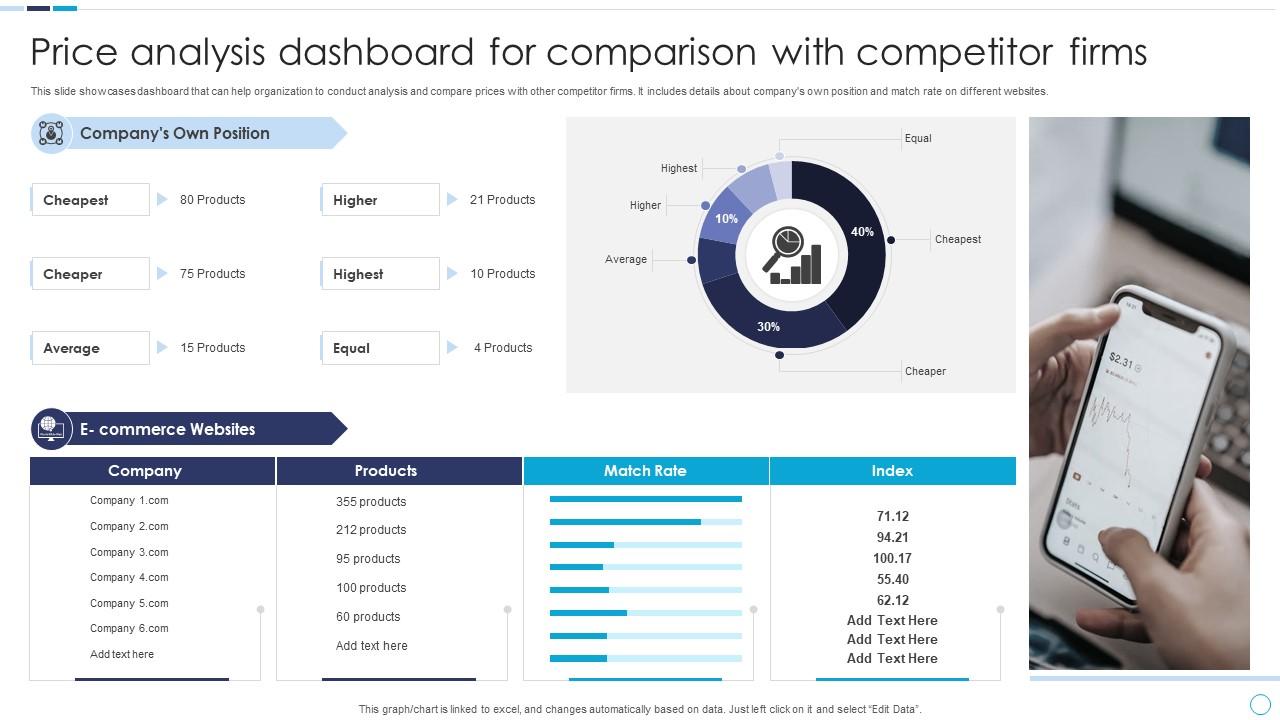
This slide showcases dashboard that can help organization to conduct analysis and compare prices with other competitor firms. It includes details about companys own position and match rate on different websites.
People who downloaded this PowerPoint presentation also viewed the following :
Price Analysis Dashboard For Comparison With Competitor Firms with all 7 slides:
Use our Price Analysis Dashboard For Comparison With Competitor Firms to effectively help you save your valuable time. They are readymade to fit into any presentation structure.
FAQs for Price Analysis Dashboard For Comparison
Key metrics should include competitive pricing comparisons, profit margin analysis, price elasticity measurements, historical pricing trends, and market positioning indicators. These metrics enable businesses to streamline pricing strategies by identifying optimal price points, monitoring competitor movements, and predicting customer responses, ultimately delivering improved profitability and competitive advantage in increasingly dynamic markets.
Data visualization improves pricing trend understanding by transforming complex datasets into intuitive charts, graphs, heat maps, and trend lines that reveal patterns instantly. Through interactive dashboards, organizations can identify seasonal fluctuations, competitor positioning, and market opportunities more effectively, enabling faster strategic pricing decisions that enhance profitability and competitive advantage.
**INPUT**: What tools or software are most effective for creating a price analysis dashboard? **OUTPUT**: Effective price analysis dashboard tools include Tableau, Power BI, Excel with Power Query, Google Data Studio, and specialized platforms like Qlik Sense. These solutions streamline price monitoring by automating data integration, enabling real-time visualization, and delivering advanced analytics capabilities, with many organizations finding that strategic dashboard implementation enhances competitive positioning and accelerates pricing decisions.
Price analysis data should be updated daily or weekly for fast-moving markets, while monthly updates suffice for stable industries like utilities or manufacturing. Through automated data feeds and real-time integration, organizations in retail, commodities, and financial services streamline pricing decisions, minimize market lag, and enhance competitive positioning, ultimately delivering more responsive pricing strategies and improved profit margins.
Common mistakes include overcrowding dashboards with excessive metrics, using inconsistent data sources, neglecting mobile responsiveness, and failing to align visualizations with user needs. Organizations often create dashboards that lack real-time updates, poor filtering capabilities, and unclear pricing trend indicators, ultimately hindering strategic decision-making and competitive pricing analysis across retail and manufacturing sectors.
A price analysis dashboard incorporates competitor pricing data through web scraping tools, API integrations, third-party data providers, manual data entry systems, and automated monitoring software. These technologies enable real-time competitor tracking, dynamic pricing adjustments, and market positioning analysis, with many retail and e-commerce organizations finding that integrated competitor insights ultimately deliver enhanced pricing strategies and improved competitive advantage.
Historical pricing data serves as the foundation for identifying patterns, seasonal fluctuations, cyclical trends, and long-term price trajectories within the dashboard's analytical framework. By analyzing past pricing behaviors across different time periods, organizations can forecast future market movements, optimize procurement timing, and develop strategic pricing strategies, ultimately enabling data-driven decisions that enhance competitive positioning and operational efficiency.
User feedback enhances price analysis dashboards by identifying missing metrics, improving interface usability, and revealing workflow bottlenecks that users encounter daily. Through regular feedback collection, organizations streamline data visualization, add predictive analytics capabilities, and customize alerts for different user roles, ultimately delivering more intuitive dashboards and faster pricing decisions.
Best practices for segmenting data in a price analysis dashboard include product categories, customer segments, geographical regions, time periods, and competitor groups. These segmentation approaches enhance decision-making by enabling targeted pricing strategies, identifying market opportunities, and revealing performance patterns across different business dimensions, with many organizations finding that strategic segmentation ultimately delivers improved profit margins and competitive positioning.
Machine learning algorithms integrate into price analysis dashboards through predictive modeling, real-time data processing, automated pattern recognition, and dynamic pricing recommendations. These AI-powered systems enhance decision-making by identifying market trends, forecasting price movements, and optimizing pricing strategies, with retail and financial services organizations finding that automated insights deliver faster responses and improved competitive positioning.
Mobile-friendly price analysis dashboards enable real-time pricing decisions, enhanced accessibility for field teams, faster competitive responses, and improved stakeholder collaboration across locations. These platforms streamline decision-making by allowing sales teams, executives, and analysts to access critical pricing data instantly, ultimately delivering faster market responses and competitive advantage, with many organizations finding that mobile accessibility significantly accelerates their pricing strategies.
Pricing strategies can be visually represented through dynamic charts showing price elasticity curves, competitive positioning matrices, margin waterfall analyses, and real-time profitability heatmaps across product lines. These visual elements enable finance teams to quickly identify optimal pricing opportunities, track competitor responses, and assess revenue impact scenarios, ultimately delivering data-driven pricing decisions that enhance competitive advantage.
Price elasticity implications include dynamic pricing controls, demand forecasting modules, competitor benchmarking tools, customer segmentation analysis, and scenario modeling capabilities. These features enable businesses to visualize demand responses across different price points, optimize pricing strategies in real-time, and anticipate market reactions, with many retail and e-commerce organizations finding that elasticity-aware dashboards deliver significantly improved profit margins and competitive positioning.
Real-time data integration enhances price analysis dashboards by delivering immediate market updates, enabling dynamic pricing adjustments, and providing instant competitor comparisons across multiple channels. This continuous data flow allows businesses to respond swiftly to market fluctuations, optimize pricing strategies automatically, and maintain competitive positioning, with many retail and e-commerce organizations finding significantly improved profit margins.
Effective communication methods include executive summary presentations with key insights, automated alerts for critical price movements, interactive dashboard sessions, detailed written reports with actionable recommendations, and stakeholder-specific visualizations. These approaches enhance decision-making by translating complex pricing data into clear business intelligence, enabling faster strategic responses, and ensuring alignment across departments, with many organizations finding that tailored communication formats significantly improve stakeholder engagement and pricing strategy implementation.
-
Love the template collection they have! I have prepared for my meetings much faster without worrying about designing a whole presentation from scratch.
-
The slides come with appealing color schemes and relevant content that helped me deliver a stunning presentation without any hassle!