Real Estate Management KPI Dashboard

Rating:
90%
Real Estate Management KPI Dashboard
Slide 1 of 10

or

Favourites Favourites

Try Before you Buy Download Free Sample Product

Audience Impress Your
Audience
Editable 100%
Editable
Time Save Hours
of Time
The Biggest Sale is ending soon in
0
0
:
0
0
:
0
0
Rating:
90%
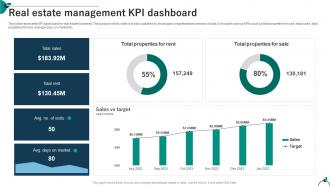
This slide represents KPI dashboard for real estate business. The purpose of this slide is to track activities to showcase comprehensive overview of data. It includes various KPIs such as total properties for sale, total sales, total properties for rent, average days on market etc. Introducing our Real Estate Management KPI Dashboard set of slides. The topics discussed in these slides are Real Estate Management. This is an immediately available PowerPoint presentation that can be conveniently customized. Download it and convince your audience.

People who downloaded this PowerPoint presentation also viewed the following :

FAQs for Real Estate

Critical residential real estate KPIs include average days on market, price per square foot, listing-to-sale price ratios, inventory turnover rates, and lead conversion percentages. These metrics enable agents and brokerages to optimize pricing strategies, streamline marketing efforts, and enhance client acquisition, with many residential firms finding that tracking these KPIs simultaneously delivers faster sales cycles and improved profitability.

Real estate investors use KPIs like compound annual growth rate, price-to-rent ratios, neighborhood appreciation trends, comparative market analysis, and cap rate changes to assess property value appreciation. These metrics enable investors to identify high-performing markets, optimize portfolio allocation, and time acquisitions strategically, with many finding that data-driven approaches deliver superior returns and competitive market positioning.

Key rental income KPIs include gross rental yield, net operating income (NOI), cash-on-cash return, cap rates, and vacancy rates. These metrics enable investors to assess profitability by analyzing rental income against property costs, operating expenses, and market conditions, with many real estate professionals finding that combining multiple KPIs delivers more accurate investment decisions and competitive market positioning.

Vacancy rates significantly impact real estate KPIs by directly affecting revenue streams, operating ratios, and property valuations through reduced rental income and increased marketing costs. Higher vacancies deteriorate net operating income, cap rates, and cash-on-cash returns, while extended vacant periods strain expense ratios and tenant retention metrics, ultimately diminishing asset performance and competitive positioning in increasingly dynamic markets.

Operational costs serve as critical performance indicators that directly impact profitability, cash flow, and property valuation in real estate analysis. These metrics enable property managers and investors to identify inefficiencies, benchmark against industry standards, and optimize resource allocation, with many real estate firms finding that systematic cost tracking ultimately delivers enhanced margins and competitive positioning.

Real estate marketing KPIs help measure effectiveness by tracking lead generation rates, cost per acquisition, conversion ratios, website engagement metrics, and sales cycle duration. Through these measurements, agencies can optimize advertising spend, identify high-performing channels like social media or email campaigns, and enhance property positioning strategies, ultimately delivering faster sales, reduced marketing costs, and improved ROI across their portfolio.

A high debt-to-equity ratio in real estate indicates significant leverage, which amplifies both potential returns and financial risks, while limiting flexibility for additional financing and increasing vulnerability to market downturns. While this strategy can accelerate portfolio growth and enhance returns during favorable market conditions, it also elevates monthly obligations and requires careful cash flow management, with many investors finding that balanced leverage ultimately delivers more sustainable long-term growth.

Market trends significantly influence real estate KPIs by driving fluctuations in property values, absorption rates, days on market, and rental yields across different cycles. During market upswings, metrics like price per square foot and cap rates improve, while downturns extend marketing periods and reduce occupancy rates, with many investors finding that tracking these correlations enables better timing for acquisitions and strategic portfolio adjustments.

Commercial property managers should focus on occupancy rates, net operating income, rent roll analysis, tenant retention rates, and operating expense ratios. These metrics enable strategic decision-making by tracking revenue performance, identifying cost optimization opportunities, and measuring tenant satisfaction, with many property management firms finding that consistent monitoring ultimately delivers enhanced portfolio performance and competitive market positioning.

Benchmark real estate KPIs by accessing industry reports from organizations like NAR, CCIM, and commercial brokerages, utilizing MLS data analytics, and joining professional networks for peer comparisons. Many real estate firms enhance their competitive positioning by comparing metrics like days on market, price per square foot, and conversion rates against regional and national averages, ultimately identifying performance gaps and growth opportunities.

Technology tracking of real estate KPIs delivers enhanced data accuracy, real-time performance monitoring, automated reporting, predictive analytics capabilities, and streamlined portfolio management across multiple properties. These digital solutions enable real estate professionals to identify market trends faster, optimize pricing strategies, and improve client experiences, with many agencies finding that automated KPI dashboards reduce manual work while delivering competitive advantages.

Real estate development firms leverage KPIs for project management by tracking construction timelines, budget adherence, cost per square foot, safety incidents, and permit approval rates. These metrics enable developers to identify bottlenecks early, optimize resource allocation, and maintain quality standards, with many firms finding that systematic KPI monitoring reduces project delays by 20-30% while enhancing profitability.

Essential tenant satisfaction KPIs include renewal rates, response times to maintenance requests, complaint resolution metrics, Net Promoter Scores, and occupancy stability measures. These indicators enable property managers to enhance tenant experiences by identifying service gaps, streamlining maintenance operations, and improving communication protocols, ultimately delivering higher retention rates and increased property values across portfolios.

Investors use KPIs to minimize risks by monitoring cash flow ratios, vacancy rates, debt-to-equity levels, and market absorption rates for early warning signals. These metrics enable strategic portfolio adjustments, with many real estate firms finding that consistent KPI tracking helps identify market shifts months ahead, ultimately delivering better timing for acquisitions and disposals.

Cash flow metrics are crucial real estate KPIs because they measure actual income generation, liquidity position, and investment viability beyond paper valuations. These metrics enable property investors and real estate firms to assess operational efficiency, predict sustainable growth, and make strategic acquisition decisions, with many commercial developers finding that positive cash flow indicators directly correlate with long-term portfolio performance and competitive market positioning.

Ratings and Reviews

90% of 100
Review Form
Write a review
Most Relevant Reviews
  1. 80%

    by Cyril Gibson

    Definitely a time saver! Predesigned and easy-to-use templates just helped me put together an amazing presentation.
  2. 100%

    by Brown Baker

    The way SlideTeam professionals work is exceptional. Thanks for being so helpful!

2 Item(s)

per page: