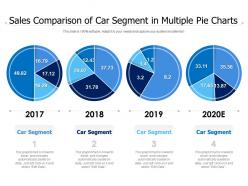
Sales comparison of car segment in multiple pie charts

Sales comparison of car segment in multiple pie charts
Slide 1 of 2
Favourites Favourites

Try Before you Buy Download Free Sample Product

Audience Impress Your
Audience
Editable 100%
Editable
Time Save Hours
of Time
The Biggest Sale is ending soon in
0
0
:
0
0
:
0
0
Presenting this set of slides with name Sales Comparison Of Car Segment In Multiple Pie Charts. The topics discussed in these slides are Sales Comparison Of Car Segment In Multiple Pie Charts. This is a completely editable PowerPoint presentation and is available for immediate download. Download now and impress your audience.

People who downloaded this PowerPoint presentation also viewed the following :

FAQs for Sales comparison of car segment in

Several factors are driving automotive sales growth, including rising consumer income levels, expanded financing options, technological advancements in safety and connectivity, government incentives for electric vehicles, and improved fuel efficiency standards. Additionally, urbanization trends, changing mobility preferences among younger demographics, and strategic manufacturer investments in SUVs and crossover segments have accelerated market expansion, with many dealerships finding that enhanced digital sales platforms ultimately deliver faster customer acquisition and improved profit margins.

Electric vehicle sales are rapidly gaining market share against traditional combustion engines, with EVs representing approximately 10% of global auto sales and growing at double-digit rates annually. While traditional vehicles still dominate overall volume, many automotive markets like Norway and China show EVs increasingly capturing consumer preference through lower operating costs, government incentives, and expanding charging infrastructure, ultimately delivering competitive advantages for early-adopting manufacturers.

COVID-19 significantly impacted car sales across segments, with luxury and electric vehicles showing resilience while economy and compact segments faced steep declines during initial lockdowns. The pandemic accelerated shifts toward contactless purchasing, online sales platforms, and increased demand for personal transportation over public transit, with many dealerships finding that premium SUVs and hybrid models recovered faster than traditional sedans.

Tesla, Toyota, and luxury brands like Mercedes-Benz have experienced significant sales increases, driven by electric vehicle adoption, hybrid technology advancement, supply chain recovery, and enhanced digital customer experiences. These manufacturers streamlined production processes, expanded EV portfolios, and leveraged data analytics for targeted marketing, ultimately delivering improved operational efficiency and stronger market positioning in an increasingly competitive automotive landscape.

Urban consumers prioritize fuel efficiency, compact designs, advanced connectivity features, and electric or hybrid options due to traffic congestion and environmental concerns. Rural buyers favor larger vehicles like SUVs and trucks with higher ground clearance, cargo capacity, and durability for varied terrain, with many finding that practical functionality outweighs technology features in their purchasing decisions.

Digital marketing revolutionizes car sales by enhancing customer targeting, streamlining lead generation, enabling personalized experiences, and accelerating purchase decisions through data-driven insights. Through social media advertising, search optimization, and interactive content, automotive dealerships deliver faster customer engagement, reduce acquisition costs, and ultimately boost conversion rates, with many finding that digital channels now drive over 70% of qualified leads.

Financing options significantly influence car purchasing decisions by expanding affordability, reducing upfront costs, and enabling access to higher-value vehicles through manageable monthly payments. Different financing structures, including low-interest loans, lease programs, and manufacturer incentives, allow consumers to balance budget constraints with desired features, ultimately driving purchase timing and brand selection across various market segments.

Emerging trends in car sales include electric vehicle acceleration, subscription-based ownership models, direct-to-consumer sales channels, AI-powered personalization, and integrated digital showroom experiences. These developments streamline purchasing processes, enhance customer engagement, and reduce operational costs, with many automotive companies finding that embracing omnichannel approaches and sustainable technologies delivers significant competitive advantage.

Seasonal changes significantly influence car sales through weather-related demand shifts, model year transitions, and consumer purchasing cycles, with spring and summer typically driving higher convertible and SUV sales while winter boosts all-wheel-drive vehicle demand. Dealerships strategically time inventory launches, promotional campaigns, and clearance events around these patterns, ultimately enabling better forecasting, optimized stock management, and enhanced sales performance across different automotive segments.

Government regulations and incentives significantly accelerate eco-friendly vehicle adoption through emissions standards, fuel economy requirements, tax credits, and purchase rebates. These policies create market advantages for hybrid and electric vehicles, with many automakers finding that regulatory frameworks drive innovation, reduce production costs through scale, and ultimately deliver competitive positioning in an increasingly sustainability-focused automotive landscape.

New technology like autonomous driving significantly boosts consumer interest by offering enhanced safety, convenience, and future-ready features that differentiate vehicles in competitive markets. While early adoption varies across demographics, automakers leveraging advanced driver assistance systems, connectivity features, and semi-autonomous capabilities often see increased showroom traffic and premium pricing power, ultimately delivering stronger sales performance and market positioning.

Car manufacturers face declining demand due to economic uncertainties, intense competition from electric vehicle startups, supply chain disruptions affecting production timelines, and shifting consumer preferences toward sustainable transportation options. These challenges require strategic adaptation through enhanced digital marketing, streamlined operations, and innovative product development, with many automakers finding that diversifying their portfolios and investing in electric infrastructure ultimately delivers competitive advantage in an increasingly dynamic marketplace.

Global supply chain issues significantly impact car availability by creating semiconductor shortages, production delays, manufacturing bottlenecks, and component scarcities that reduce inventory levels across dealerships. These disruptions translate into longer customer wait times, increased vehicle prices, and constrained sales figures, with many automotive manufacturers finding that strategic supplier diversification and inventory management become critical for maintaining competitive advantage in an increasingly volatile market environment.

Income levels, age groups, family size, geographic location, and education levels show the strongest correlations with car segment preferences. Luxury segments attract high-income demographics aged 35-55, while compact cars appeal to younger buyers and urban dwellers, with SUV sales correlating strongly with families and suburban locations, ultimately enabling automakers to target marketing strategies and optimize inventory allocation for maximum market penetration.

Trade policies and tariffs significantly influence international car sales by affecting pricing competitiveness, market access, and consumer demand across different regions. Higher tariffs increase vehicle costs, potentially reducing sales volume, while favorable trade agreements enable manufacturers to offer competitive pricing in foreign markets, ultimately driving greater market penetration and revenue growth for automotive companies operating globally.

Ratings and Reviews

0% of 100
Review Form
Write a review
Most Relevant Reviews

No Reviews