Sales profit and gross margin financial highlights graphs

Sales profit and gross margin financial highlights graphs
Slide 1 of 2

or

Favourites Favourites

Try Before you Buy Download Free Sample Product

Audience Impress Your
Audience
Editable 100%
Editable
Time Save Hours
of Time
The Biggest Sale is ending soon in
0
0
:
0
0
:
0
0
Presenting this set of slides with name Sales Profit And Gross Margin Financial Highlights Graphs. The topics discussed in these slide is Sales Profit And Gross Margin Financial Highlights Graphs. This is a completely editable PowerPoint presentation and is available for immediate download. Download now and impress your audience.

Content of this Powerpoint Presentation

Description:

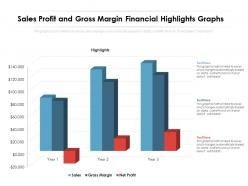
The image is a PowerPoint slide titled "Sales Profit and Gross Margin in Financial Highlights Graphs". It features a bar graph comparing three financial metrics—Sales, Gross Margin, and Net Profit—across three consecutive years (Year 1, Year 2, Year 3). Sales and Gross Margin are shown in different shades of blue, indicating positive values, while Net Profit is shown in red, which interestingly suggests negative values for Year 1 and Year 2, turning positive in Year 3. The graph is interactive and linked to an Excel spreadsheet, as indicated by the note: "This graph/chart is linked to Excel, and changes automatically based on data. Just left-click on it and select 'edit data'."

Use Cases:

Here are seven specific industries that can benefit from using such slides:

1. Retail:

Use: Reviewing annual financial performance

Presenter: CFO or financial analyst

Audience: Retail management and shareholders

2. Manufacturing:

Use: Presenting profitability and cost management

Presenter: Financial controller

Audience: Investors and company executives

3. Healthcare:

Use: Analyzing the financial health of medical facilities

Presenter: Hospital administrator

Audience: Board members and stakeholders

4. Technology:

Use: Showcasing revenue and profit trends

Presenter: Business development manager

Audience: Investors and analysts

5. Real Estate:

Use: Comparing yearly sales and profit data

Presenter: Real estate developer

Audience: Investors and finance teams

6. Automotive:

Use: Financial performance review of car sales

Presenter: Sales director

Audience: Dealership owners and investors

7. Energy:

Use: Illustrating financial outcomes from energy sales

Presenter: Financial planner

Audience: Energy company stakeholders and policy makers

FAQs for Sales profit and gross margin

Sales profit represents the total revenue remaining after deducting all operating expenses, taxes, and costs, while gross margin focuses specifically on revenue minus the direct cost of goods sold before other expenses. Sales profit provides a comprehensive view of overall business profitability across all operations, whereas gross margin evaluates production efficiency and pricing strategies, with many retail and manufacturing organizations finding that strong gross margins enable sustainable sales profit growth.

Businesses calculate gross margin percentage by subtracting cost of goods sold from total revenue, then dividing by total revenue and multiplying by 100. This fundamental metric enables companies to assess pricing strategies, operational efficiency, and product profitability across different lines, with many organizations finding that regular gross margin analysis ultimately delivers better resource allocation and competitive positioning.

Sales profit serves as a critical indicator of operational efficiency, revenue generation capability, and long-term sustainability, directly impacting cash flow, investment capacity, and shareholder value. Through consistent profit margins, companies can fund expansion initiatives, weather economic downturns, and maintain competitive positioning, with many organizations finding that sustainable sales profitability ultimately drives market confidence and strategic growth opportunities.

Understanding gross margin enables businesses to set strategic pricing by revealing true profitability thresholds, cost structures, and competitive positioning opportunities. Through margin analysis, companies can optimize pricing to maximize revenue while maintaining profitability, with many retail and manufacturing organizations finding that data-driven pricing strategies ultimately deliver improved market share and sustainable growth.

Common pitfalls include overlooking product mix impacts, failing to account for hidden costs, misclassifying expenses between COGS and operating costs, ignoring seasonal variations, and analyzing margins in isolation without market context. These challenges often lead to flawed pricing strategies, poor product portfolio decisions, and missed optimization opportunities, with many organizations finding that comprehensive margin analysis frameworks ultimately deliver clearer profitability insights and stronger competitive positioning.

Businesses use gross margin analysis to identify underperforming products by comparing individual product margins against category averages, tracking margin trends over time, and evaluating cost structures versus revenue generation. Through systematic margin comparison, companies can pinpoint products with declining profitability, excessive production costs, or pricing misalignment, enabling strategic decisions about product optimization, discontinuation, or repositioning to enhance overall portfolio performance.

Gross margin fluctuations stem from changes in cost of goods sold, pricing strategies, product mix shifts, supplier costs, and operational efficiency improvements. Market competition, raw material price volatility, manufacturing scale economies, and labor cost variations significantly impact margins, with many companies finding that strategic pricing adjustments and supply chain optimization ultimately deliver sustained profitability advantages.

Industry benchmarks establish performance standards that help companies set realistic gross margin targets, identify competitive positioning, and uncover improvement opportunities across their sector. Through comparative analysis, organizations can assess whether their margins reflect operational efficiency or indicate areas needing strategic attention, with many companies finding that benchmark-driven insights ultimately enhance pricing strategies and resource allocation decisions.

Businesses can use dashboard software like Tableau and Power BI, Excel pivot tables and charts, specialized analytics platforms such as Looker, and integrated CRM reporting tools. These visualization technologies streamline financial analysis by creating interactive charts, trend comparisons, and real-time performance tracking, with many retail and manufacturing organizations finding enhanced decision-making capabilities.

Effective cost management strategies improve gross margin by optimizing procurement processes, negotiating better supplier terms, reducing waste, and streamlining operations to lower cost of goods sold. Through strategic vendor partnerships and automated inventory management, companies across manufacturing and retail sectors enhance profitability while maintaining quality, with many organizations finding that systematic cost control delivers 15-25% margin improvements.

Sales volume and gross margin share a complex relationship where increased volume can improve margins through economies of scale, better supplier negotiations, and fixed cost absorption, while also potentially reducing margins through discounting or product mix changes. Many retail and manufacturing organizations find that strategic volume growth enhances operational efficiency and supplier leverage, ultimately delivering improved profitability when balanced with pricing discipline and cost management.

Businesses leverage gross margin analysis to enhance decision-making by identifying profitable products, optimizing pricing strategies, streamlining operational costs, and allocating resources more effectively. Through detailed margin analysis, companies across retail, manufacturing, and services can pinpoint underperforming segments, negotiate better supplier terms, and focus investments on high-margin offerings, ultimately delivering improved profitability and competitive advantage.

Seasonal trends significantly impact sales profit and gross margin through demand fluctuations, inventory costs, pricing pressures, and operational scaling challenges. Retail businesses experience holiday surges while travel companies face summer peaks, with many organizations finding that strategic inventory management, dynamic pricing strategies, and flexible staffing models help maintain profitability across seasonal cycles, ultimately delivering more consistent margins.

Gross margin significantly influences investor confidence by demonstrating operational efficiency, pricing power, and competitive positioning within the market. Higher margins signal strong management execution and sustainable business models, with technology companies and pharmaceutical firms often commanding premium valuations, ultimately delivering enhanced shareholder returns and attracting long-term investment capital.

Competitive analysis reveals market pricing standards, competitor profit structures, and strategic positioning opportunities that directly impact your sales margins. By examining competitor pricing strategies, cost management approaches, and value propositions, businesses can identify margin optimization opportunities, adjust pricing models strategically, and enhance competitive advantage while maintaining profitability.

Ratings and Reviews

0% of 100
Review Form
Write a review
Most Relevant Reviews

No Reviews