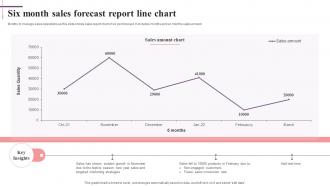
Six Month Sales Forecast Report Line Chart
Try Before you Buy Download Free Sample Product
Audience
Editable
of Time
Months to manage sales operations as this slide shows sales report chart of six per forecast. It includes months and six months sales amount.
People who downloaded this PowerPoint presentation also viewed the following :
Six Month Sales Forecast Report Line Chart with all 7 slides:
Use our Six Month Sales Forecast Report Line Chart to effectively help you save your valuable time. They are readymade to fit into any presentation structure.
FAQs for Six Month Sales Forecast
So there's basically two ways to tackle this - quantitative stuff uses your historical data and math models like time series analysis or regression. Then qualitative is more about getting insights from your sales team, customer surveys, that kind of thing. Most places I know mix both approaches since pure number-crunching misses a lot of context. Start with whatever data you've got lying around, then add human gut checks for the weird stuff that doesn't show up in spreadsheets. Oh and moving averages are pretty solid if you're just getting started - they're way less intimidating than they sound.
So definitely pull up your historical sales data - that's where the gold is. I usually go back 2-3 years to catch seasonal patterns and growth trends. Plot it all on a basic chart first (sounds boring but trust me, the visual helps). Check how external stuff impacted your numbers too. Here's what I learned the hard way - always compare your old forecasts to what actually happened. You'll probably find you're consistently optimistic or pessimistic in certain areas. Once you've got that baseline, project forward but tweak it for any big changes you know are coming.
Oh man, you really can't skip seasonality stuff when forecasting. Like, Q4 holiday spikes will totally mess you up if you're not ready for them. I made that mistake with back-to-school season last year - oof. Market trends matter just as much too. Economic changes, industry shifts, all that impacts your numbers. What I do now is dig into historical data to spot those patterns, then bake them right into my models. Also staying current with what's happening in your market obviously. Short version: don't just rely on baseline numbers. Layer in the trend analysis or you'll get burned.
So basically you layer qualitative stuff on top of your numbers. Pick the big things that'll actually move the needle - market vibes, what competitors are doing, regulatory stuff, seasonal patterns. Then just assign percentage bumps or drops. Like if you're doing a huge marketing push in Q4, maybe add 15% to those forecasts. Some people get all sophisticated with sentiment analysis from social media (which honestly feels like overkill half the time), but even just having managers score their gut feelings works if you're consistent about it. The trick is writing down what you assumed so you can look back later and see what actually worked. Otherwise you'll forget why you made those adjustments.
Your CRM probably already does this stuff - Salesforce, HubSpot, Pipedrive all have decent forecasting built in. Start there. Excel with pivot tables works great too, honestly. I've watched so many teams blow money on crazy AI tools when they didn't even use their basic features yet. Power BI and Tableau are solid if you need prettier charts. Oh, and if you're doing serious predictive stuff down the road, Anaplan's pretty good but expensive. Don't overthink it though - use what you've got first, then upgrade when it actually stops working for you.
Look, your sales forecasts are basically the backbone of everything inventory-related. They tell you what to buy, when to order it, and how much extra stock you should keep on hand. Get the forecasts right and you won't deal with stockouts or mountains of inventory collecting dust (which honestly just feels like throwing money away). Your supply chain people use these numbers to plan everything - procurement timing, supplier deals, warehouse space. It even affects your manufacturers upstream. Oh, and check your forecast accuracy every month. Use what you learn to tweak your inventory rules as you go.
Honestly, the biggest mistake is being way too rosy with your projections. I made that error so many times! Also don't just pull from one data source - learned that lesson the expensive way. Market shifts and seasonal dips will catch you off guard if you're not careful. Your team probably can't handle as much as you think they can either. Oh, and actually update these things regularly instead of making them once then never touching them again. I'd start by looking at where last quarter's forecast totally missed the mark, then use those failures to build something better next time.
When the market goes sideways, don't panic but move fast. Get on calls with your sales team and key customers to figure out what's actually happening. Is this temporary or are we looking at a bigger shift? If it's just a rough quarter, tweak those months and leave the rest alone. But if something fundamental changed, you'll probably need to rebuild your whole model - ugh, I know. This is exactly why I always tell people to build scenario plans ahead of time. Most don't though. Start with whatever got hit hardest, then work your way out from there. And please, make small adjustments instead of completely overhauling everything at once.
So I'd definitely start with MAPE - Mean Absolute Percentage Error. Shows your average miss as a percentage, super easy to read. Track forecast bias too because honestly, we all tend to be way too optimistic with our predictions. RMSE is solid since it punishes your bigger screw-ups more heavily. Break it down by time period and product line - you'll spot weird patterns that way. I usually calculate MAPE monthly and just compare it to whatever benchmarks make sense for your industry. Root mean square error sounds fancy but it's actually pretty straightforward once you get into it.
Dude, when sales and marketing actually talk to each other, your forecasting becomes so much better. Marketing sees which leads are getting hot from campaigns. Sales knows what's really closing and when. These teams work separately way too often - drives me nuts honestly. You'll get better lead scores and more realistic conversion rates when they share intel regularly. Quick fix: set up weekly calls where marketing talks campaign numbers and sales gives feedback on lead quality. Even that small change will boost your forecasting accuracy big time.
Dude, economic indicators are basically like checking the weather before planning a big outdoor event. Unemployment rates and GDP growth? They directly affect how much cash people have to blow on stuff. When unemployment drops, sales usually spike because people feel secure spending again. I totally bombed my first forecast by ignoring this - learned that lesson fast! Inflation and interest rates mess with purchasing power too. Honestly, you don't need to track everything though. Pick 2-3 indicators that actually correlate with your industry and check them monthly. Consumer confidence index is gold for most businesses.
Dude, you gotta break down your customers by age and demographics - it makes such a difference. Millennials buy small amounts constantly while boomers drop bigger chunks less often. We totally bombed our Q3 numbers because I assumed everyone shopped the same way (rookie mistake). Once you split your historical data by demographic stuff, you'll see crazy patterns. Like how price sensitivity changes between groups, or seasonal trends that only hit certain ages. Honestly it's kinda fascinating how different segments behave. Your forecasts will be way more accurate.
Be totally honest about what you're confident in and what you're guessing at - nobody likes getting blindsided later. Charts and dashboards are your friend here. Seriously, spreadsheets just sit there unread. Make your timeframes crystal clear, plus what might mess up your predictions. Always give them three scenarios: best case, worst case, and what'll probably happen. That way they get the full picture. Oh, and set up regular meetings to update everything as new info rolls in. It's kinda tedious but builds major trust in your forecasts down the road.
Dude, the amount of data AI can crunch is insane - customer patterns, market shifts, even what people are saying on social media. It catches connections you'd totally miss doing it by hand. Way more accurate than those boring linear forecasts we grew up with. Real-time updates are clutch too, so you're not working with stale info. Oh and definitely test it on just one product line first - I learned that the hard way lol. See how it stacks up against whatever method you're using now before going all in.
Honestly, just start with whatever sales data you've got - even a couple months is better than nothing. I'd throw it in a basic spreadsheet first (fancy software can wait). Look for any seasonal stuff that jumps out at you. Track your conversion rates too. Also peek at what others in your industry are doing for benchmarks. Factor in any big marketing pushes or launches coming up. Here's the thing though - I see people get stuck perfecting forecasts that never get used. Better to have something rough that you actually look at each month and tweak. You'll get way more out of adjusting as you go than trying to nail it perfectly upfront.
-
Templates are beautiful and easy to use. An amateur can also create a presentation using these slides. It is amazing.
-
The visual appeal of the templates is just unparalleled! I was so worried about the design of my presentation but SlideTeam made it all so easy.Â