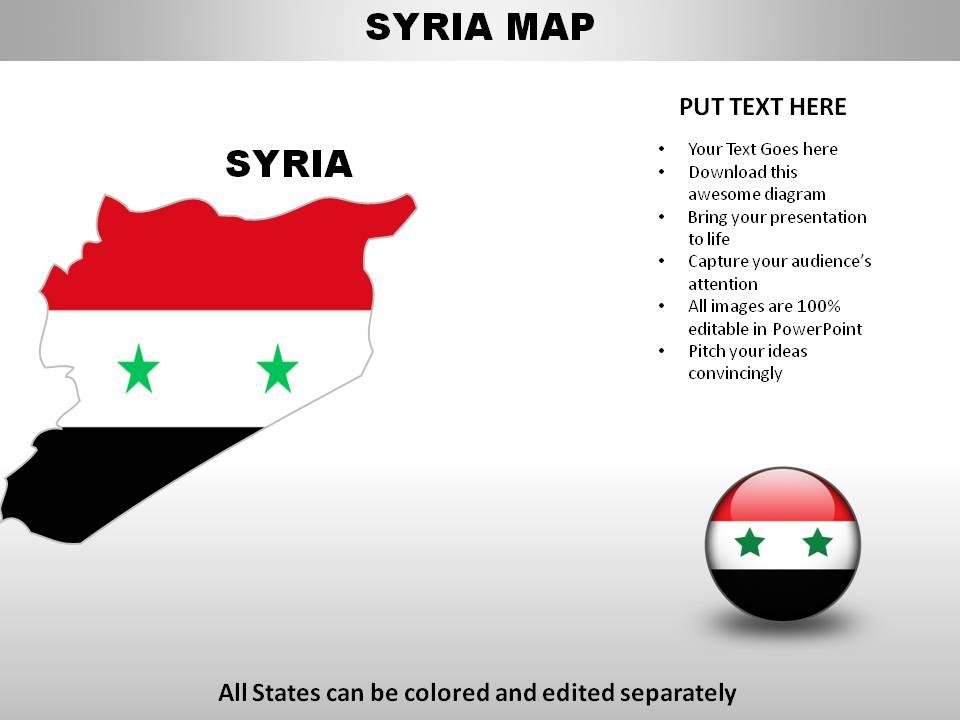
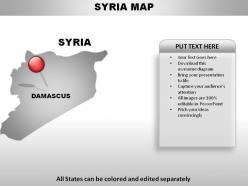
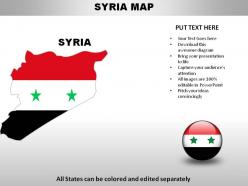
Syria country powerpoint maps
Try Before you Buy Download Free Sample Product
Audience
Editable
of Time
The audience may have many a question. Our Syria Country Powerpoint Maps will find the answers.
People who downloaded this PowerPoint presentation also viewed the following :
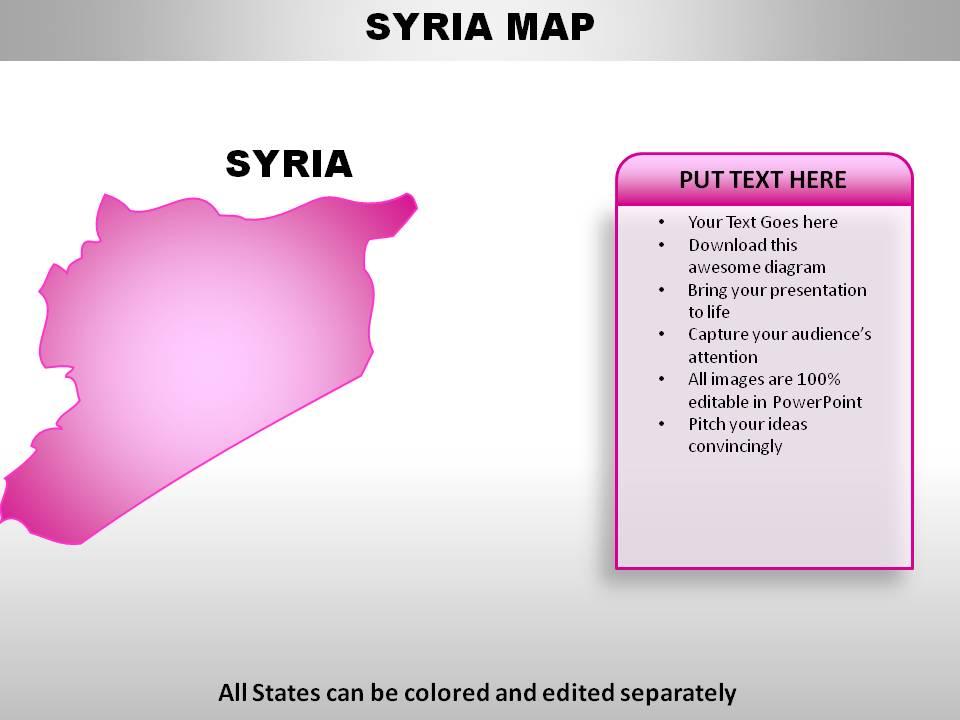
Syria country powerpoint maps with all 7 slides:
Clear and concise is the credo of our Syria Country Powerpoint Maps. Use them and dispel any doubts your team may have.
FAQs for Syria
Syria's territorial borders have shifted through Ottoman provincial reorganizations, French Mandate administrative divisions, independence adjustments, and regional conflicts affecting disputed territories like the Golan Heights. Historical maps illustrate these transformations by documenting colonial boundary changes, post-independence consolidations, and ongoing territorial challenges, with many geopolitical analysts finding that these visual representations reveal Syria's complex evolution from Ottoman vilayets to modern statehood.
Modern geopolitical conflicts have significantly redrawn Syria's territorial control through fragmented governance zones, refugee displacement patterns, and shifting regional influence boundaries. These changes create complex mapping challenges for humanitarian organizations, international agencies, and regional governments, with many finding that traditional territorial representations no longer reflect operational realities on the ground.
Syria's ethnic and religious demographics significantly influence mapping through territorial control patterns, population distribution analysis, and conflict zone documentation. These demographic overlays help organizations understand sectarian boundaries, displacement patterns, and resource allocation needs, with humanitarian groups, military analysts, and reconstruction planners finding that ethnoreligious mapping enables more targeted interventions and strategic decision-making in this complex geopolitical landscape.
Historical maps of Syria reveal how colonial boundaries, ethnic distributions, and resource locations shaped today's conflicts and alliances. These cartographic records help analysts understand sectarian divisions, territorial disputes, and strategic interests by showing how Ottoman provinces, French mandate borders, and tribal territories evolved into modern political fault lines, ultimately providing context for current governance challenges and regional power dynamics.
International borders on Syria's map define critical geopolitical relationships with Turkey, Iraq, Jordan, Lebanon, and Israel, influencing trade routes, refugee movements, and regional security dynamics. These boundaries significantly impact diplomatic relations, economic partnerships, and humanitarian corridors, with many neighboring countries finding that border management directly affects their domestic policies, regional stability, and strategic positioning in Middle Eastern affairs.
Syria's internal conflict has significantly altered administrative boundaries, with government-controlled areas, opposition territories, Kurdish autonomous regions, and contested zones creating fragmented control that differs from official maps. These changes present both challenges and opportunities for cartographers and analysts, with many geopolitical organizations finding that dynamic mapping technologies enable better tracking of territorial shifts, ultimately delivering more accurate intelligence and strategic insights.
Syria's topographical maps reveal the Anti-Lebanon and Coastal Mountain ranges, the Euphrates River valley, vast desert plateaus, and strategic Damascus-Aleppo corridor. These geographic features significantly impact military operations by controlling supply routes, defensive positioning, and resource access, with many defense analysts finding that elevated terrain and river crossings ultimately determine tactical advantages in regional conflict scenarios.
Satellite imagery and drone mapping technology enhance understanding of Syria's geography by providing real-time topographical data, monitoring infrastructure changes, tracking urban development patterns, and documenting environmental shifts across conflict-affected regions. These technologies enable researchers, humanitarian organizations, and policy institutions to analyze terrain modifications, population movements, and resource distribution with unprecedented accuracy, ultimately delivering strategic insights for reconstruction planning, aid distribution, and geographical research in an increasingly complex regional landscape.
Creating accurate maps in conflict zones like Syria involves challenges including rapidly changing territorial control, restricted field access, damaged infrastructure, security risks for surveyors, and limited reliable data sources. These obstacles require innovative approaches like satellite imagery analysis, crowdsourced information, and remote sensing technologies, with many humanitarian organizations finding that collaborative mapping efforts help deliver more comprehensive situational awareness despite ongoing conflicts.
Refugee movements have significantly altered Syria's demographic landscape, with millions displaced internally and externally, creating population voids in conflict zones while concentrating communities in safer regions. These shifts present both challenges and opportunities for reconstruction planning, with mapping technologies enabling organizations, NGOs, and government agencies to track population flows, optimize resource allocation, and develop strategic resettlement programs.
Syria maps employ distinctive cartographic techniques including color differentiation with darker shades for urban centers, varied symbol densities with clustered dots for cities, road network complexity showing highway concentrations, land use patterns through different textures, and population density gradients. These visualization methods enable urban planners, humanitarian organizations, and government agencies to analyze demographic distributions, infrastructure needs, and resource allocation patterns, ultimately delivering clearer insights for development projects and strategic planning initiatives.
Maps from different time periods reveal Syria's socio-economic evolution through changing urban densities, infrastructure networks, agricultural zones, and industrial centers. Historical cartographic analysis shows how conflict zones have shifted economic activity, with many financial institutions and manufacturing sectors relocating from traditional hubs like Aleppo to more stable regions, ultimately demonstrating how geopolitical changes reshape economic landscapes and resource distribution patterns.
Map-making significantly impacts humanitarian efforts in Syria by enabling precise resource allocation, safe route planning, and damage assessment across conflict zones. Through satellite imagery and ground data, humanitarian organizations can identify displaced populations, locate functioning hospitals and schools, and coordinate aid distribution, ultimately delivering faster assistance and saving lives in an increasingly complex operational environment.
Mapping platforms differ significantly in their Syria conflict representations through data source reliability, update frequency, verification processes, and political neutrality standards. While commercial platforms like Google Maps often show generalized territorial boundaries, specialized conflict mapping services provide real-time incident tracking, displacement patterns, and infrastructure damage assessments, with humanitarian organizations increasingly finding that multi-platform analysis delivers more comprehensive situational awareness.
Historical landmarks and cities in Syria's mapping serve as crucial anchors for documenting millennia of cultural heritage, preserving archaeological sites, ancient trade routes, and architectural treasures for future generations. These mapped cultural assets enable heritage organizations, educational institutions, and tourism sectors to strategically plan conservation efforts, develop educational resources, and create sustainable cultural tourism initiatives, ultimately delivering enhanced cultural preservation and economic opportunities while maintaining Syria's rich historical identity in an increasingly digital documentation landscape.
-
Excellent template with unique design.
-
Innovative and Colorful designs.