Weekly Progress Report With Total Budget And Tasks

Rating:
100%
Weekly Progress Report With Total Budget And Tasks Weekly Progress Report With Total Budget And Tasks
Slide 1 of 7
Favourites Favourites

Try Before you Buy Download Free Sample Product

Audience Impress Your
Audience
Editable 100%
Editable
Time Save Hours
of Time
The Biggest Sale is ending soon in
0
0
:
0
0
:
0
0
Rating:
100%
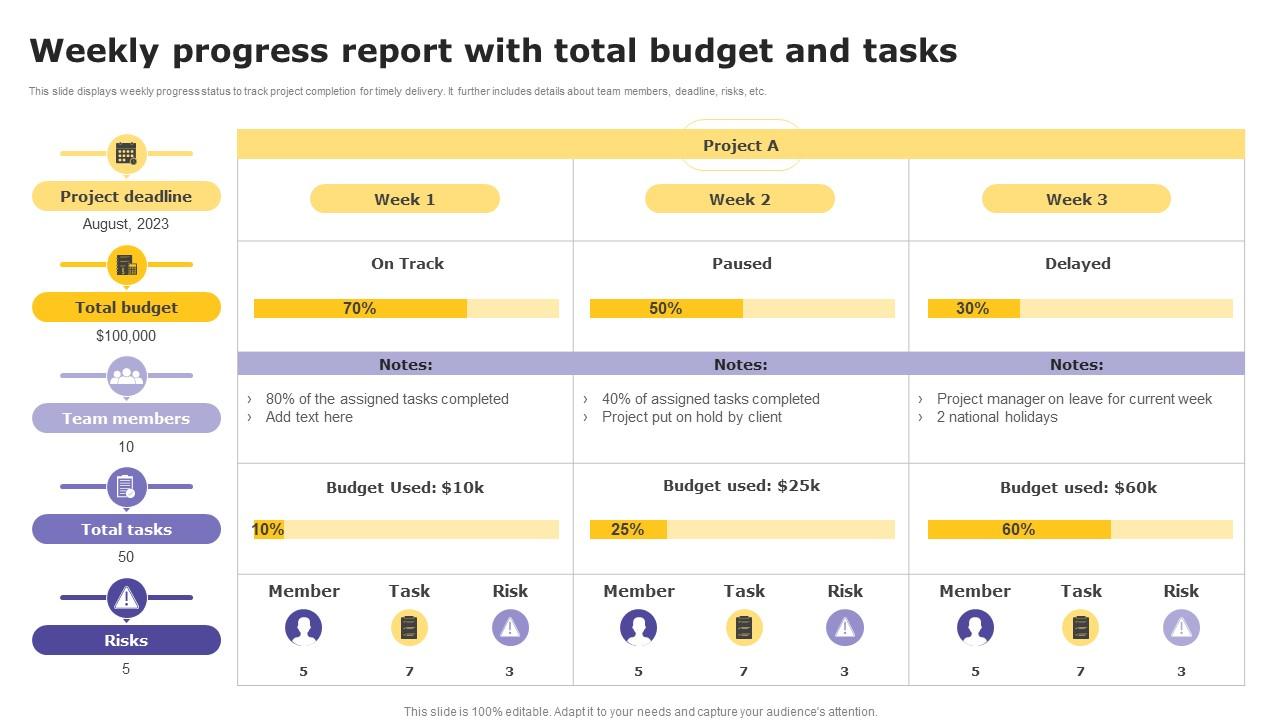
This slide displays weekly progress status to track project completion for timely delivery. It further includes details about team members, deadline, risks, etc. Presenting our well structured Weekly Progress Report With Total Budget And Tasks. The topics discussed in this slide are Report, Budget, Tasks. This is an instantly available PowerPoint presentation that can be edited conveniently. Download it right away and captivate your audience.

People who downloaded this PowerPoint presentation also viewed the following :

FAQs for Weekly Progress Report With Total

Key elements include project milestones achieved, upcoming deliverables, resource allocation updates, budget status, and risk assessments or roadblocks encountered. These components streamline communication by providing stakeholders comprehensive visibility, enabling faster decision-making, and maintaining project momentum, with many organizations finding that structured weekly reporting enhances accountability and delivers improved project outcomes.

Visuals enhance weekly progress reports by transforming complex data into easily digestible charts, graphs, and infographics that accelerate comprehension and decision-making. Through strategic visual elements like progress bars, trend charts, and milestone timelines, organizations streamline stakeholder communication, reduce meeting times, and enable faster identification of bottlenecks, ultimately delivering improved transparency and more efficient project management across teams.

Weekly progress reports should track schedule adherence, budget variance, milestone completion, resource utilization, and risk indicators. These metrics enable project managers to identify bottlenecks, reallocate resources strategically, and maintain stakeholder alignment, with many organizations finding that consistent tracking delivers improved project outcomes and enhanced team accountability.

Weekly progress reports foster better communication by creating structured information sharing, establishing regular touchpoints, identifying collaboration opportunities, and highlighting project dependencies across team functions. Through centralized updates, team members gain visibility into each other's priorities, challenges, and achievements, while managers can address bottlenecks proactively, ultimately enabling more coordinated workflows and strategic alignment.

**INPUT**: What tools or software can streamline the creation of weekly progress reports? **OUTPUT**: Tools for streamlining weekly progress reports include project management platforms like Asana and Monday.com, automated reporting software such as Tableau and Power BI, and collaborative solutions like Microsoft Teams and Slack integrations. These technologies enhance efficiency by automating data collection, standardizing formats, and enabling real-time updates, with many organizations finding that strategic implementation reduces reporting time while improving accuracy and stakeholder engagement. [Word count: 60 words]

Teams ensure weekly progress report alignment with project goals by establishing clear KPIs, regularly mapping completed tasks to strategic objectives, and conducting milestone reviews that connect weekly outcomes to broader deliverables. This systematic approach enables project managers to identify potential deviations early, adjust resource allocation accordingly, and maintain stakeholder confidence, with many organizations finding that structured alignment processes ultimately deliver faster project completion and enhanced team accountability.

Common pitfalls include being overly vague about accomplishments, focusing solely on tasks rather than outcomes, overwhelming readers with excessive detail, and failing to highlight blockers or risks early. These issues undermine report effectiveness by reducing transparency and strategic value, with many organizations finding that structured, outcome-focused reports enhance accountability, streamline decision-making, and ultimately deliver better project visibility and stakeholder alignment.

Feedback from weekly progress reports can be utilized by identifying skill gaps, recognizing high-performing practices, realigning resource allocation, and addressing workflow bottlenecks before they escalate. These insights enable managers to provide targeted coaching, redistribute workloads strategically, and implement process improvements, with many organizations finding that consistent feedback loops ultimately enhance team productivity and employee engagement.

Weekly progress reports should address challenges through transparent problem identification, root cause analysis, and actionable solution proposals, while maintaining focus on recovery timelines and resource requirements. This approach enables teams to pivot strategically, with many organizations finding that honest challenge documentation paired with clear mitigation steps ultimately strengthens project resilience and stakeholder confidence.

Teams should review reporting templates quarterly to ensure alignment with evolving project needs, stakeholder requirements, and organizational priorities, while making minor adjustments monthly based on feedback. This balanced approach enables continuous improvement without disrupting established workflows, with many organizations finding that regular template optimization enhances data quality, streamlines communication, and ultimately delivers more actionable insights for strategic decision-making.

Audience awareness determines the report's focus, detail level, language complexity, and priority emphasis, ensuring stakeholders receive relevant, actionable information tailored to their decision-making needs. By understanding whether recipients are executives seeking high-level outcomes, project managers requiring operational details, or clients wanting deliverable updates, organizations streamline communication effectiveness and enhance stakeholder engagement, ultimately delivering clearer accountability and stronger project alignment.

Weekly progress reports support organizational decision-making by providing real-time performance data, identifying bottlenecks early, tracking resource allocation efficiency, and highlighting emerging trends across departments. These insights enable managers to make informed strategic adjustments, reallocate resources where needed, and address challenges proactively, ultimately delivering faster response times and improved operational outcomes.

Analytical techniques for weekly progress reports include trend analysis, variance analysis, performance benchmarking, ratio calculations, and comparative analysis against targets. These methods enable organizations to identify patterns, bottlenecks, and improvement opportunities by examining week-over-week changes, resource utilization rates, and milestone completion percentages, ultimately delivering actionable insights for strategic decision-making and operational efficiency.

Storytelling elements like narrative structure, challenge-outcome frameworks, and contextual backgrounds can transform weekly progress reports into engaging business communications. By presenting project milestones as story arcs, highlighting team achievements through character-driven narratives, and framing setbacks as plot developments with resolution strategies, organizations create more compelling updates that enhance stakeholder engagement and improve information retention across departments.

Effective accountability strategies include setting clear metrics and deadlines, implementing standardized reporting templates, conducting regular review meetings, establishing transparent feedback loops, and creating consequence frameworks for missed targets. These approaches streamline performance tracking by enabling consistent monitoring, fostering open communication, and maintaining momentum, with many organizations finding that structured weekly reporting cycles ultimately deliver improved project outcomes and enhanced team responsibility.

Ratings and Reviews

100% of 100
Review Form
Write a review
Most Relevant Reviews
  1. 100%

    by Dale Tran

    “Thanks to SlideTeam. Now I can make smart presentations in a fraction of time without any hassle.”
  2. 100%

    by Dino Grant

    Commendable slides with attractive designs. Extremely pleased with the fact that they are easy to modify. Great work!

2 Item(s)

per page: