Bull market trends powerpoint presentation

Rating:
90%
Bull market trends powerpoint presentation
Slide 1 of 5
Favourites Favourites

Try Before you Buy Download Free Sample Product

Audience Impress Your
Audience
Editable 100%
Editable
Time Save Hours
of Time
The Biggest Sale is ending soon in
0
0
:
0
0
:
0
0
Rating:
90%
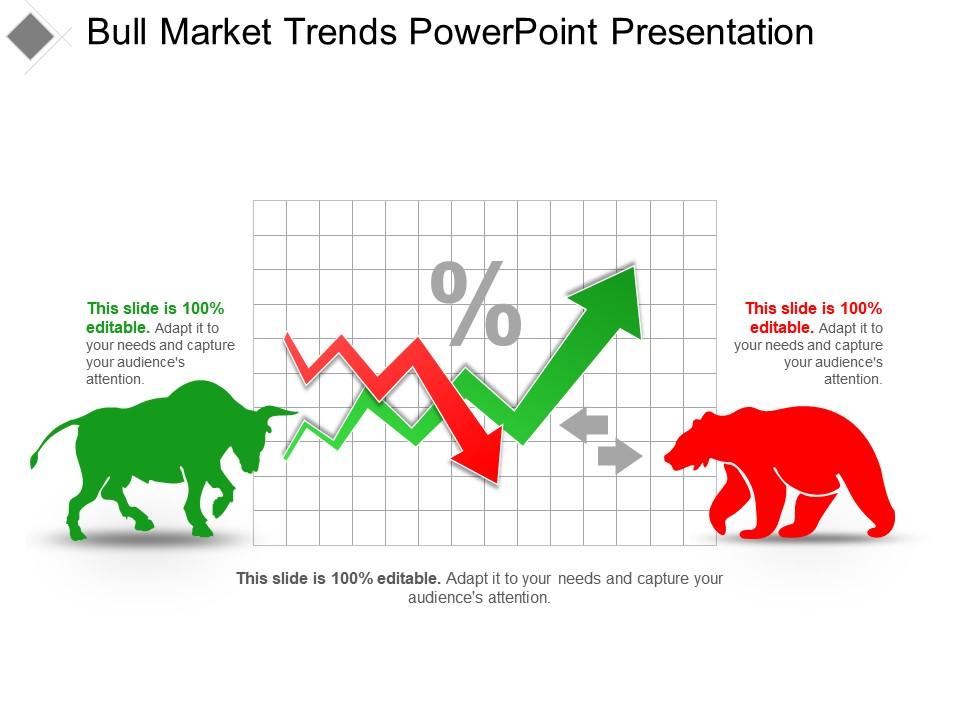
Presenting Bull Market Trends PowerPoint Presentation. Customize the slide as per your presentation theme. Everything in this slide can be altered. You can increase or decrease the size of the bear and bull graphics. Change the font type and the font size. All our slides are adaptable with Google Slides. Get this template in 2 screen sizes and transform it in JPG and PDF formats.

FAQs for Bull market

Key bull market indicators include rising stock prices across sectors, increased trading volumes, strong corporate earnings growth, low unemployment rates, and positive investor sentiment. These signals often emerge through sustained market gains over months, expanding price-to-earnings ratios, and sector rotation patterns, with many institutional investors finding that combining technical analysis with economic data delivers early identification advantages and enhanced portfolio positioning opportunities.

Investor sentiment sustains bull markets by creating self-reinforcing cycles of optimism, increased buying activity, and rising asset valuations that attract more participants. Positive sentiment drives institutions and retail investors to deploy capital more aggressively, while confidence in sectors like technology and healthcare amplifies momentum, ultimately delivering sustained market growth and broader economic expansion.

Technology, consumer discretionary, financial services, real estate, and growth-oriented sectors typically outperform during bull markets due to increased investor confidence, higher spending power, and expanded credit availability. These sectors benefit from rising valuations, improved earnings expectations, and greater risk appetite among investors, with many financial institutions and tech companies finding that bullish conditions accelerate their expansion plans and ultimately deliver stronger returns.

Interest rates and inflation significantly influence bull markets by affecting investor behavior, corporate profitability, and market liquidity conditions. Low interest rates typically fuel bull markets by making borrowing cheaper and stocks more attractive than bonds, while moderate inflation signals healthy economic growth, with many financial institutions and investment firms finding that balanced monetary policy creates optimal conditions for sustained market expansion and enhanced portfolio performance.

Successful investors employ strategies including diversified growth stock selection, systematic profit-taking, momentum investing, sector rotation, and strategic position scaling during bull markets. These approaches enhance returns by capitalizing on upward trends, managing risk exposure, and maintaining liquidity for opportunities, with many institutional investors finding that disciplined rebalancing and gradual profit realization ultimately deliver sustained competitive advantage.

Bull markets present both challenges and opportunities for prediction, with technical analysis, economic indicators, market sentiment surveys, and fundamental analysis serving as primary forecasting tools. While no method guarantees accuracy, many financial institutions find that combining multiple approaches, including trend analysis and historical pattern recognition, enhances predictive capabilities and strategic positioning.

Global events and geopolitical stability significantly influence bull market trends by affecting investor confidence, capital flows, and economic fundamentals across international markets. Political stability, trade agreements, and diplomatic relations enhance market optimism and cross-border investments, while tensions or conflicts can trigger volatility, with many institutional investors finding that diversified global portfolios help navigate geopolitical uncertainties effectively.

**INPUT**: What psychological factors contribute to the onset and continuation of a bull market? **OUTPUT**: Psychological factors driving bull markets include investor optimism, herd mentality, fear of missing out, confirmation bias, and overconfidence in rising asset values. These behavioral patterns create momentum through increased buying pressure, media amplification of positive sentiment, and risk-taking behaviors, with many institutional investors finding that sustained confidence cycles ultimately deliver self-reinforcing market growth. [Word count: 55 words]

Diversification during bull markets reduces concentration risk while capturing growth across multiple sectors, asset classes, and geographic regions, ensuring investors don't miss broader opportunities. While growth stocks may dominate headlines, diversified portfolios including value stocks, international markets, and bonds often deliver more consistent returns with lower volatility, ultimately protecting wealth when market conditions inevitably shift.

Bull markets typically follow cyclical patterns lasting 2-9 years, characterized by economic expansion, rising corporate earnings, low interest rates, and increasing investor confidence. These cycles often emerge after recessions or market corrections, with sectors like technology, consumer discretionary, and financials leading early phases, while many investors find that recognizing these patterns enables strategic positioning for sustained growth and competitive advantage.

Technological advancements accelerate bull market dynamics by enhancing trading efficiency, improving market accessibility, and enabling faster information dissemination across global networks. Through algorithmic trading, mobile platforms, and real-time analytics, investors can capitalize on opportunities more quickly, while fintech innovations streamline market participation, ultimately amplifying trading volumes and market momentum during bullish periods.

Central banks significantly influence bull market conditions through monetary policy tools, including interest rate adjustments, quantitative easing programs, and forward guidance communications. These institutions can facilitate bull markets by lowering rates and increasing liquidity, while tightening policies often interrupt rallies, with many financial markets finding that central bank dovish stances typically enhance investor confidence and asset valuations.

During active bull markets, investors should maintain disciplined risk management through portfolio diversification, position sizing limits, profit-taking strategies, and stop-loss orders to protect gains. While bull markets create wealth-building opportunities, they also encourage overconfidence and excessive risk-taking, with many successful investors finding that systematic rebalancing and maintaining cash reserves ultimately delivers better long-term returns.

Individual investors can capitalize on bull markets through faster decision-making, smaller position flexibility, and direct stock picking, while institutional investors leverage extensive research, diversified portfolios, and systematic risk management strategies. Through retail trading platforms, individual investors can quickly pivot into trending sectors like technology or healthcare, while institutions benefit from professional analysis and bulk trading advantages, ultimately delivering different but complementary approaches to market gains.

Bull markets typically drive stock prices significantly higher while bonds often underperform due to rising interest rates, and commodities present mixed results depending on inflation expectations and supply dynamics. During these periods, growth stocks, small-cap equities, and risk-oriented assets generally outpace defensive investments like government bonds and utilities, with many portfolio managers finding that strategic asset allocation across sectors maximizes returns.

Ratings and Reviews

90% of 100
Review Form
Write a review
Most Relevant Reviews
  1. 100%

    by Dylan Richards

    Great quality slides in rapid time.
  2. 80%

    by Claude Price

    Great quality product.

2 Item(s)

per page: