

Digital Banking Data Analytics Dashboard





Try Before you Buy Download Free Sample Product
 Impress Your
Audience
 100%
Editable
 Save Hours
of Time


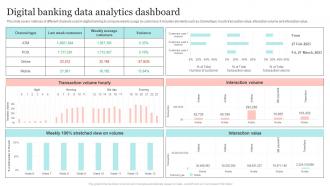
This slide covers matrices of different channels used in digital banking to compare weekly usage by customers. It includes elements such as channel type, hourly transaction value, interaction volume and interaction value.
People who downloaded this PowerPoint presentation also viewed the following :
Digital Banking Data Analytics Dashboard with all 7 slides:
Use our Digital Banking Data Analytics Dashboard to effectively help you save your valuable time. They are readymade to fit into any presentation structure.





FAQs for Digital Banking
Digital banking analytics success hinges on metrics like customer acquisition cost, churn rate, customer lifetime value, and digital channel usage. These technologies streamline operations by identifying trends, personalizing services, and optimizing resource allocation, with many financial services institutions finding that proactive insights enhance customer experiences and ultimately deliver increased revenue and operational efficiency.
Predictive analytics improves customer engagement in digital banking by personalizing offers, proactively addressing concerns, and streamlining services through churn prediction, fraud detection, and next-best-action recommendations. While requiring robust data infrastructure, it also enables banks to enhance customer experiences, ultimately delivering increased loyalty and revenue growth with many financial services institutions finding that targeted interventions significantly boost customer lifetime value.
Customer segmentation plays a crucial role in personalized banking experiences by identifying distinct groups based on demographics, behaviors, and financial goals. These segments—ranging from young professionals to high-net-worth individuals—enable banks to tailor product offerings, marketing campaigns, and service channels. With many financial services institutions finding that targeted approaches enhance customer engagement, ultimately delivering increased loyalty and revenue streams while optimizing resource allocation.
Digital banking analytics ensures data privacy and security through encryption, tokenization, and multi-factor authentication, while also employing robust access controls and anomaly detection. These technologies streamline compliance with regulations like GDPR and CCPA, enabling banks and financial services institutions to minimize fraud and enhance customer trust, ultimately delivering competitive advantage and operational efficiency.
Digital banking analytics implementation presents both challenges and opportunities, including data silos, legacy systems, and a shortage of skilled data scientists. While these hurdles can delay progress, banks also grapple with ensuring data privacy, regulatory compliance, and integrating analytics into existing workflows. With many financial services institutions finding that strategic data governance and cloud migration streamline these processes, ultimately delivering enhanced fraud detection and personalized customer experiences.
Real-time analytics enhances fraud detection in digital banking by monitoring transactions, user behavior, and location data, ultimately flagging suspicious activities instantaneously. These technologies streamline investigations by automating alerts, minimizing false positives, and accelerating response times, with many financial services institutions finding that proactive monitoring significantly reduces financial losses and enhances customer trust.
Digital banking analytics leverages technologies including machine learning, artificial intelligence, big data, and cloud computing, alongside robotic process automation. These approaches streamline fraud detection, personalize customer experiences, and enhance risk management, with many financial services institutions finding that predictive modeling significantly improves loan approvals and reduces operational costs, ultimately delivering enhanced efficiency and competitive advantage.
Customer feedback data can be leveraged by banks through sentiment analysis, journey mapping, and predictive modeling, ultimately enhancing digital service offerings. While collecting this data presents both challenges and opportunities, analyzing these insights enables institutions to streamline customer interactions, personalize financial products, and minimize service friction, with many finding that proactive feedback loops deliver increased customer loyalty and operational efficiency.
Machine learning significantly impacts digital banking analytics strategies by automating fraud detection, personalizing customer experiences, and streamlining risk assessment. These technologies enhance decision-making by predicting customer behavior, optimizing loan approvals, and identifying emerging market trends, ultimately delivering enhanced operational efficiency and a competitive advantage. With many financial services institutions finding that proactive analytics minimizes losses and fosters stronger customer relationships.
Digital banking analytics are significantly influenced by regulations like GDPR, CCPA, and Basel III, demanding robust data governance, model validation, and transparency. While these requirements present both challenges and opportunities, institutions are increasingly leveraging advanced analytics for regulatory reporting, fraud detection, and risk management. These technologies streamline compliance by automating processes, enhancing data security, and ultimately delivering improved operational efficiency and reduced penalties with many banks finding that proactive analytics builds trust and minimizes legal exposure.
Digital banking analytics visualization best practices include clear chart selection, focused storytelling, interactive dashboards, and strategic color palettes, alongside simplified data representation. These techniques enhance comprehension by enabling stakeholders—from loan officers to executives—to quickly identify trends, assess risk, and ultimately deliver data-driven decisions and competitive advantage, with many financial services institutions finding that clarity fosters trust and accelerates insights.
Sentiment analysis gauges customer satisfaction in digital banking by processing feedback from sources like social media, surveys, and chatbot interactions, identifying positive, negative, or neutral tones. While providing valuable insights into customer emotions, it also requires careful data cleansing and contextual understanding; banks, credit unions, and financial services institutions are increasingly leveraging this to enhance customer experiences, streamline services, and ultimately deliver improved loyalty and reduced churn.
Digital banking analytics leverages tools like SAS, Python, R, and Tableau, alongside specialized platforms such as IBM SPSS and SAP Analytics Cloud. These technologies streamline data processing by automating reporting, predicting trends, and personalizing customer experiences, ultimately delivering enhanced fraud detection and improved risk management. With many financial services institutions finding that integrated analytics platforms enhance operational efficiency and competitive advantage.
Competitive benchmarking and market analysis empower digital banks by revealing customer preferences, identifying emerging trends, and assessing competitor strategies across offerings. These analyses streamline resource allocation, enhance customer experiences, and enable strategic combination of services, with many financial services institutions finding that data-driven insights deliver significant competitive advantage and ultimately boost market share.
Digital banking analytics improve cross-sell and upsell opportunities by identifying customer behaviors, predicting needs, and personalizing offers through data mining, machine learning, and predictive modeling. While enhancing customer experiences, it also enables banks to strategically combine product recommendations with individual financial goals, with many institutions finding that targeted campaigns deliver significantly higher conversion rates and ultimately increased revenue streams.
-
Fantastic and innovative graphics with useful content. The templates are the best and latest in the industry.
-
I have been using SlideTeam for the past six months. Very happy and satisfied!