

Electric vehicle sales scorecard with growth percentage ppt slides graphics





Try Before you Buy Download Free Sample Product
 Impress Your
Audience
 100%
Editable
 Save Hours
of Time


Our Electric Vehicle Sales Scorecard With Growth Percentage Ppt Slides Graphics are topically designed to provide an attractive backdrop to any subject. Use them to look like a presentation pro.
People who downloaded this PowerPoint presentation also viewed the following :
Electric vehicle sales scorecard with growth percentage ppt slides graphics with all 2 slides:
Use our Electric Vehicle Sales Scorecard With Growth Percentage Ppt Slides Graphics to effectively help you save your valuable time. They are readymade to fit into any presentation structure.
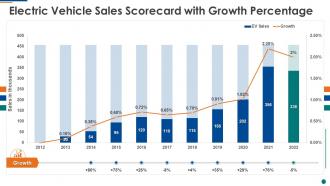

FAQs for Electric vehicle sales scorecard with growth percentage
Key trends driving electric vehicle sales growth in 2023 include expanded charging infrastructure, declining battery costs, government incentives and regulations, increased model availability from major automakers, and growing consumer environmental awareness. These developments streamline adoption by addressing range anxiety, improving affordability, and enhancing accessibility, with many automotive manufacturers finding that strategic investments in EV technology ultimately deliver competitive advantages and market positioning in an increasingly sustainability-focused landscape.
Government incentives and policies significantly influence electric vehicle purchasing decisions by reducing upfront costs through tax credits, rebates, and purchase incentives, while creating long-term value through HOV lane access and reduced registration fees. These strategic policy combinations address price barriers and operational benefits, with many consumers finding that federal tax credits coupled with state incentives often offset the premium over conventional vehicles, ultimately accelerating adoption rates.
Charging infrastructure serves as the foundational backbone for electric vehicle adoption, directly influencing consumer confidence, range anxiety reduction, and purchase decisions. Robust charging networks enable widespread EV acceptance by providing convenient access points, faster charging speeds, and reliable service coverage, with many automotive markets finding that infrastructure density correlates strongly with sales growth and customer satisfaction.
Consumer preferences have shifted toward longer driving ranges, faster charging capabilities, advanced autonomous features, enhanced connectivity options, and competitive pricing structures. Through improved battery technology and charging infrastructure, buyers increasingly prioritize vehicles offering 300+ mile ranges, with many automotive manufacturers finding that features like over-the-air updates and integrated smart home connectivity significantly influence purchasing decisions.
China, Europe, and California lead electric vehicle sales growth, driven by government incentives, charging infrastructure expansion, emissions regulations, and consumer adoption initiatives. These regions deliver competitive advantages through policy support, manufacturing scale, and strategic investments, with many automotive companies finding that early market entry in these areas ultimately accelerates global expansion and operational efficiency.
The global semiconductor shortage has significantly disrupted electric vehicle production through manufacturing delays, reduced inventory levels, and extended delivery times for consumers. While traditional automakers faced greater challenges due to supply chain inflexibility, many EV manufacturers adapted by redesigning systems, securing alternative suppliers, and prioritizing chip allocation, ultimately accelerating their competitive advantage in an increasingly electrified market.
Electric vehicle sales in emerging markets currently lag behind traditional vehicles due to infrastructure limitations, higher upfront costs, and consumer awareness gaps, though growth rates are accelerating rapidly. Countries like India, Brazil, and Southeast Asian nations are experiencing significant EV adoption increases through government incentives and local manufacturing initiatives, with many markets finding that targeted policy support and charging network expansion are driving competitive momentum against conventional vehicles.
Solid-state batteries, silicon nanowire anodes, lithium-metal technologies, faster charging capabilities, and improved energy density represent key innovations driving EV adoption. These advancements streamline manufacturing costs, enhance vehicle range, and minimize charging times, with automotive manufacturers increasingly finding that superior battery performance delivers competitive advantage and accelerates consumer acceptance across global markets.
Electric vehicle resale values traditionally lagged behind conventional vehicles due to rapid technological advancement and battery degradation concerns, but this gap is narrowing significantly as EV technology matures. Many luxury EVs now retain 50-60% of their value after three years, with manufacturers like Tesla demonstrating strong resale performance, while improving battery warranties and growing consumer acceptance enhance long-term value retention.
Increased electric vehicle sales reduce greenhouse gas emissions, air pollution, and fossil fuel dependency while promoting renewable energy integration and sustainable transportation systems. These environmental benefits accelerate through reduced urban smog, lower carbon footprints in manufacturing, and cleaner energy grids, with many cities finding that widespread EV adoption significantly improves air quality and public health outcomes.
Automakers target urban markets through compact models, charging infrastructure partnerships, and sustainability messaging, while rural strategies emphasize longer-range vehicles, home charging solutions, and utility partnerships. Urban campaigns focus on convenience and environmental benefits, whereas rural approaches highlight cost savings, reliability, and practical applications like farm equipment electrification, with many manufacturers finding that localized marketing significantly improves adoption rates.
Electric vehicle manufacturers face challenges including battery supply chain constraints, semiconductor shortages, charging infrastructure limitations, skilled workforce gaps, and manufacturing facility scaling costs. These obstacles present both production bottlenecks and strategic opportunities, with many automakers finding that partnerships with battery suppliers, government incentives, and automated manufacturing technologies ultimately deliver faster scaling capabilities and competitive market positioning.
Consumer perception is shifting from skepticism to acceptance as electric vehicles increasingly deliver longer ranges, faster charging times, and lower total ownership costs compared to gasoline alternatives. Traditional car buyers, particularly in suburban and rural markets, are finding that modern EVs address previous concerns about reliability and convenience, with many discovering significant fuel savings and reduced maintenance requirements ultimately enhance their driving experience.
Effective electric vehicle marketing strategies include emphasizing cost savings through fuel and maintenance reduction, highlighting environmental benefits, offering test drive experiences, partnering with charging infrastructure companies, and leveraging government incentives. These approaches work by addressing consumer concerns about range anxiety, upfront costs, and charging availability, with many automakers finding that experiential marketing and financial incentive communication ultimately drive higher conversion rates and brand trust.
Corporate fleets drive electric vehicle sales growth by purchasing vehicles in bulk quantities, creating economies of scale, and demonstrating long-term commitment to electrification that encourages manufacturer investment. Through strategic fleet transitions, companies like delivery services, ride-sharing platforms, and government agencies accelerate market adoption while reducing operational costs, ultimately delivering competitive advantages and inspiring broader consumer acceptance.
-
Topic best represented with attractive design.
-
Colors used are bright and distinctive.