

Implementing design thinking powerpoint presentation slides






Try Before you Buy Download Free Sample Product
 Impress Your
Audience
 100%
Editable
 Save Hours
of Time


Focus on various aspects of creativity with this content ready Implementing Design Thinking Powerpoint Presentation Slides. Design thinking PowerPoint complete deck has 14 custom made PPT slides such as why we need innovation in business processes & operations, where does design thinking add value, how does design thinking work in business processes & operations, process roadmap, recommendations, etc. All templates are 100 % editable in PowerPoint so that users can enter text in the placeholders, change color if they wish to and present in the shortest possible time. Showcase building blocks of design thinking like observation, prototyping, ideation and testing using systems thinking presentation deck. Utilize our design thinking framework PPT visuals to create an understanding of overall workflow. Furthermore, you can also present the systematic approach of design thinking with the help of this visually appealing implementing innovation PowerPoint template. Download pre-made strategic design presentation deck to transmit your message in an impressive manner.Grab the chance as it comes with our Implementing Design Thinking Powerpoint Presentation Slides. They enable you to follow the ball.
People who downloaded this PowerPoint presentation also viewed the following :
Content of this Powerpoint Presentation
In rapidly changing business and creative landscapes, the power of implementing design thinking in presentations is immense. More than a methodology, design thinking is a philosophy that helps foster innovation, empathy, and unique ways of problem-solving. However, effectively using the potential of design thinking and introducing it to your presentation may present a few challenges like how to explain the unnatural, and transmit the aura of being unusual, yet producing results.
With SlideTeam, the advantage of design thinking in presentations is achievable. Our Implementing Design Thinking powerpoint presentation slides comprise a number of slides devoted to major questions around the concept, explaining the nuances of dividing each issue into sections of design thinking.
By the end of the presentation, you will get familiar with the extra tips on implementing design thinking and will acquire the set of skills necessary for further development. Further, you will know the meaning of design thinking properly.
Let’s explore these necessary design thinking templates, each is 100% customizable and editable, to overcome potential challenges.
Check out the blog on Design Thinking Powerpoint Templates for a better approach.
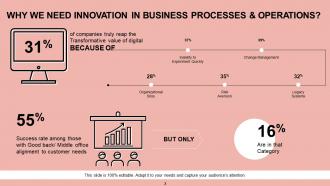
Template 1 - Why We Need Innovation In Business Processes And Operations
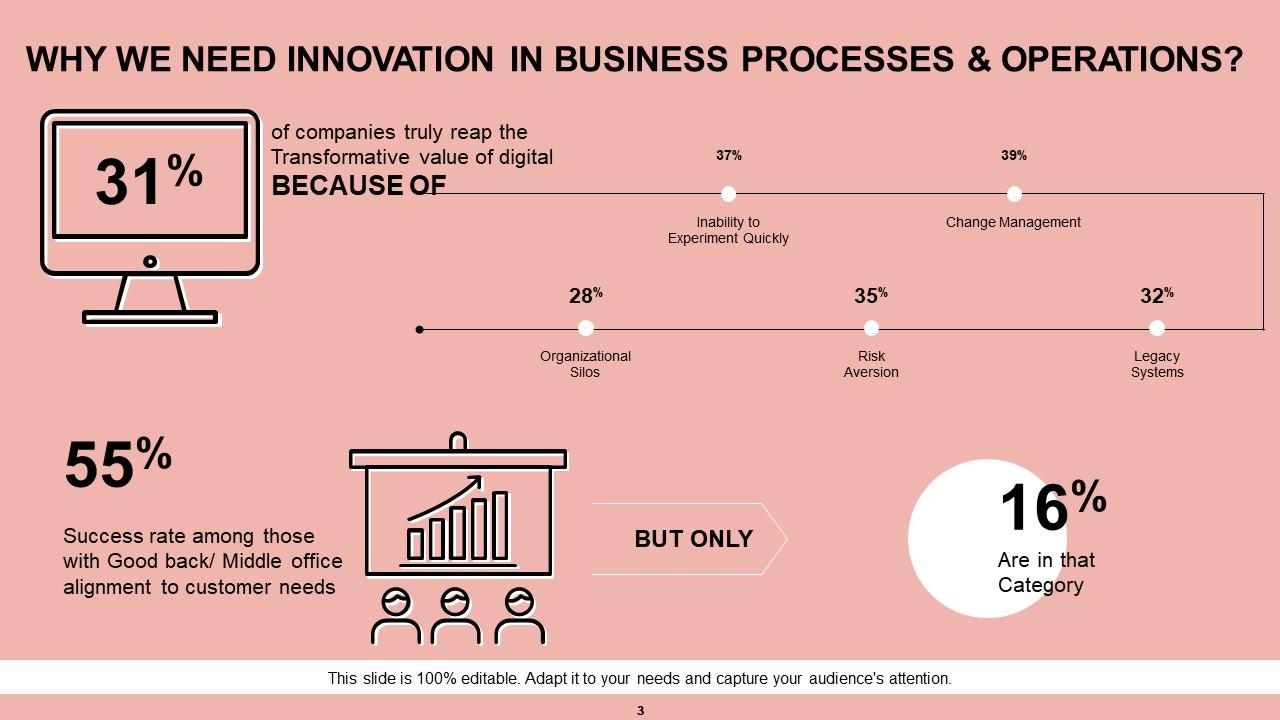
The slide highlights the importance of innovation and emphasizes the need for sweeping change in the processes and operations. It breaks down in percentages how much companies face challenges of organizational silos, propensity for avoiding risk, dependence on legacy systems, and lack of aptness for swift experimentation. Therefore, not only does it show how ordinary these challenges can be, but it also accentuates how much they can be improved. It also serves to underscore the importance of innovation as a prerequisite in responding to these challenges and building agility and efficiency in organizational operations.
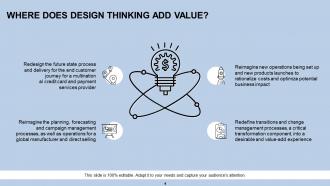
Template 2 - Where Does Design Thinking Add Value
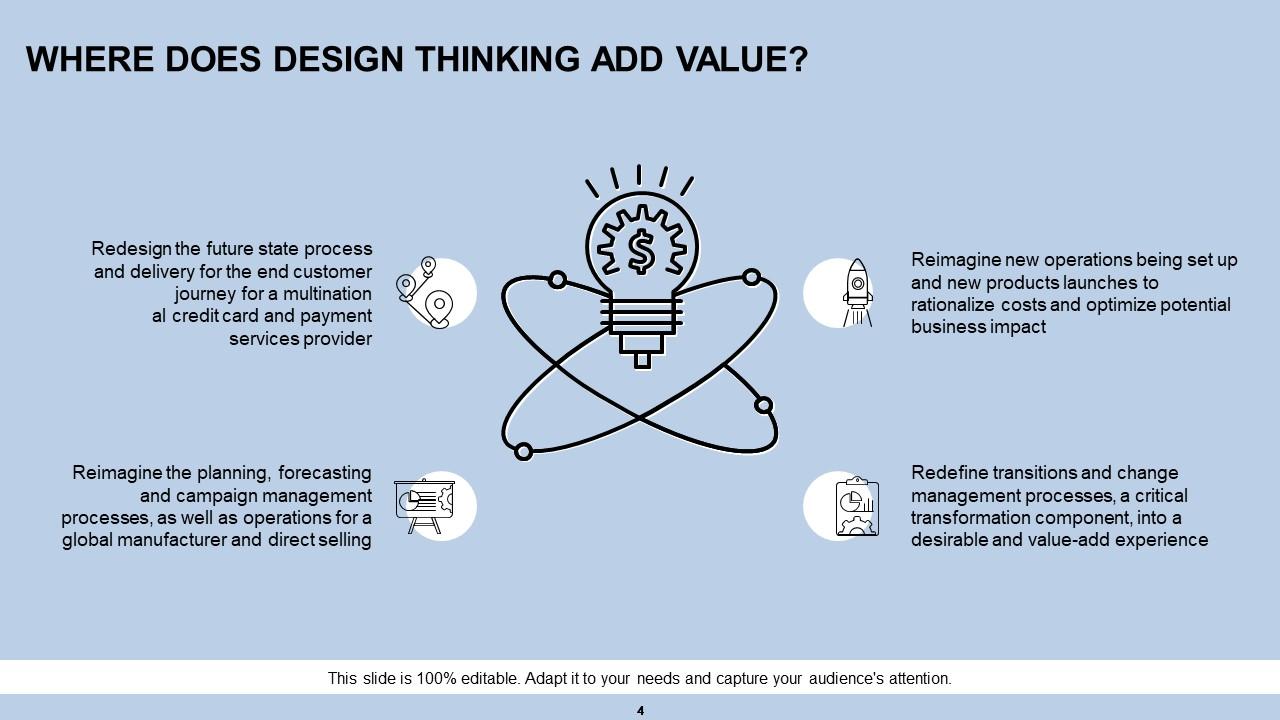
This Slide is divided into four steps, each of which illustrating how Design Thinking can affect and transform a particular operation. Thus, first, it is about redesigning future-state processes and deliveries, as such a shift can facilitate end-customer consumption. Second, it is essential to reconsider future operations and product launches, trying to minimize costs and maximize output. Third, planning and forecasting processes, as well as procedures used by global manufacturers, can be redesigned. Fourth, transitions and change management and their redesign: every change requires a system to be altered. Thus, this slide provides a specific idea for helping modern organizations plan to design new processes.
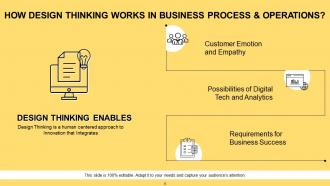
Template 3- How Does Design Thinking Work In Business Process and Operations?
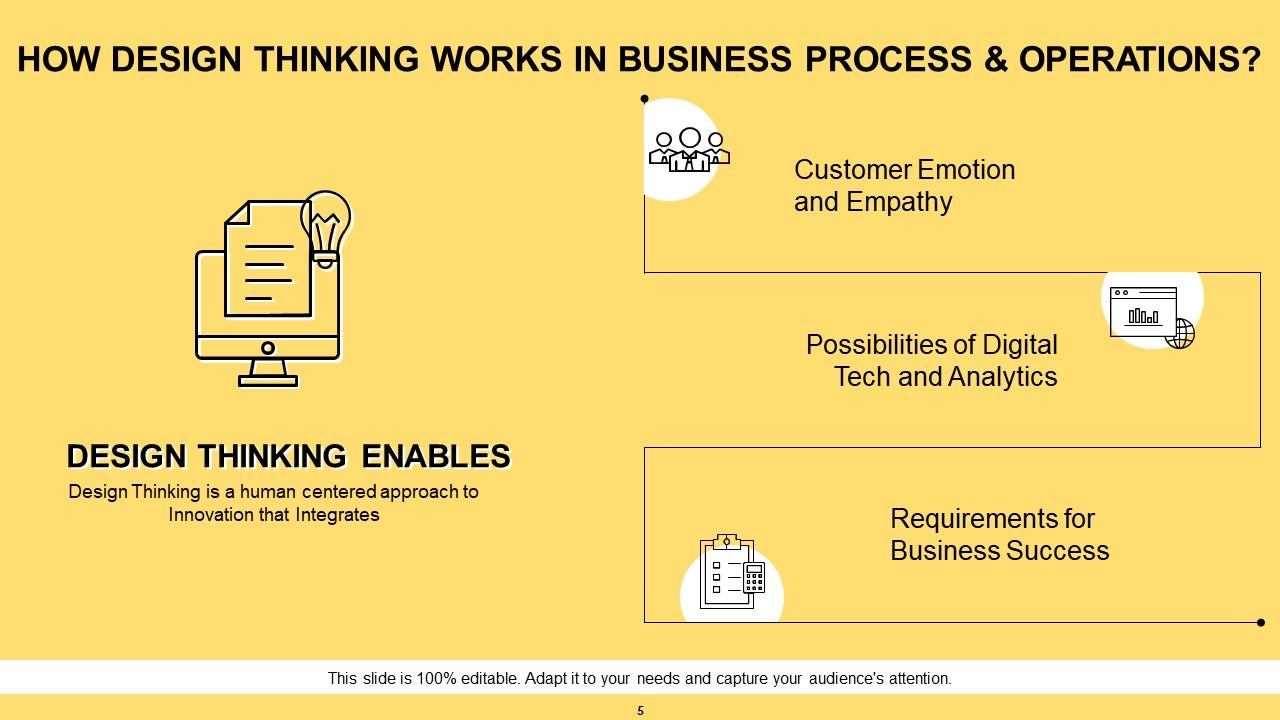
This Slide explains how Design Thinking can integrate into every aspect of business innovation and performance. The three fundamental factors that help Design Thinking succeed are: it facilitates the study of customer emotion and empathy for a customer. It helps to focus on the value of using technology to reach and measure the goal of customer efficiency. Finally, Design Thinking is based on the basic needs and much knowledge that makes the business successful and incorporated into every sphere of its design. This slide is helpful because it explains design thinking and contains a lot of ideas for its application.
Don’t lag in reading the blog on the steps flow, which illustrates the design thinking process in detail.
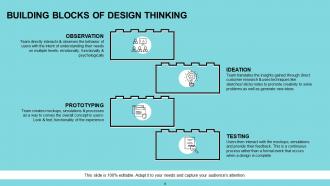
Template 4 - Building Blocks of Design Thinking
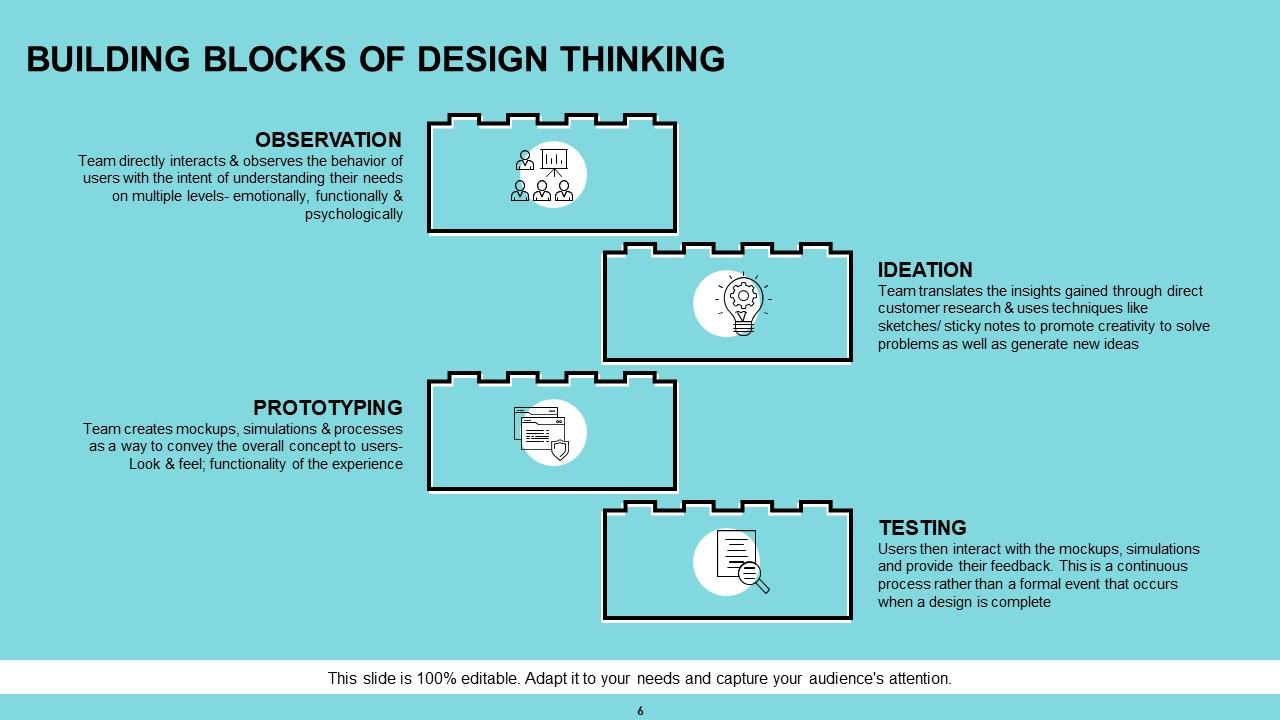
This template slide is a basic outline of the foundational ideas of Design Thinking, highlighting the critical elements of the approach. These include the observation stage, at which the team observes user behavior to define needs and experiences. Further, the idea generation stage, at which the insights collected from the observation are transformed into a concept, is represented. In the third step, developing a mockup or other prototype forms allows the team to present the ideas in a clear but not final form to users, allowing them to personalize it. Finally, in the testing phase, users work with prototypes, comment on them, and contribute to their improvement. In general, this slide is an instruction for conducting step-by-step design thinking.
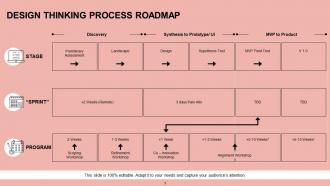
Template 5 - Design Thinking Process Roadmap
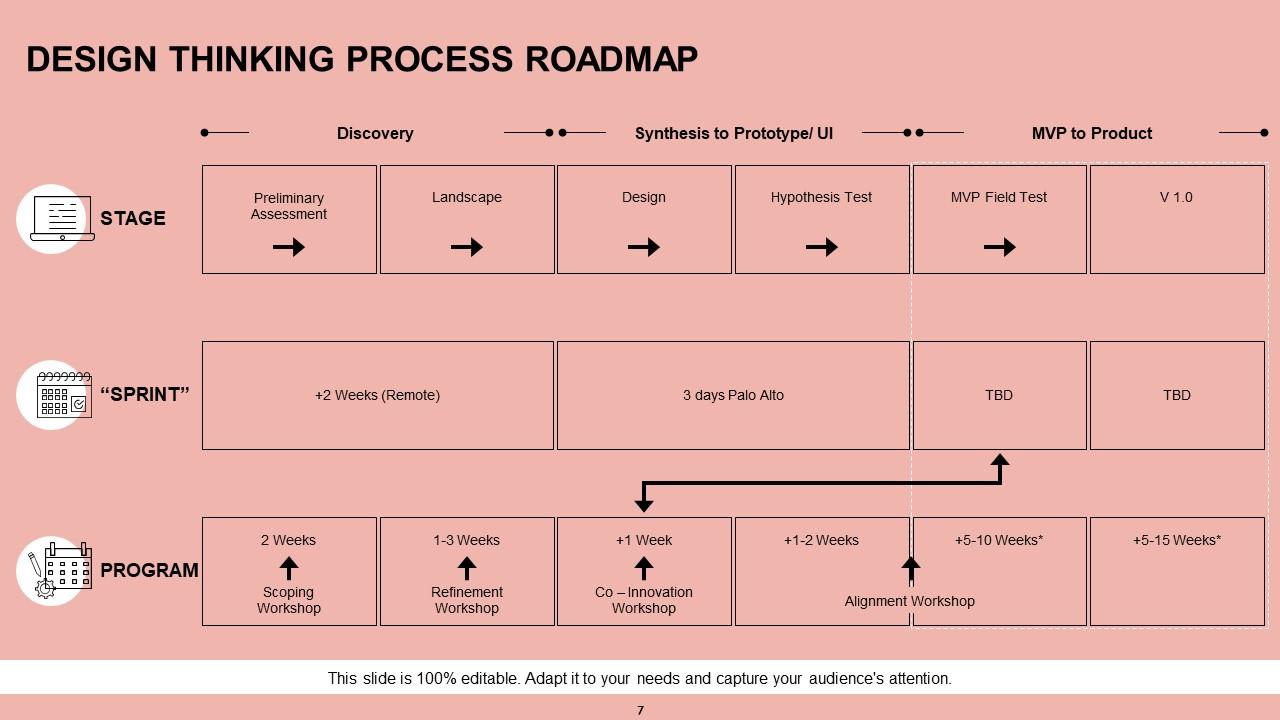
This slide serves as a guide for you when navigating through the course stages. The stage focused on the initial week, which was dedicated to the landscape phase and preliminary assessment, which will help you familiarize yourself with the overall context of a particular assignment. Next is the Design phase, where the ideas and hypotheses are developed. The third feature of the roadmap includes hypothesis testing and MVP field testing, ensuring that the solution propositions comply with the project at hand. There is also the Sprint phase, which is organized for two-week periods to provide intensive art time and remote collaboration and is to be specified. The process phase includes the program segment with weeks of workshops, including refinement, co-innovation, and alignment sessions.
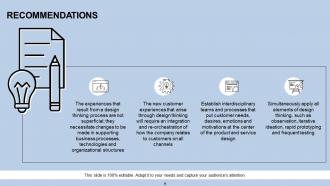
Template 6 - Recommendations
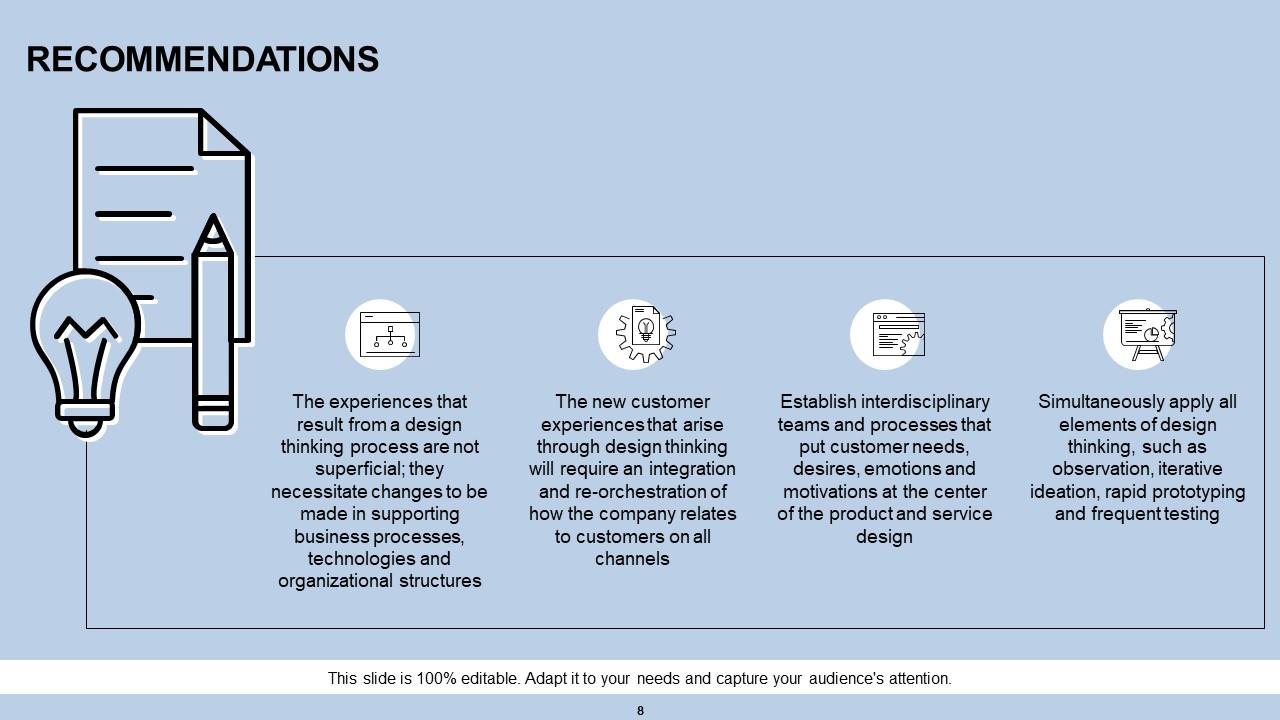
Use this PPT Template to suggest using the outputs of design thinking processes to enhance customer experiences. Secondly, it recommends instigating the creation of new customer experiences with the use of design thinking methodologies. Thirdly, the Slide argues for the necessity of using interdisciplinary teams and expansive, hyper-focused processes with the customer in the center. Fourthly, it suggests the application of all the core design thinking elements simultaneously, such as observation, testing, prototyping, and creativity. This slide is a concentrated source of strategy.
*****
INTELLIGENT NOVELTY HELPS
To sum up, implementing design thinking PowerPoint presentation slides is a strategic method to impress, tell, and cheer your audience up. Suppose you pay more attention to the following aspects: engagement, clarity, interactiveness, storytelling, a user as a focus point, iteration, and outcome focus. In that case, you will benefit from your slides. Thus, keep the concepts of design thinking in your head while creating a presentation, and you will see how your slides will be received better and your goals will be achieved faster.
Look out for our Slide on Design Thinking Framework Analysis Inspiration Service Innovation Template to inspire new ideas.
Implementing design thinking powerpoint presentation slides with all 14 slides:
Extract the brilliance in your genes. Our Implementing Design Thinking Powerpoint Presentation Slides are excellent excavators.


FAQs for Implementing design thinking
So Design Thinking has five stages: Empathize, Define, Ideate, Prototype, and Test. First you research users and figure out their actual needs. Then define what problem you're really solving. Brainstorming comes next - honestly the most fun part because you just throw out crazy ideas without judging them. Build rough prototypes after that to make things real, then test with actual people. The whole thing loops back on itself though, which threw me off at first. Maybe pick one stage and try it on your next project? Way easier to learn by doing than reading about it.
Honestly, Design Thinking basically forces you to get out of your own head and figure out what users actually want - not what you assume they want. You end up doing tons of quick prototypes and tests, which means you fail early instead of wasting months building something nobody needs. My team has dodged so many bullets this way! The empathy stuff is huge too. Like, you'll discover problems you never would've thought of otherwise. Those are usually where the best ideas come from. Oh, and definitely do user interviews before you start brainstorming anything - I always find weird insights that completely change our direction. It's wild how wrong your initial assumptions can be.
Honestly, empathy is everything in design thinking. You can't just guess what users want - you'll be wrong like 90% of the time. That first empathy stage where you actually watch people and talk to them? Game changer. I remember being shocked at how users interacted with stuff compared to what I thought they'd do. Once you really get their pain points, defining problems becomes way clearer. Same with brainstorming solutions and testing prototypes. My biggest tip? Go watch real people struggle with whatever exists now before you try fixing it. Sounds obvious but most people skip this step.
Oh this is actually easier than it sounds! During sprint planning, just bake in some quick user research or persona check-ins upfront. Then while you're developing, keep prototyping and testing small stuff constantly. Don't make it this whole separate thing - that's where teams mess up. I'd say spend maybe 20% of each sprint on user validation. Short bursts work better than those marathon workshop days nobody wants to sit through. You'll spot problems way faster and actually build things people give a damn about instead of just cranking through tickets.
Tech and healthcare are the obvious ones, but design thinking really works everywhere. Financial services, education, retail, manufacturing - you name it. Pretty much any industry dealing with complex problems or messy human needs benefits from it. And let's be real, that's most industries these days. Companies facing rapid change or customer experience headaches especially see results. If you're considering it for your field, I'd start small. Pick one project where you can really dig into what's frustrating your users first. That's honestly the best way to prove it works before going bigger.
Honestly, just start with paper sketches or wireframes - don't overthink it. Role-playing scenarios work too if you're testing something more complex. Figma's decent for digital stuff, but I've learned more from cardboard mockups than fancy app demos sometimes. Make something users can actually poke at, not just stare at. Your first attempt should feel kinda cringey to share - that's normal. Give yourself like 1-2 days max, then immediately test with real people. The whole point is testing assumptions fast without getting stuck on polish. Feedback early beats perfection every time.
Honestly, most companies think Design Thinking is some miracle cure and rush through it. The empathy part gets skipped because it seems "soft" - but that's literally where all the good stuff is hiding. Leadership wants everything neat and linear when it's supposed to be chaotic and messy. Plus people hate prototyping so they just build the whole thing right away. Which is... the opposite of what you're trying to do? My take: pick one team that's actually into it, don't rush them, and expect some failures. That's the whole point.
Design Thinking basically forces you to think like your actual customers. You do empathy interviews and shadow real users - seriously, it's eye-opening how much you miss with regular surveys. The whole point is catching pain points people can't even explain themselves. Quick prototyping is where it gets good though. You test stuff super early instead of building something massive that flops. Honestly beats guessing what works every time. The iterative approach means you're constantly refining based on real feedback, not assumptions. Start with those user interviews - you'll probably discover your biggest assumptions are wrong.
Oh man, brainstorming can be such a mess if you don't structure it right! Try "How Might We" questions first - they flip problems into opportunities. Then do rapid ideation where everyone silently writes ideas on sticky notes for like 10-15 minutes. There's this thing called Crazy 8s too - fold paper into sections and sketch 8 ideas in 8 minutes. Sounds brutal but honestly it works. Always use "Yes, and..." instead of shooting down ideas immediately. Mix solo thinking with group sharing so you don't just hear from the loudest people. Oh, and designate someone to keep things moving - otherwise you'll spend forever on one topic.
You know how most people just dive into fixing problems? Design Thinking does the opposite - you actually start by watching real users and figuring out what they really need. Super weird at first, honestly. Instead of stakeholders telling you "here's the problem," you go observe people in their natural habitat (sounds dramatic but it works). The whole thing's way more messy too - constant prototyping and testing instead of that neat linear process we're used to. I swear by this approach now though. Next time you're stuck on something, just spend a day talking to whoever will actually use your thing.
Honestly, measuring Design Thinking is kinda tricky because the soft stuff matters just as much as the hard numbers. Yeah, track your usual suspects - user satisfaction, adoption rates, time-to-market improvements, revenue from new solutions. But don't sleep on team collaboration levels and how many ideas people are actually generating. Are you solving real problems for users? Employee engagement usually goes up too when people feel creative and empowered - which is pretty cool to see happen. I'd start with maybe 2-3 metrics that match your project goals, then build from there.
Honestly? Most companies totally sabotage themselves here - they claim they want innovation but freak out over every mistake. Make failure feel safe first. Celebrate the "beautiful failures" that actually teach you something valuable. Give people dedicated time for crazy creative projects. Mix up your teams regularly so different perspectives collide. Train your leaders to ask "How might we..." instead of immediately jumping to solutions. Oh, and set up those rapid prototyping sessions where people can test wild ideas fast. The best innovations come from unexpected places, so don't limit who gets to contribute.
Yeah, remote design thinking workshops can definitely work! You just gotta be way more organized than usual. Get everyone on Miro or Figma - honestly those digital boards are sometimes cleaner than real sticky notes anyway. Good audio/video is crucial, and break people into small groups so it's not total chaos. Send stuff ahead of time and assign roles upfront. Your facilitator really needs to stay on top of calling people out since everyone's muted half the time. Oh, and build in extra time for when someone inevitably can't share their screen. Been there!
Oh totally - there's actual proof this stuff works! Airbnb literally lived with their users when they were failing, which is kinda extreme but it saved them. IBM went all-in and hired thousands of designers, saw real ROI improvements. PepsiCo redesigned their packaging, GE shadowed doctors for medical equipment insights. What's crazy is they all did the same thing first - figured out what users actually needed before building anything. Next time you're stuck, just map out what your users go through. Works way better than guessing.
Don't do separate workshops - that's where most companies mess up. Instead, weave Design Thinking into what your teams already do. Train a few people as internal coaches who can teach others. Build some templates so people aren't starting from scratch each time (seriously saves everyone's sanity). Get leadership on board first though, because without exec support you're basically screwed. Mix up your project teams with people from different departments and give them real problems to solve. The whole point is making it feel natural, not like some forced corporate thing that'll disappear in six months.
No Reviews