Project Timeline And Task Status Card With Budget Allocations

Rating:
90%
Project Timeline And Task Status Card With Budget Allocations
Slide 1 of 6
Favourites Favourites

Try Before you Buy Download Free Sample Product

Audience Impress Your
Audience
Editable 100%
Editable
Time Save Hours
of Time
The Biggest Sale is ending soon in
0
0
:
0
0
:
0
0
Rating:
90%
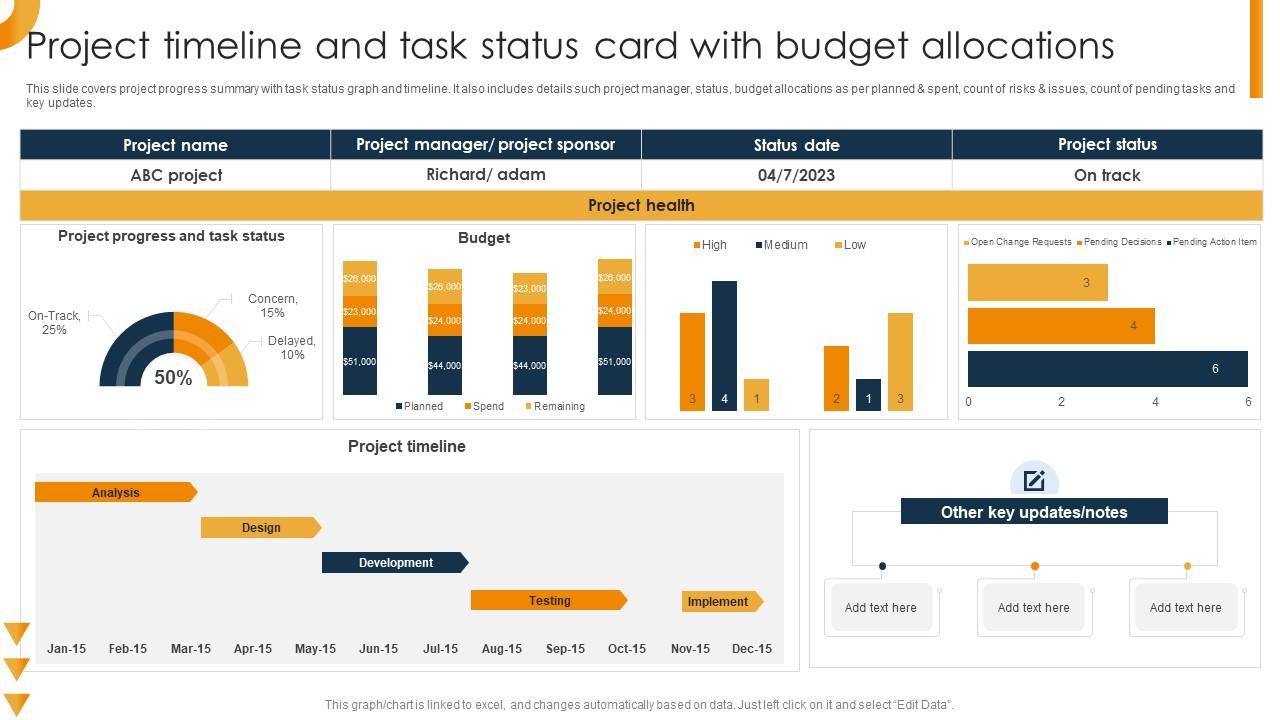
This slide covers project progress summary with task status graph and timeline. It also includes details such project manager, status, budget allocations as per planned and spent, count of risks and issues, count of pending tasks and key updates. Introducing our Project Timeline And Task Status Card With Budget Allocations set of slides. The topics discussed in these slides are Project Manager, Project Sponsor, Project Status. This is an immediately available PowerPoint presentation that can be conveniently customized. Download it and convince your audience.

FAQs for Project Timeline And Task Status Card

Project management comprises five key phases: initiation, planning, execution, monitoring and controlling, and closing, each building upon the previous phase's deliverables. These phases interconnect through continuous feedback loops, with planning informing execution, monitoring results triggering plan adjustments, and lessons from closing enhancing future initiations, ultimately delivering streamlined workflows and improved project outcomes.

Effective communication enhances team collaboration by establishing clear expectations, fostering transparency across all project phases, and enabling real-time problem-solving through structured information sharing. With many organizations finding that regular status updates, collaborative platforms, and open feedback loops significantly reduce project delays, teams ultimately deliver faster results while maintaining higher quality standards and stronger stakeholder alignment.

Risk management serves as a critical foundation for project success by identifying potential threats, assessing their impact, developing mitigation strategies, and continuously monitoring risks throughout project lifecycles. Through proactive risk assessment and contingency planning, organizations streamline project delivery, minimize costly delays, and enhance stakeholder confidence, with many finding that structured risk frameworks ultimately deliver better outcomes and competitive advantage.

Project managers can effectively handle scope changes by establishing clear change control processes, maintaining detailed documentation, and implementing stakeholder approval workflows for all modifications. Through structured change management protocols, organizations streamline decision-making, minimize project delays, and preserve budget integrity, with many finding that proactive communication and impact assessments ultimately deliver better project outcomes.

Effective project progress tracking tools include Asana, Trello, Microsoft Project, Monday.com, and Jira, each offering real-time dashboards, milestone tracking, and team collaboration features. These platforms streamline project oversight by automating status updates, centralizing communication, and providing visual progress indicators, with many organizations finding that integrated reporting capabilities ultimately deliver enhanced transparency and faster project completion rates.

Stakeholder engagement significantly impacts project outcomes by ensuring alignment with business objectives, securing necessary resources and support, and minimizing resistance to change throughout implementation. Through regular communication and collaborative decision-making, organizations achieve higher project success rates, reduced scope creep, and enhanced user adoption, with many finding that engaged stakeholders ultimately deliver faster approvals and sustainable long-term results.

**INPUT**: What are the best practices for developing a project timeline? **OUTPUT**: Best practices for developing project timelines include defining clear deliverables, breaking work into manageable tasks, estimating realistic durations, identifying dependencies, and building buffer time for contingencies. These approaches streamline project execution by enhancing resource allocation, minimizing delays, and improving stakeholder communication, with many organizations finding that structured timeline development ultimately delivers better project outcomes and increased client satisfaction. [Word count: 60 words]

Project managers can measure success through stakeholder satisfaction, budget adherence, quality deliverables, team performance, and strategic business value creation. These comprehensive metrics enable organizations to evaluate project impact beyond timelines, with many companies finding that customer satisfaction scores, return on investment, and long-term operational improvements ultimately deliver more meaningful indicators of true project success.

Effective remote project team management strategies include establishing clear communication protocols, implementing robust project tracking systems, scheduling regular virtual check-ins, creating detailed documentation processes, and fostering team collaboration through digital platforms. These approaches streamline coordination by enhancing transparency, maintaining accountability, and ensuring seamless information flow, with many organizations finding that structured virtual workflows ultimately deliver improved productivity and stronger team cohesion across distributed workforces.

Cultural differences significantly influence international project management through varying communication styles, decision-making processes, time orientations, hierarchy expectations, and conflict resolution approaches. These variations can create both challenges and opportunities, with many global organizations finding that embracing cultural diversity through structured frameworks, cross-cultural training, and inclusive leadership ultimately enhances creativity, problem-solving capabilities, and market understanding across international projects.

Task prioritization methods include the Eisenhower Matrix, MoSCoW technique, weighted scoring models, critical path analysis, and value-based ranking systems. These approaches streamline project workflows by categorizing urgency and importance, aligning resources with strategic objectives, and minimizing bottlenecks, with many project managers finding that systematic prioritization ultimately delivers faster completion times and enhanced team productivity.

Lessons learned are documented through post-project reviews, knowledge repositories, template updates, and standardized reporting processes that capture successes, failures, and key insights. Organizations streamline future project planning by creating searchable databases, conducting team debriefs, and integrating these insights into project templates, ultimately reducing risks, accelerating timelines, and enhancing project success rates.

Agile project management offers greater flexibility, faster delivery cycles, enhanced collaboration, and adaptive planning compared to traditional methodologies, while traditional approaches provide structured timelines, comprehensive documentation, and predictable outcomes. Many organizations find that agile accelerates product launches and improves customer responsiveness, though traditional methods remain valuable for regulated industries requiring extensive compliance and fixed-scope projects.

Project managers balance resource allocation by implementing portfolio prioritization frameworks, establishing cross-project visibility dashboards, and creating flexible resource pools that can shift based on strategic importance and deadlines. Through resource management software and regular capacity planning sessions, organizations streamline competing demands while maintaining project quality, with many finding that strategic resource sharing ultimately delivers improved efficiency and reduced bottlenecks across their entire project portfolio.

Quality control throughout the project lifecycle requires establishing clear standards, implementing regular checkpoints, conducting systematic reviews, and maintaining continuous monitoring processes. Through milestone assessments, peer reviews, and automated testing protocols, project managers can identify issues early, reduce rework costs, and ensure deliverables meet specifications, ultimately delivering higher client satisfaction and competitive advantage.

Ratings and Reviews

90% of 100
Review Form
Write a review
Most Relevant Reviews
  1. 80%

    by Jacob Brown

    Their templates are super easy to edit and use even for the one like me who is not familiar with PowerPoint. Great customer support.
  2. 100%

    by Colin Barnes

    Attractive design and informative presentation.

2 Item(s)

per page: